This week in Neo4j: Context graphs, Dify, Cypher, GraphRAG and more

Staff Community Manager
4 min read
Welcome to This Week in Neo4j, your fix for news from the world of graph databases!
This edition explores context graphs making AI more explainable, how the new Dify plugin lets LLMs interact with graphs using natural language and we take a look at a new Byte-Sized Cypher video series makes learning graph queries approachable and fun.
It also shows how to build a full multi-agent GraphRAG system in under an hour using Neo4j, MCP, and Google ADK, bringing graph-powered agent orchestration into real-world workflows.
NODES AI, our global graph-and-AI event, is taking place April 15, and we’ve just announced the first featured speakers across themes like GraphRAG, Graph Memory and AI in Production – register now so you don’t miss the Road to NODES AI workshop series.
Happy Graphing,
Alexander Erdl
Coming up!
- Livestream: Going Meta S03E05 on February 03, Discover Aura DB – Aura Agents on February 09 & Neo4j Live: From Language to Logic – Why Graph AI Succeeds Where LLMs Fail on February 12
- Conferences: Find us at technicalsummit, Munich on January 28, AgentCon, Vienna on January 29, jFokus, Stockholm on February 2-4, AgentCon, Zurich on February 4 & MCP Conference, London on February 11-12
- Meetup: Meet us in San Francisco, US on January 27, Delhi, IN on January 27, Munich, DE on February 25 & Berlin, DE on February 26
- All Neo4j Events: Webinars and More
- GraphSummit Series: Transform Your Enterprise with Graph and GenAI – Next Stop: Copenhagen on March 10
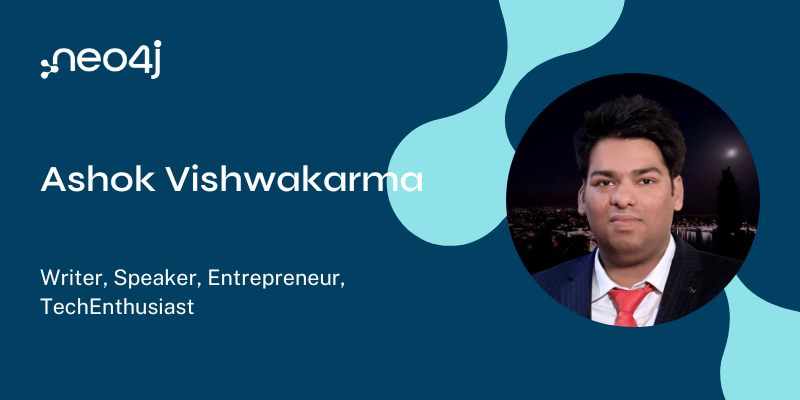
FEATURED COMMUNITY MEMBER: Ashok Vishwakarma
Ashok Vishwakarma is enthusiastic about tech for products used and loved by millions of people. He has acquired a sound knowledge of Web Technologies, System Design, Performance, Database, Cloud, and Tools. And speaks at tech conferences, writes blogs, and contributes to Open Source.
Connect with him on LinkedIn.
Ashok is a featured speaker for NODES AI. His talk “Tracing Agent Decisions with Graph Evals and Neo4j” introduces Graph Evals. This practical technique stores every agent step (actions, states, tool calls, reasoning hops, failure points) as a knowledge graph. By modeling an agent’s internal decision-making journey in Neo4j, we can analyse its reasoning patterns, detect blind spots, identify loops and understand why it behaved the way it did.
CONTEXT GRAPHS: Hands On With Context Graphs And Neo4j
This post by Will Lyon introduces context graphs – knowledge graphs that capture not just the current state but also the whole reasoning, causality, and decision history behind events – making AI systems more explainable and auditable. Using Neo4j, it shows how to model entities, decisions, policies, and causal relationships and demonstrates a working demo in which an AI agent traces past decisions and applies a hybrid semantic–structural search to inform recommendations.
DIFY: Introducing Neo4j Dify plugin
Nikola Milosevic introduces the Neo4j Dify Plugin, an extension that enables Dify-powered LLMs to interact directly with Neo4j graphs to generate Cypher queries, ingest data and perform graph queries – all via natural language prompts. By lowering the barrier between LLMs and graph databases, the plugin enables developers to build conversational or agent-driven graph workflows without writing Cypher by hand.
CYPHER: Byte-Sized Cypher Series
Jason Koo started with “Byte-Sized Cypher”, a beginner-friendly video series that teaches the query language through short, practical lessons built around memorable snack-based metaphors. Using a playful Japanese snack dataset, the series makes nodes, relationships, and patterns easy to understand while showing how Cypher works.
AGENTIC GRAPHRAG: Build Your First GraphRAG Multi-Agent System in Under an Hour using Google ADK and Neo4j
This codelab by Romin Irani and Siddhant Agarwal and its companion blog shows how to build a multi-agent GraphRAG system using Google’s Agent Development Kit (ADK), Neo4j and the MCP Toolbox, letting specialised agents collaborate to answer complex, real-world questions by traversing knowledge graphs. You’ll create a full investment research pipeline where graph-aware agents execute pre-validated Cypher queries, reason over relationships and orchestrate responses—demonstrating how agent orchestration and graph context elevate retrieval-augmented generation.
Continuous learning
- GraphAcademy: Kearn how to effectively manage and monitor Neo4j Aura instances in “Aura in Production“
- Learn on Your Schedule: Go deeper into graph technology on Neo4j’s On-Demand webinar library
- Workshops: Join our virtual classrooms workshops from Fundamentals to GenAI
- New Webinar: Effective Context Engineering Techniques for AI – Americas, Europe, Middle East & Africa, Asia Pacific
POST OF THE WEEK: Structr
Please share it if you like it!
Share Article


Explore
Related Articles

Connected Intelligence: Accelerating Enterprise AI throughout the cloud ecosystem

This Week in Neo4j: Agent Orchestration, GraphRAG, Geospatial Knowledge Graph and more