Whose signature really matters? Understanding PageRank through yearbook signatures

Sr. Manager, Technical Product Marketing, Neo4j
5 min read

This is Part 3 in a 5-part series on Graph Algorithms:
- Why LeBron James Shouldn’t Drive Your Recommendations
- From Cafeteria Cliques to Graph Communities: Understanding the Louvain Algorithm
- Whose Signature Really Matters? Understanding PageRank Through Yearbook Signatures
- Finding the Fastest Way Out: How Dijkstra’s Algorithm Finds Shortest Paths
- Why Machines Need Embeddings: Turning Graph Structure into Features
PageRank surfaces what actually matters in your network. It identifies the most influential nodes based not just on how many connections they have, but on the quality of those connections. Whether you’re pinpointing critical suppliers, high-value customers, emerging fraud hubs, or key infrastructure assets, PageRank cuts through the noise and ranks what truly drives impact. But how exactly does it know which nodes are most important?
PageRank models popularity the way a school figures out who the most popular kid is.
Imagine everyone is passing around yearbooks. Each signature is basically a vote for who someone thinks is cool. But not all signatures carry the same weight. If a kid who already has tons of signatures signs your yearbook, that boosts your popularity a lot. In the next “round,” more people may decide you’re popular because someone influential endorsed you.
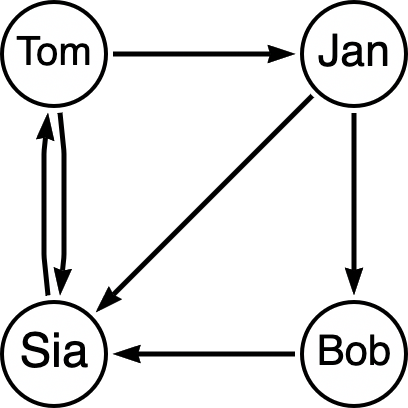
But if a kid nobody knows signs your yearbook, that signature doesn’t change much. Their influence is small, so their endorsement carries less weight. And similarly, if a student who signs everyone’s yearbook signs yours, then that doesn’t carry much weight either.
That’s the power of PageRank: your importance depends not just on how many people link to you, but who those people are and how influential they are themselves.
So, who is the most popular student in this very small graduating class? At first glance, Sia and Tom look like the standouts.
Everyone wanted to sign Sia’s yearbook, so clearly she was well-liked.
Tom, meanwhile, received that exclusive signature from Sia—the most sought-after reviewer—which gives Tom a little extra prestige over Bob and Jan. When a popular kid like Sia signs your yearbook, you must be pretty popular too.
That’s exactly the intuition PageRank formalizes. It measures importance not just by how many incoming edges you get, but by who those edges come from.
Get the Free eBook Toady
Learn the math and intuition behind the five graph algorithms that can solve 80% of your business use cases!
The formula
Originally, PageRank was developed to determine which webpages Google should surface. But it could be used for many different things.
Continuing our yearbook analogy, PageRank models what would happen if you wandered around the school asking people to sign your yearbook, moving from one student to the next based on who they suggested you approach next. Popular students tend to recommend other well-liked students, and those endorsements carry weight.
And unfortunately, the easiest way to explain this is to actually walk through the formula:
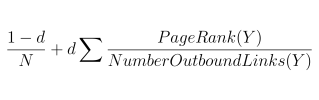
The damping factor — the little d — represents the idea that most of the time you follow a referral (“Who else should sign my yearbook?”), but sometimes you ignore that and walk up to a completely random student.
In PageRank world, the standard is 0.85:
- 85% of the time, you follow referrals
- 15% of the time, you pick someone at random
This keeps influence from getting stuck forever in little circles of “you sign my yearbook / I’ll sign yours.”
Iterations
As you might suspect, we don’t do this just once, but continue until the values converge or we reach the maximum number of iterations. Let’s walk through it once to see what happens. Initially, we assume that all students are equally popular:
- Tom is 1/4 of all the students or .25
- Jan is 1/4 or .25
- Sia is 1/4 or .25
- Bob is 1/4 or .25
Then we run our formula for each member.
For Tom
Only Sia signs Tom’s yearbook, so filling in the formula looks like the following:

or

For Jan
In this case, only Tom signs Jan’s yearbook, but because Tom signs two yearbooks, each signature is a little less valuable.

or

For Sia
Everyone wanted to sign Sia’s yearbook, so we might guess that she is the most popular!

or

Here we can see how important it is to have everyone sign your yearbook, but also that Bob’s signature is more exclusive and thus important because they only signed Sia’s yearbook.
For Bob

or

After one full iteration, our updated PageRank values look like this:
- Tom: 0.25
- Jan: 0.14375
- Sia: 0.4625
- Bob: 0.14375
Just like we thought at the beginning, Sia is the most popular. Congratulations Sia! Tom is the second most popular due to his friendship with Sia. And Bob and Jan are about the same!
We would then repeat the process, running additional iterations until the scores stabilize. In practice, we say the algorithm has converged when the changes between iterations become very small or fall below some predefined threshold.
Once converged, PageRank gives us a stable measure of influence within the network. And while our example used students signing yearbooks, the same technique applies to far more complex systems: identifying the most authoritative webpages, highlighting influential customers in a referral network, ranking important suppliers in a supply chain, or even spotting key spreaders in patterns of fraud and misinformation.
Wherever connections carry meaning, PageRank helps reveal the people—or pages—that matter most.
Share Article



Explore
Related Articles

Managing risk in a manufacturing plant with Neo4j Aura graph analytics

What are the different types of graph algorithms & when to use them?

From cafeteria cliques to graph communities: Understanding the Louvain algorithm