Cognita Learning Lab builds a graph-native construction learning experience with Neo4j
UniCTE deployment boosts corporate learning outcomes with graph-driven training built around real-world construction challenges.
80.4%
Organic completion rate, vs. ~5% for typical online learning
78 topics
Across 10 academies, serving 31 companies and 2,300 students
4,200 hours
Logged by learners across applied training journeys
Rewiring 20th-century education for 21st-century learners with Neo4j
For much of the 20th century, education systems were optimized for a world where information was scarce. An educator’s job was to standardize, scale, and deliver core knowledge efficiently. Every student needed to know the same basic facts and skills. When digital learning tools were created, many adopted this linear model and expanded it with libraries of content, completion tracking, and a one-direction learner journey.
Today, information is abundant. Workers can look up almost anything instantly, but what matters for the job and how concepts connect often gets lost in the noise. The challenge now is navigation and relevance: helping people identify what matters, connect it to their daily lives, and use the training to make better decisions at work.
“We are trying to teach in a network, but we have been using assembly-line tools. Passive experiences lead to disengagement, fast forgetting, and weak transfer into real work,” explains Daniel Luzzi, founder of Cognita Learning Lab.
Cognita Learning Lab was founded to help organizations move beyond one-size-fits-all training and toward learning that feels as accessible as using a mobile phone, but far more actionable. That philosophy is grounded in Cognita’s broader background. Founded 23 years ago, Cognita Learning Lab has delivered educational projects across Brazil and with international organizations such as UNICEF, earning awards along the way.
Why Brazil’s workforce is leaning on upskilling
Helping workers learn the skills they need for work is especially relevant in Brazil, where educational attainment and opportunities are still uneven. In 2024, only 56% of Brazilians ages 25 and older had completed compulsory basic education. At the same time, adult literacy is high — Brazil’s adult literacy rate was 94.8% in 2024.
For employers, that combination increases the importance of corporate learning programs that can meet learners at different starting points. In ManpowerGroup’s Talent Shortage research, 81% of employers in Brazil reported talent scarcity in 2025.
As technical skills reshape specialized roles, companies are increasingly building capability from within, helping employees learn what they need, when they need it, without pulling them away from the job for long stretches.
Cognittron turns learning into curiosity, not consumption
Cognita’s approach reframes learning as a question-driven process. Instead of asking learners to passively consume information, the company’s Cognittron Learning and Development platform starts with practical challenges, prompts students to think of the next useful question, and guides them toward the knowledge needed to improve their expertise and judgment. Cognita emphasizes applied learning tied to real situations and decision-making, with the learner positioned as an active agent.
A knowledge network learners can actually navigate
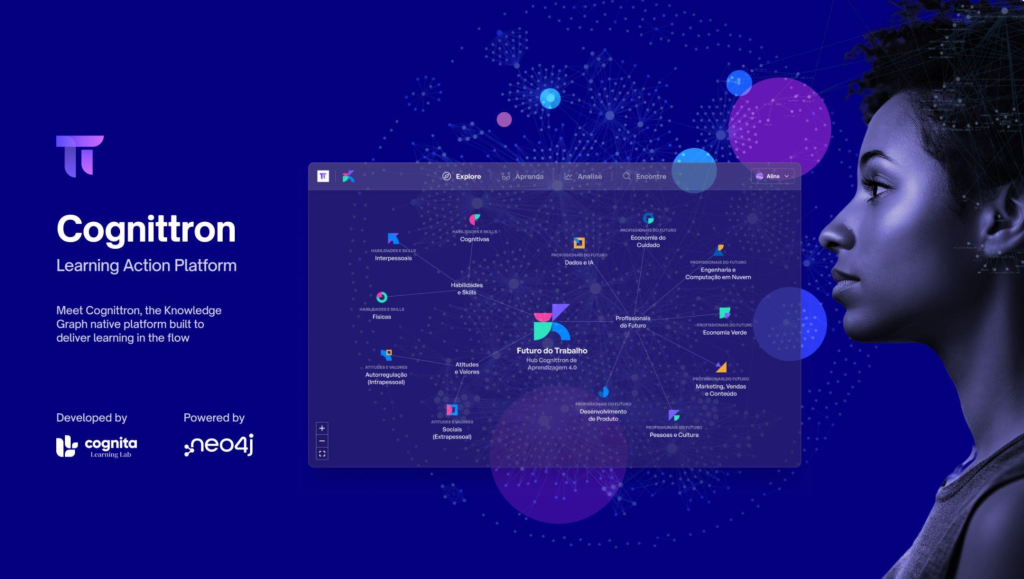
Cognita structures corporate learning as a connected system of challenges, concepts, and learning objects, delivered through visual, interactive maps where the learner stays in control. Cognita designed these maps for students to explore, learn, and find the knowledge that matches their needs and objectives.
This structure is the basis for non-linear learning paths, creating multiple ways to move through a domain, with a knowledge graph–based model that treats connections among ideas as the point of the system rather than just infrastructure.
Before Neo4j, linear systems could not match how people actually learn
Cognita began as an education company trying to improve outcomes. Early work relied on conventional tools and web stacks, including WordPress and relational databases such as MySQL, which were effective for publishing and managing content, but naturally reinforced a linear, content-first experience.
As Cognita pushed deeper into corporate learning, the limits of that model became harder to ignore. Learners were being asked to complete sequences, not build understanding. Knowledge stayed isolated in silos. Personalization often stalled at recommendations rather than true guidance through connected concepts. The result across many programs was disengagement and dropout.
Why the Cognittron was born with Neo4j
The Cognittron user experience depends on easy movement across relationships: between challenges, decisions, concepts, and supporting materials. Cognita’s engineering team realized early on that relational databases would not support the navigation model or the multi-hop queries needed for “choose your own adventure” style learning paths. Graph was the natural fit, so the platform was built with Neo4j from the start.
“People build knowledge by connecting information. Those connections form schemas that support retention and enable learning to be transformed into decision and action. That is why navigation through connected knowledge matters,” says Luzzi.
Cognita’s thesis was reinforced by learning science. Luzzi explains that neuroscience research points to a simple mechanism: people build knowledge by connecting information and forming schemas. That insight led the team to prototype a model focused on connections and action before the technology was fully built. Early results were strong enough to justify making the learning network the product, then choosing a graph database that matched it.
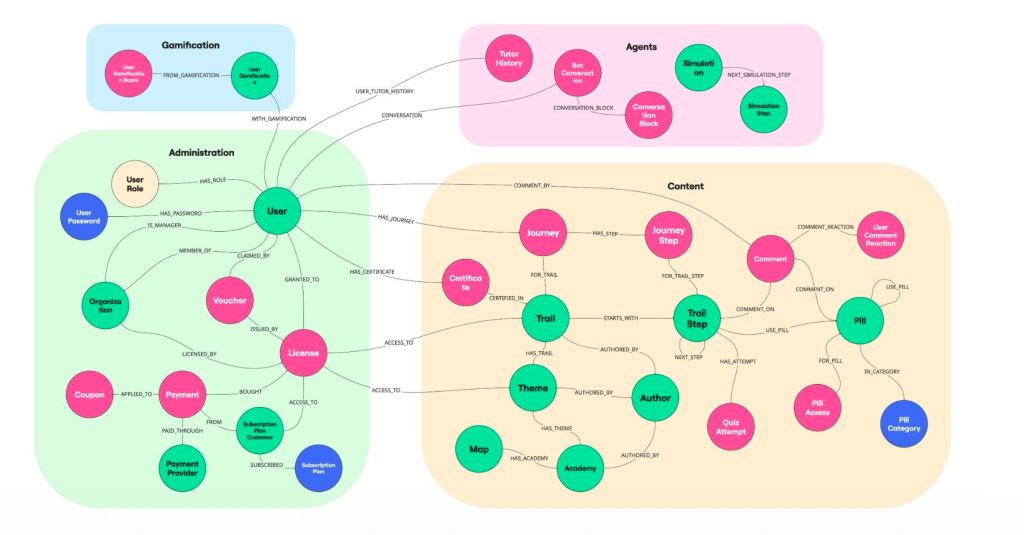
Above: Cognittron graph data model
UniCTE brings the model to the realities of construction
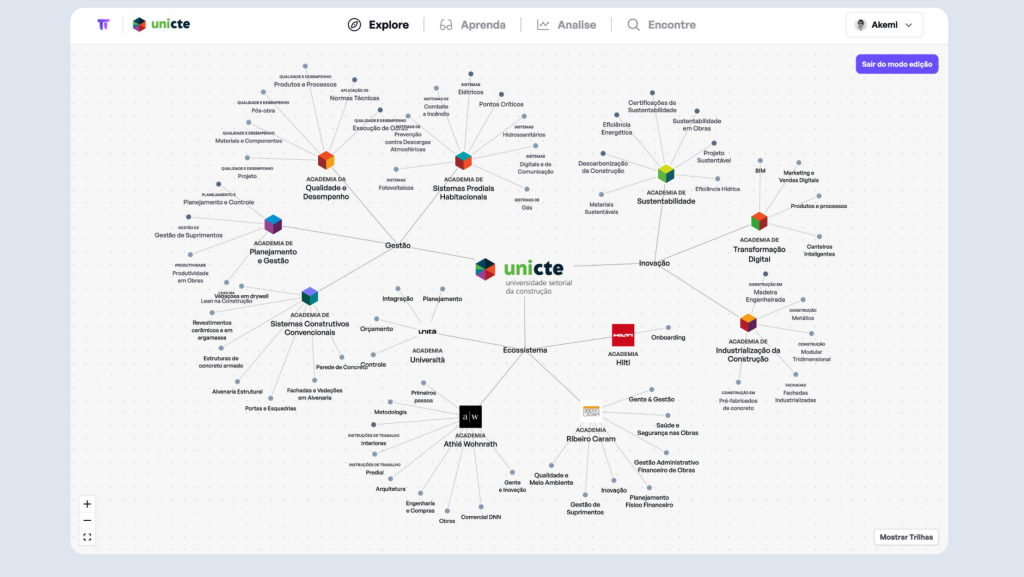
One of the first deployments for Cognittron was with UniCTE, an organization that provides courses for engineers, architects, and other construction professionals in Brazil. Built in partnership with CTE, a consulting and management company, UniCTE is a construction-sector learning platform built for professionals and independent practitioners. UniCTE offers more than 43 courses, with technical and applied learning paths, offering timely online content supported by AI.
UniCTE’s stakeholders are facing rapid change in construction, including innovation, digital transformation, industrialization, sustainability, and ESG demands, with an emphasis on respecting time requirements while accelerating learning through applied challenges.
Leading Brazilian construction firms such as Athié Wohnrath, Hilti BR, Ribeiro Caram, Unità Engenharia, and CTE have launched exclusive corporate academies within UniCTE to support continuous professional development and help businesses be more competitive in the market.
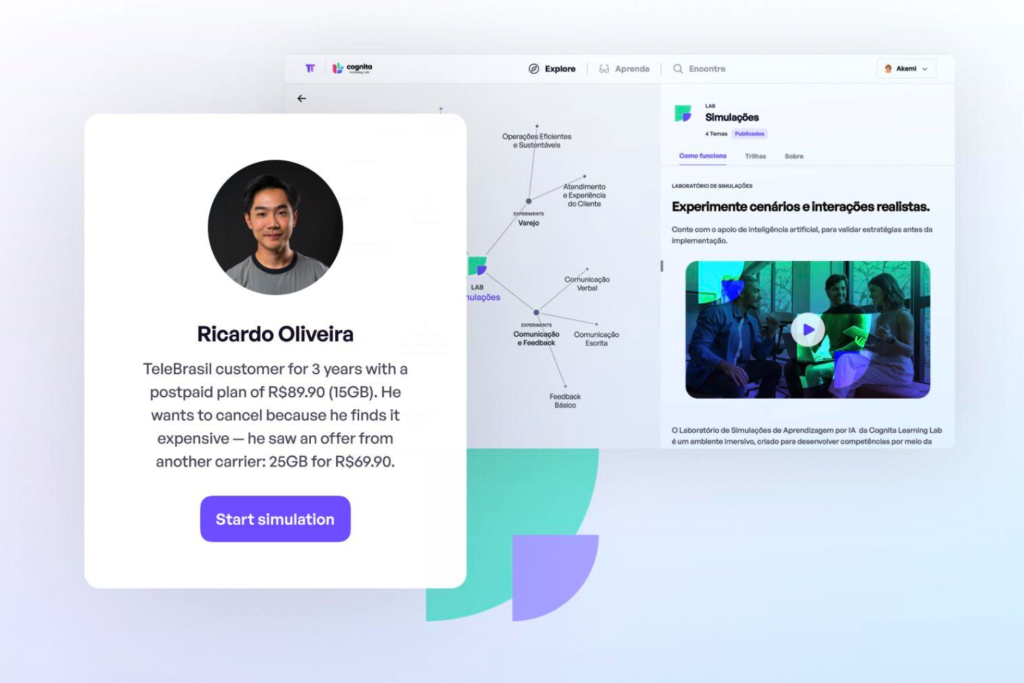
Above: Cognittron provides conversational simulators to train employees in specific competencies that require procedural learning.
Learners choose their path, while a graph guides them forward
Learners start from a real construction problem and navigate outward through adjacent concepts, examples, and decision points based on what they need to do on the job, using the connections in the underlying knowledge structure to keep the journey coherent.
Cognita’s digital tutor reinforces this inquiry-led model, described as a “cognitive mediator” that contextualizes information based on practical challenges, identifies key points and concepts in a connected way, and encourages relevant questions and critical thinking.
The Cognittron platform uses multiple map types to support different kinds of learning:
- Flow maps capture procedural knowledge and step-by-step processes.
- Image maps develop skills through contextual challenges.
- Circle maps guide exploration through questions and connected concepts.
- Hierarchy maps structure views of prerequisites, levels, or conceptual taxonomy.
When learning shows up exactly when work demands it
Three features in the knowledge graph–based system are directly targeted at the reality of corporate learning: people rarely learn everything up front, but they often need to recover the right information quickly when work demands it.
- Just-in-time education retrieves the right knowledge in the flow of work.
- Smart reminders resurface key concepts to strengthen retention over time.
- Connected knowledge shows how concepts relate so learners can build a usable mental model.
What changes when learning is connected to the job
Cognita’s ultimate goal is to help reduce the high dropout rates typical of conventional online learning. Luzzi notes that traditional dropout rates can approach 95% in many programs, compared with 80.4% of organic learners actually completing the tasks with Cognita. The company has reported a 300% return on investment for partners like UniCTE. The Cognittron platform helps turn learning into curiosity, not disengaged consumption.
“Education was designed for a 20th-century reality where the goal was to transmit the same information at scale. Today, information is everywhere. The challenge is guiding people to what matters,” says Luzzi.
Cognita: delivering focused training for today’s workers
Cognita is extending its approach across multiple fronts, including the development of the Mastersense Corporate University, designed for bilingual operations across Brazil and five additional countries in Latin America.
At the same time, the company is advancing a strategic roadmap that includes deeper hyper-personalization, expanded simulations, and a shift toward a more service-oriented architecture as adoption grows.
By treating connections between ideas as the center of the learning experience, Cognita aims to make workforce education more relevant, more durable, and easier to apply in the moments that matter.
Explore more