What Is Agentic AI Architecture? Common Patterns and When to Use Them


10 min read
As AI systems move beyond answering prompts and begin taking actions in real environments, architecture becomes the deciding factor in whether they behave predictably.
Agentic architecture is the system design that enables agentic AI systems to plan, act, observe, and collaborate efficiently and safely in production environments.
The shift from generative AI to agentic AI is a shift from response generation to workflow execution. Once an agent can query databases, call APIs, update records, or trigger infrastructure changes, the surrounding system design matters more than the prompt itself.
Architecture may seem straightforward in a single-agent system, but it gets complex in multi-agent systems where agents depend on one another. Choosing the right architecture becomes crucial to building a production-grade agentic AI system that efficiently works toward the goal while avoiding costly mistakes.
Agentic AI Architecture Components
An agentic AI system has these foundational components in its architecture: agent(s) with access to models, tools, and memory to complete tasks; orchestration to coordinate multiple agents; and guardrails to keep agent actions bounded and safe.
- Models are the reasoning engine. A language model interprets the goal, reasons using available context, and creates a plan to achieve it. You can use different models for different agents or tasks.
- Tools connect agents to external systems so they can retrieve data and take actions (databases, internal services, SaaS apps, automation, code execution, and search). Model Context Protocol (MCP) is the standardized way to connect agents to external tools and data sources.
- Memory keeps agents coherent across steps and sessions. Short-term memory stores intermediate results in the current session. Long-term memory stores durable facts, preferences, and prior decisions. Memory needs a reliable retrieval pipeline like GraphRAG so the agent pulls the right context at the right step, instead of guessing.
- Agents are programs that use models to reason, tools to act, and memory to reflect. They run in a loop until a goal or task is completed. An agentic system requires at least one agent, but more often has multiple agents with different specializations working together toward a shared goal.
- Orchestration coordinates work across multiple agents so they can work toward a shared goal efficiently by routing work, managing handoffs through shared state and memory, and handling when tools are called.
- Guardrails keep the system safe and auditable with mechanisms like tool access, validation, data access, human oversight, and traceability.
Architecture Patterns for Agentic AI Systems
You can build a simple agentic system with a single agent that runs in a loop. As requirements grow and you need specialization, concurrency, or stronger verification, multi-agent patterns become valuable. The architecture’s complexity varies depending on the use case. More often than not, agentic AI systems in production use a combination of these architecture patterns to get to their desired output efficiently.
Single-Agent Systems
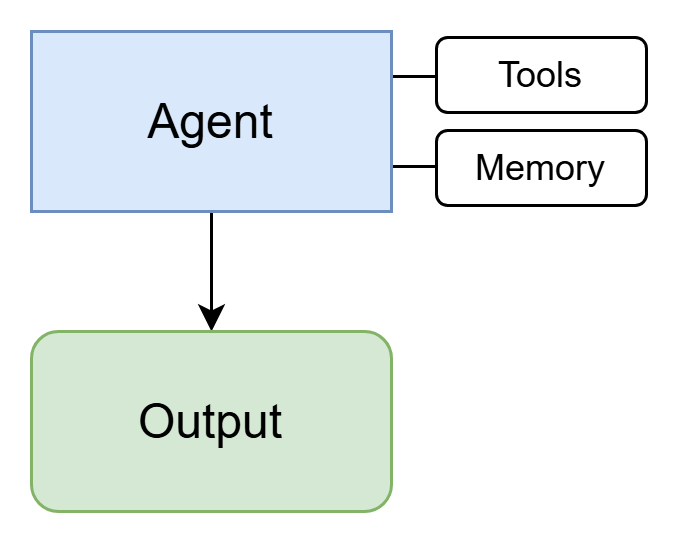
A single-agent architecture is a simple agentic system consisting of a single agent, which is a model with memory and tools. It plans, takes action, reflects on results, and repeats until the task is completed. This is often the right starting point for simple use cases because you can:
- Validate tool inputs and outputs (schemas and error handling)
- Measure quality at each step
- Add guardrails before scaling complexity
For example, a simple customer support agent answers questions about products and orders using approved knowledge sources and real-time order status.
Multi-Agent Systems
Multi-agent systems coordinate multiple agents toward a shared goal. They can improve speed and specialization, but they also add coordination overhead and make evaluation and observability more challenging.
A complex multi-agent system typically includes:
- Specialist agents that complete specific tasks
- Supervisor agents that plan and delegate tasks
- An orchestrator that shares state and memory with agents
Here are some of the most common architecture patterns used in agentic systems.
Parallel
Parallel agents work on independent subtasks simultaneously. Use this architecture when the tasks are different and don’t depend on each other’s output. For example, if you’re researching the market for a potential new product, one agent could analyze market demand, another could examine the competitive environment, and another could research the regulations.
Competitive
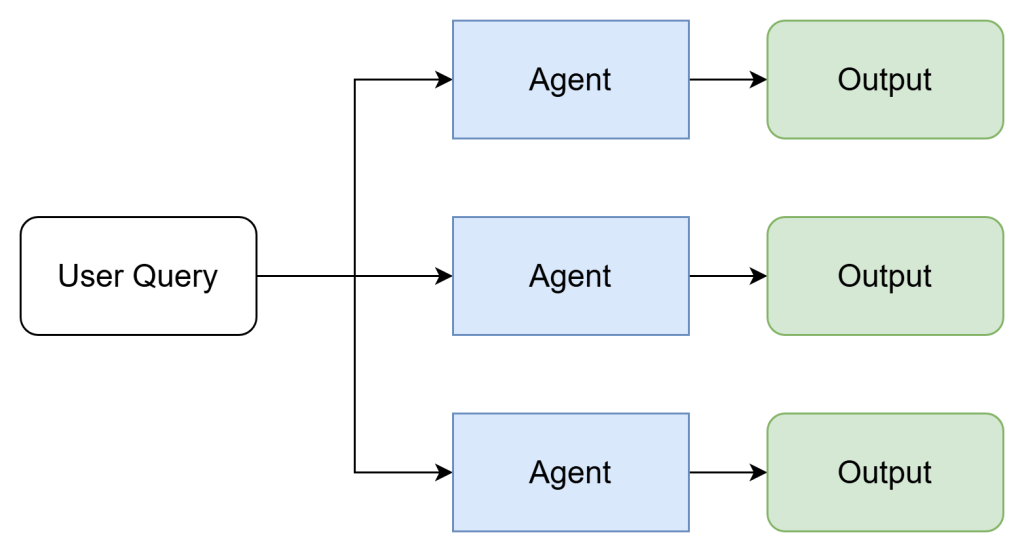
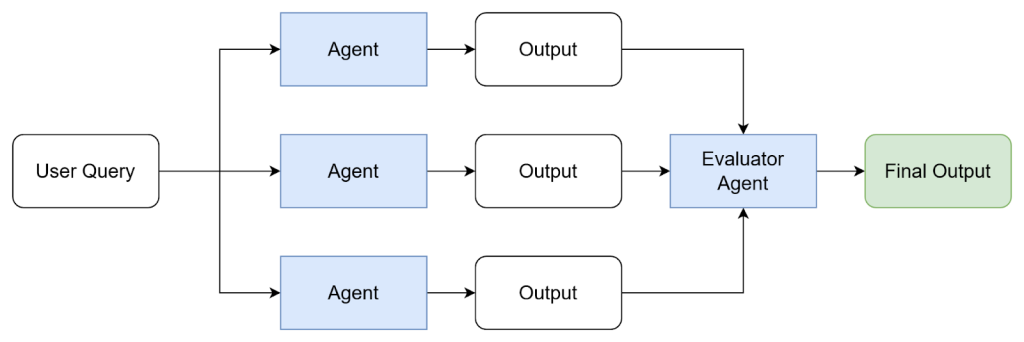
Multiple agents work simultaneously but on the same problem, each proposing its own solution. At the end, the evaluator agent scores the outputs and selects the most suitable one or combines them into a final output. Use it when you need robustness and diversity of thought. This works well for use cases like generating marketing copy, where agents work on different versions, and the evaluator chooses the one that best fits the criteria.
Sequential
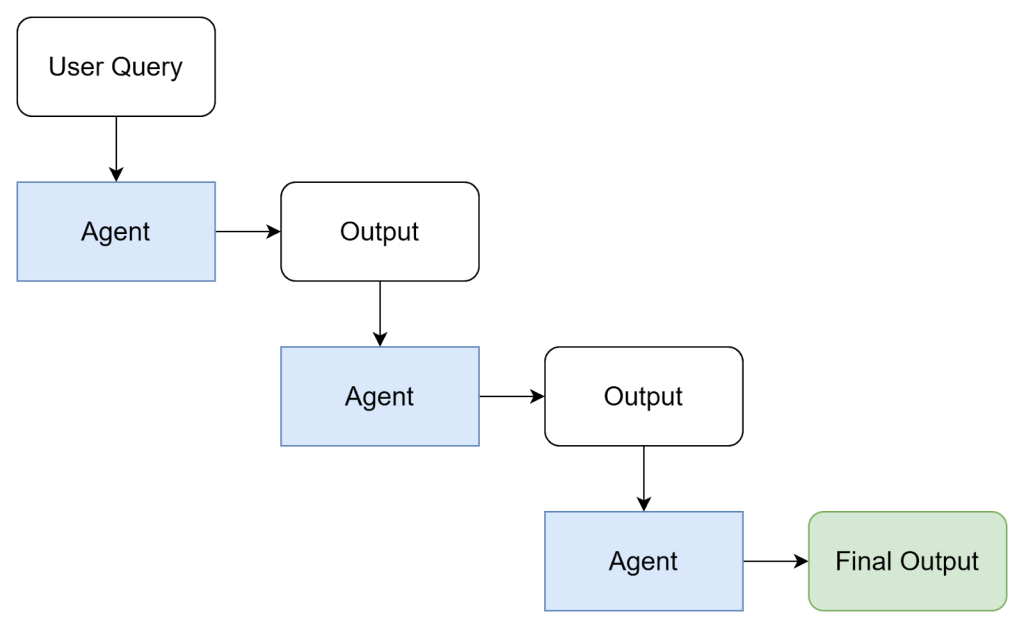
Agents operate in a pipeline. Use it when each step depends on the previous one. In the real world, it may look like this: A retriever agent makes API calls to retrieve real-time data, an analysis agent cleans up and analyzes the data, and the interpreter agent interprets this data and generates an explanation of the analysis in natural language.
Router
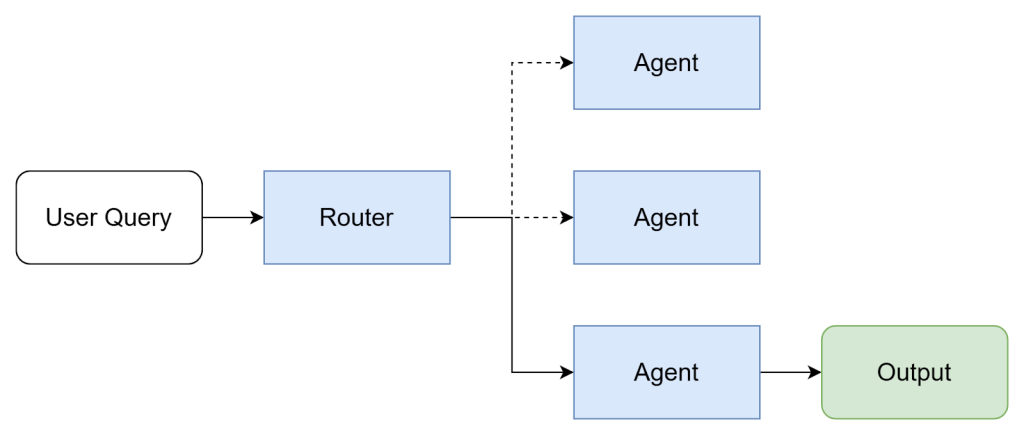
A router agent routes work to the appropriate specialist. Use it when you have different agents for different specializations. For example, a customer support agent may route customer requests to technical support, billing, or refund agents depending on the nature of the request.
Network
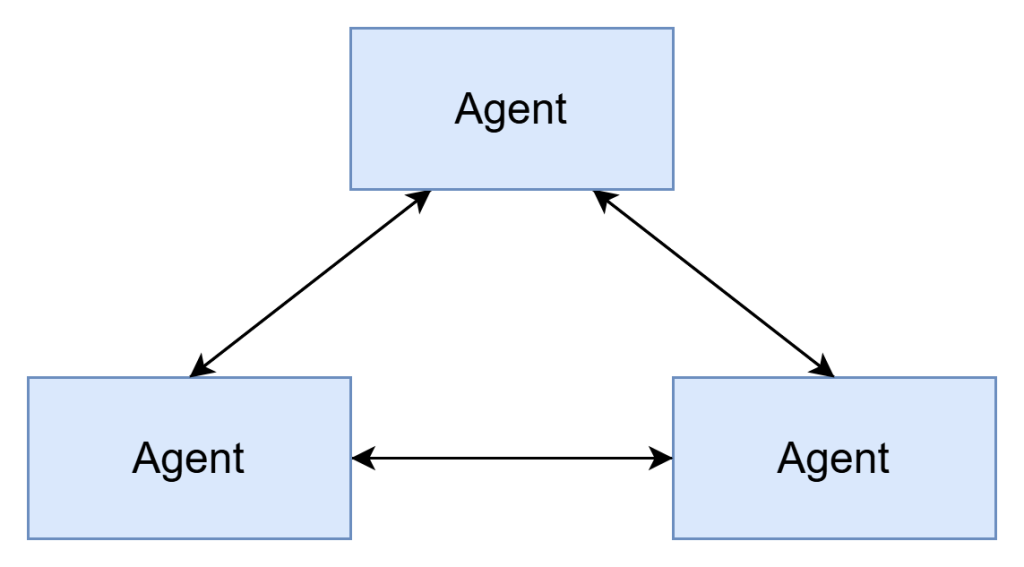
A network architecture, also called a horizontal architecture, connects specialist agents and allows them to share information or hand off work to one another. Use it when you have a complex use case with collaborative tasks that require different specialist agents to work together. It’s like a war room where different specialists are all talking to each other directly. They continuously challenge and build on each other’s input until they align on the best response.
- Example: agents triaging an incident across multiple services – sharing ownership, dependencies, recent deploys, and live findings as they work toward a coordinated resolution
Hierarchical
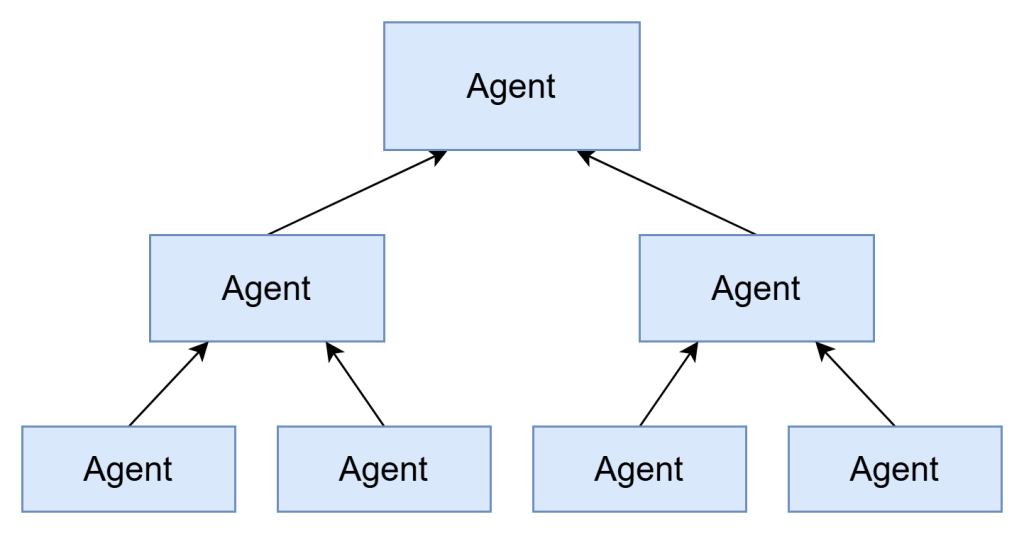
The hierarchical architecture mirrors an organizational structure in which employees work under supervisors. Agents have levels where a supervisor agent breaks down the goal and delegates tasks to specialist agents. Specialist agents produce the output and return it to the supervisor, who aggregates it and delivers it to the supervisor above, if there is one. Use it when you have a complex use case with different departments or domains and need strong control, clear delegation, and auditability.
This is often used for complex enterprise systems with multiple departments and specialists who need to work cross-functionally. For example, if the goal is to create an ESG report, a central lead coordinates the work by asking each department, such as HR, finance, and legal, each of which delegates specific tasks to specialists. Those specialists don’t interact with each other directly; the supervisors pull everything together into the final report.
Which Architecture Should I Choose for My Use Case?
Start simple, then add structure only where you have a clear failure mode to fix – think latency, specialization, verification, governance, or coordination complexity.
| Nature of Use Case | Architecture Pattern | Strength |
| One clear task or bounded workflow | Single-agent | Lowest complexity and operational overhead |
| Subtasks are independent | Parallel | Low latency and time to output |
| Need multiple viewpoints or verification | Competitve | Output comparison and evaluation |
| Steps must happen in order | Sequential | Dependencies follow a sequence, allowing an agent to work with the outputs of another agent |
| Many request types with different tools/policies | Router | Lower likelihood of failure and time to completion |
| Complex collaboration across agents | Network | Dynamic collaboration across agents at the same level |
| Complex coordination across domains/teams | Hierarchical | Structured like a real-world organization with cross-functional coordination |
Practical tips:
- Make orchestration observable. The biggest risk of complex agentic architecture is the loss of observability. Log each decision, tool call, and intermediate result so you can debug failures, evaluate quality, and audit behavior at each step.
- Constrain tools before you scale agents. Most production incidents come from tool misuse, unclear contracts, or overly broad permissions. Make sure agents are equipped with only the right tools and data access to prevent misuse.
How Knowledge Graphs Strengthen Agentic Architecture
Knowledge graphs organize information as entities and relationships. Instead of storing data as scattered text, they connect it – showing who owns what, what depends on what, and how everything fits together. This makes it easier to find answers because agents can follow the connections to find related entities rather than just search for similar words in the vector space.
For agentic AI systems, knowledge graphs provide structured context for long-term memory. An AI agent can retrieve data from the knowledge graph via GraphRAG and quickly understand context by seeing how services, users, and actions are linked, along with a trace of how decisions were made. That means better reasoning, fewer blind spots, and more reliable outcomes.
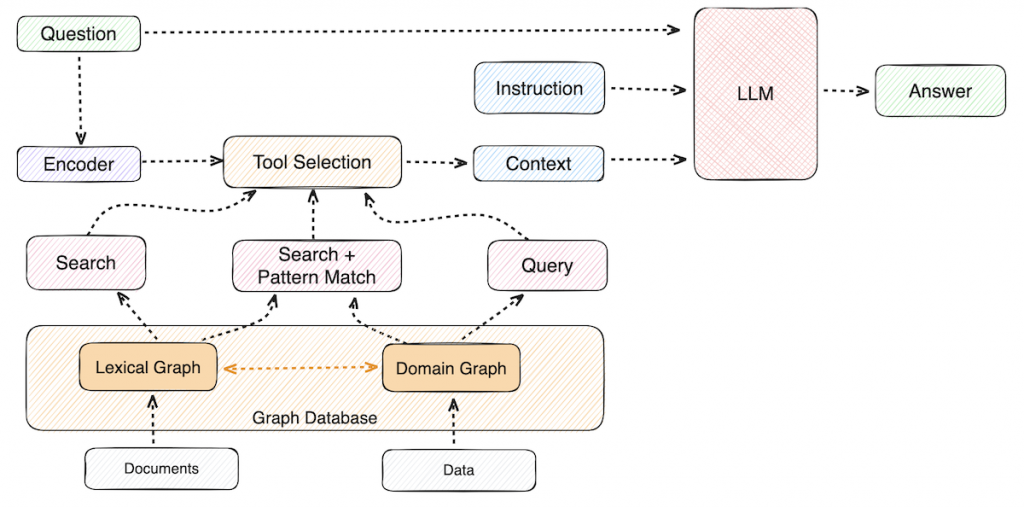
Think about an incident response system. An agentic workflow might pull logs and deployment data, but it still needs to answer practical questions: What broke? Who owns it? And what can we safely do next? With a knowledge graph, it can follow relationships across systems to quickly and accurately get those answers.
In more advanced setups, such as multi-agent systems, agents can coordinate through a shared logical view of connected facts and current state without stepping on each other or accessing information they shouldn’t.
Build Production-Ready Agentic Systems
Architecture makes agentic AI systems dependable. To build a production-ready agentic system, start with single specialist agents that carry out a task and evaluate their performance. Then integrate the specialists into multi-agent patterns according to your use case. Use a knowledge graph when your agent needs structured memory, shared state across agents, and traceable retrieval that can hold up in production. Make sure to log everything, provide narrow tools and permissions to each agent, and build appropriate guardrails.
Neo4j knowledge graphs provide a reliable context and memory layer – connected data, role-based access control, and GraphRAG – for production-ready agentic AI systems.
Learn how to improve retrieval quality, traceability, and grounding in agentic AI systems with GraphRAG.
Essentials of GraphRAG
Pair a knowledge graph with RAG for accurate, explainable AI. Get the authoritative guide from Manning.
Agentic Architecture: FAQs
Agentic architecture is the system design that enables AI agents to plan, act, access tools, collaborate, and operate safely in production environments.
In practice, it looks like an execution loop around an LLM: The system decides the next step, calls the right tools, checks results, updates memory and state, and stops or escalates when needed. It also includes the boundaries that make this safe in production, like scoped tool access, validation, and auditability.
It bridges the gap between a model that can answer a prompt and a system that can complete multi-step tasks. This becomes especially critical in multi-agent systems, where multiple agents need to coordinate work, share context, and rely on each other’s outputs.
Through orchestration. In a multi-agent system, orchestration coordinates agents toward a shared goal by routing work, managing handoffs through shared state and memory, and controlling when tools are called. Agents iteratively plan, act, reflect, update shared state, and continue until the goal is achieved.
Start simple, then add structure when you have a clear failure mode:
• Use single agent for narrow tasks
• Use parallel when subtasks are independent and latency matters
• Use competitive when you need evaluation and rigorous results
• Use sequential when steps have hard dependencies
• Add a router when requests need different tools/policies
• Use network when agents need to collaborate on the same level
• Use hierarchical when agents work in an organizational setup with cross-functional teams
Share Article


Explore
Related Articles


Beyond the Lakehouse: Why Your Microsoft Fabric Strategy Needs Neo4j Graph Intelligence

Graph-Driven AI for All: Neo4j Aura Agent Enters General Availability