NODES 2025 — A Recap in 10 Videos

Senior Developer Marketing Manager
5 min read
We did it again! NODES 2025 brought thousands of graph developers and data enthusiasts together for 24 hours of live sessions on AI engineering, graph-powered applications, data intelligence, and knowledge graphs. With more than 140 technical talks spanning multiple time zones and skill levels, there was something for everyone to enjoy.
If you’re already excited about the next NODES, we have news for you: NODES AI is happening April 15, and we’re accepting submissions! NODES AI will have three tracks, focusing on knowledge graphs and GraphRAG, graph memory and agents, and graph + AI in production.

Before diving into the sessions, I’d like to bring our two opening keynotes to your attention:
- Andrew Ng is the Founder of DeepLearning.AI, Managing General Partner at AI Fund, Executive Chairman of LandingAI, Chairman & Co-Founder of Coursera, and Adjunct Professor at Stanford. He’s an AI and online education pioneer, who has taught more than 8 million people.
Together with Emil Eifrem, CEO and Co-Founder of Neo4j, they explore how developers can move beyond simple RAG to robust agentic AI systems and why clean, graph-shaped knowledge is key for reliability and debuggability. They also discuss when to use frameworks vs. raw code, how to think about agentic memory, and why specialized models plus knowledge graphs will power the next wave of enterprise AI applications.

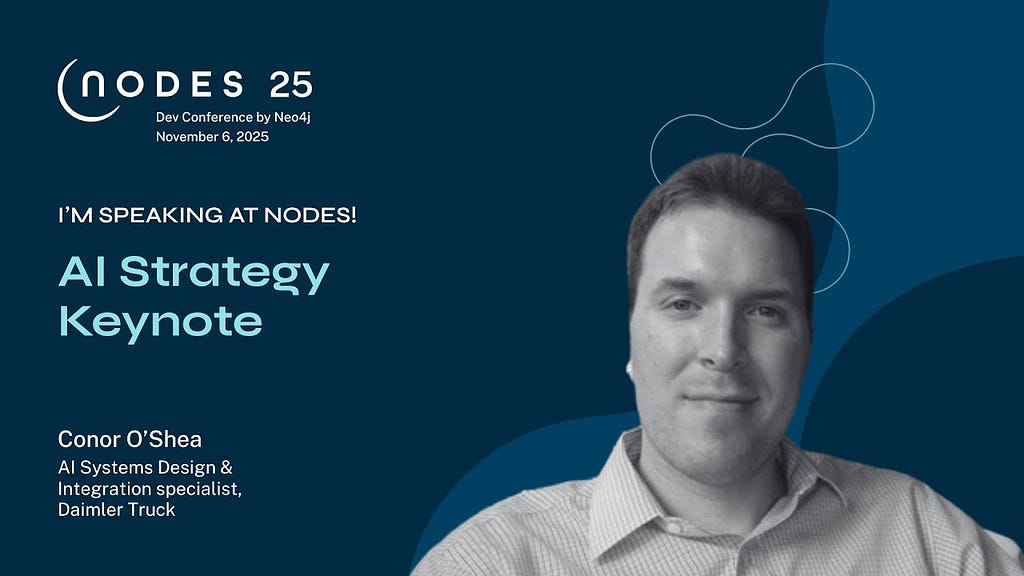
- Conor O’Shea, AI Systems Design & Integration, Daimler Truck North America, shows how they used Neo4j to build a live “architecture graph” of every application interaction. He then extends the idea with multiple business graphs (sales, engineering, service) fronted by an MCP-driven LLM, enabling anyone — from architects to finance — to ask natural-language questions about outages, warranty spikes, or design changes and get graph-grounded, actionable answers.
I know, it’s hard to find the right session among the many interesting talks from NODES 2025. That’s why we picked a few interesting topics and selected a few must-watch sessions for you, making it easier to start watching right away.
GraphRAG
Rajarshee Dhar and Vivek Singh use Neo4j to build a deeper multimodal understanding of content and its relationships, which directly improves Cisco’s ability to solve day-to-day customer issues by transforming unclear inquiries into well-defined problems, resulting in significantly more accurate and actionable contextual answers.
Context Engineering
Christophe Willemsen examines the limitations of traditional techniques, explores emerging strategies, and discusses the trade-offs between privacy, utility, and cost.
Agentic AI
Mike Morley introduces the Personal Knowledge Vault (PKV) as a system to support memory augmentation for individuals with functional memory challenges, using AI to make personal documents, notes and media easily searchable and contextual.
Knowledge Graph
Samira Korani shares how she built contextual knowledge graphs by combining diverse datasets like Geonames, OpenStreetMap, Yelp, and Wikidata. These graphs were designed to enrich LLMs with real-world context, enabling more relevant and grounded outputs.

Fraud and Anti-Money Laundering
Adam Conovaloff applies graph neural network (GNN) techniques to fraud detection in IRS networks. GNNs not only match suspicious taxpayer network patterns but also individual taxpayer nodal properties. This technique incorporates multi-modal data to include natural language.
Life Sciences
Isaac Ritharson and Ishan Chaudhary present the Medical Record Knowledge Graph (MRKG), a scalable framework that transforms structured MIMIC-IV EHR data into an interpretable, queryable graph using Neo4j. MRKG integrates diverse clinical entities, diagnoses, procedures, and medications into a cohesive structure, enabling comprehensive exploration of patient history.
Supply Chain
Pedro Parraguez Ruiz and Nelson Guamán Leiva present the architecture of a cross-border knowledge graph built in Neo4j that transforms fragmented public data into an engine for regional resilience. They provide an overview of their GraphRAG architecture, which combines vector search with rich graph context to ground LLMs for nuanced, real-time queries.
Cybersecurity
Mahantesh Halappanavar, Siddhartha Shankar Das, Moqsadur Rahman, and Joseph Aguayo present CyRAG, which employs Neo4j knowledge graphs to store and retrieve interconnected information in cybersecurity threat intelligence, enabling informed decisions and optimized cyber defense.
Graph Data Science
Brian Shi presents a graph algorithms agent (MCP server) that can execute algorithms from the Graph Data Science library on Neo4j, enabling users to ask natural language questions that implicitly require graph algorithms to answer.
Neo4j Aura
Philip Mortiboy takes you through how to build one-click recovery processes for key disaster recovery scenarios. And he shows how this was taken a step further using Aura’s integration with Datadog to build fully automated procedures triggered by key metrics from Aura.
You can watch all sessions from NODES 2025 in our YouTube Playlist.
NODES 2025 — A Recap in 10 Videos was originally published in Neo4j Developer Blog on Medium, where people are continuing the conversation by highlighting and responding to this story.
Share Article


Explore
Related Articles
Hey LLM, you’re using OPTIONAL MATCH wrong. Here’s the Cypher that actually works.