
Power Connected Intelligence for AI and Analytics with Neo4j and Databricks


5 min read
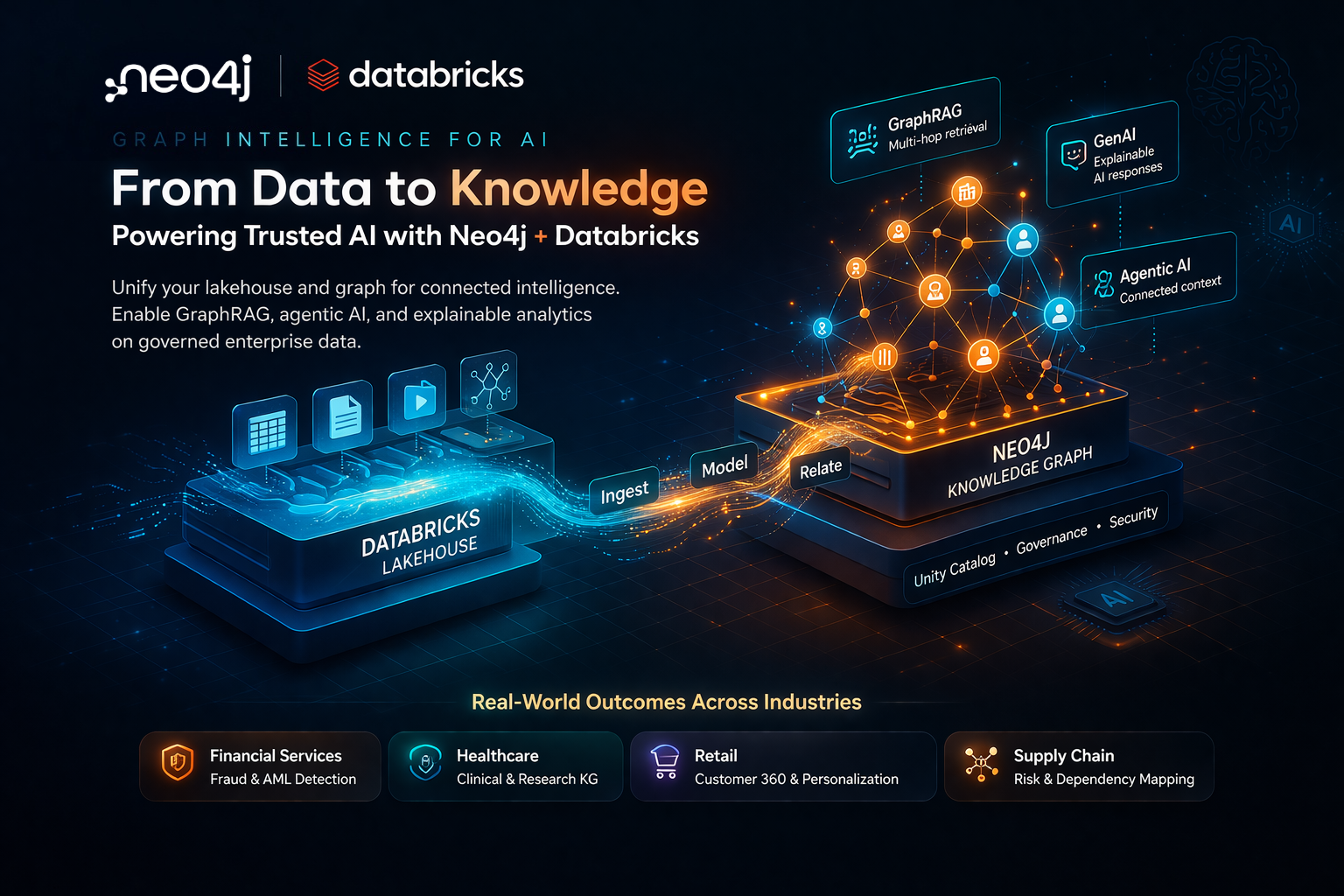
Across industries, enterprises are modernizing their data and AI stacks on the Databricks Data Intelligence Platform. Yet many critical decisions still depend on understanding relationships hidden in massive data. This is where GraphRAG with Neo4j and Databricks comes in, combining knowledge graphs and retrieval to ground AI in connected, trusted enterprise context.
That’s why organizations are increasingly pairing Databricks with Neo4j’s graph intelligence platform. Together, they unify data, analytics, and AI workflows—creating a connected intelligence layer where raw data evolves into a continuously improving knowledge asset.
Why Neo4j + Databricks: From Data to Knowledge
Databricks provides the scale, governance, and operational foundation for enterprise analytics and AI. Neo4j adds the missing dimension: relationships.
Many of the most challenging enterprise issues—fraud, risk, customer intelligence, and supply chain disruption—depend not just on data volume, but on understanding how entities connect across systems, domains, and time.Neo4j complements the Databricks platform by transforming lakehouse data into a graph-based knowledge asset that enables real-time reasoning, deeper insight, and more trustworthy AI. Learn more about the joint approach on the Neo4j + Databricks partnership page.
Powering Trustworthy GenAI With GraphRAG
Large language models lack an inherent understanding of enterprise relationships, often leading to hallucinations and opaque results. When retrieval is limited to isolated document chunks, important structural context is lost. Neo4j enables GraphRAG patterns where AI systems retrieve explicit relationship paths from a connected knowledge graph rather than fragmented text.
With Neo4j GraphRAG, organizations can execute multi-hop traversals over modeled entities, and AI applications can incorporate structural dependencies, role relationships, and cross-domain linkages into the prompt context before response generation. This approach reduces hallucinations, improves answer accuracy, and provides traceable reasoning paths that support explainability and audit requirements.
Beyond retrieval, graphs can serve as structured memory for agentic systems. By storing decisions, entities, and interaction traces as connected data, enterprises allow agents to reason across sessions and over time, not just within a single prompt. Organizations building production agents with Databricks Agent Bricks can use Neo4j GraphRAG to follow relationships and gather connected context that improves agent quality, while Agent Bricks handles model optimization and evaluation.
Because the graph is built from governed lakehouse data in Databricks, AI reasoning remains aligned with enterprise data controls, lineage, and security policies.
The result is GenAI that reasons over enterprise knowledge—not just text.
Graph Ontologies: The Context Layer for Enterprise AI
Traditional ontologies describe conceptual relationships in a semantic layer. Neo4j graph ontologies go further by storing and computing over physical relationships at scale—optimized for traversal, pattern detection, and multi-hop reasoning.
In the Databricks ecosystem, Neo4j acts as the graph ontology and reasoning layer, enabling:
- Incremental, domain-driven modeling that evolves with the business
- Real-time relationship traversal across billions of connections
- Graph-derived features for ML and AI pipelines
- Structure-aware retrieval for GenAI via GraphRAG
By leveraging Neo4j Knowledge Graphs, organizations turn static metadata into an operational knowledge foundation for analytics and AI.
Knowledge graphs shouldn’t be static. New relationships discovered through analytics or AI agents can be validated and written back into the graph, allowing the enterprise knowledge layer to evolve alongside the business.
Enterprise-Ready Integration and Governance
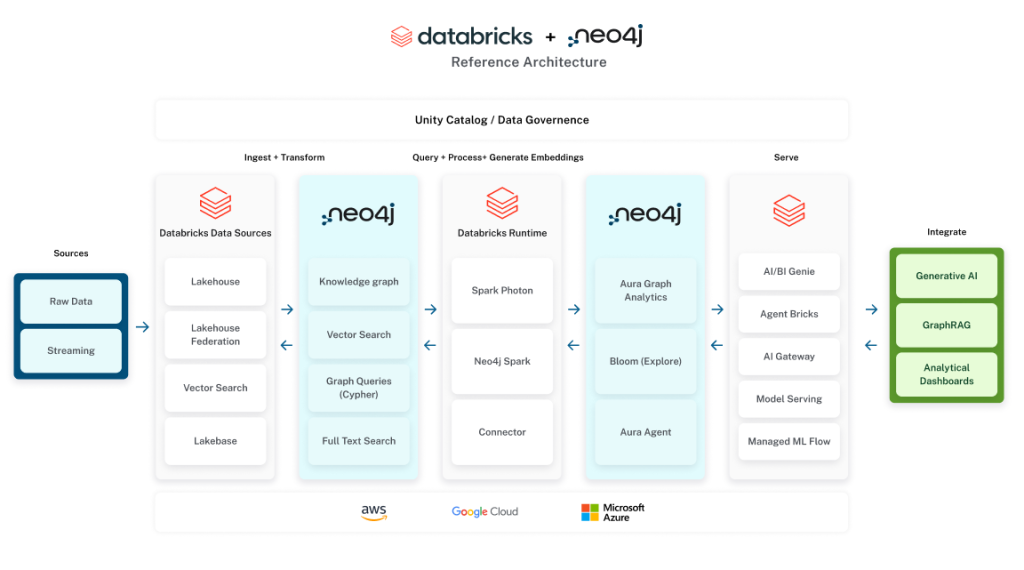
Neo4j integrates seamlessly with Databricks through:
- A certified Neo4j Connector for Apache Spark for bi-directional data movement
- Unity Catalog support for unified governance and lineage
- Secure authentication and enterprise-grade compliance
This ensures data, knowledge, and AI remain governed across the full lifecycle—from ingestion to insight to intelligent automation. Graph-derived features and relationship-enriched data materialized back to the lakehouse can also be queried conversationally through Databricks AI/BI Genie, making graph intelligence accessible to business users without requiring specialized skills.
Real-World Industry Impact
Organizations using Neo4j and Databricks together are delivering measurable outcomes across industries:
- Financial Services
Model accounts, entities, and transactions as connected networks to detect hidden intermediaries, flow concentration, and structural similarities between authorized and unauthorized actors. Multi-hop analysis exposes patterns that remain invisible in tabular monitoring systems, strengthening fraud detection, AML, and regulatory compliance. - Healthcare & Life Sciences
Unify clinical, research, and claims data into connected knowledge graphs linking patients, treatments, trials, and outcomes. Graph-based modeling enables traceable reasoning across care pathways and safely grounds GenAI in governed medical context. - Retail & Consumer Goods
Build customer 360 knowledge graphs connecting identities, products, transactions, and behaviors across channels. This enables relationship-aware recommendations and agentic ecommerce experiences where AI agents reason over real customer context, inventory, and preferences in real time. - Supply Chain & Manufacturing
Model suppliers, components, and logistics dependencies as connected networks. Multi-hop traversal exposes concentration risk, critical paths, and disruption impact, supporting explainable forecasting and operational optimization.
Why This Partnership Matters Now
Enterprises are racing to adopt GenAI—but most lack the governed, contextual foundations required for reliable outcomes.
Databricks provides the data intelligence backbone.
Neo4j provides the graph intelligence layer.
Together, organizations can move faster—from raw data to connected knowledge to trustworthy AI—without sacrificing governance, explainability, or scale.
Extend Your Databricks Platform with Connected Intelligence
Explore how Neo4j and Databricks work together to power knowledge-driven analytics and AI. https://neo4j.com/databricks/
Share Article


Explore
Related Articles

Neo4j Brings High Speed Identity Resolution to the Snowflake AI Data Cloud
The Data Strategy That Makes Truly Personalized Customer Experiences Possible

Finding the Fastest Way Out: How Dijkstra’s Algorithm Finds Shortest Paths

Beyond the Lakehouse: Why Your Microsoft Fabric Strategy Needs Neo4j Graph Intelligence

Designing Agentic AI for Pharma & Life Sciences with Graph Technology: From Complex Evidence to Explainable Insights