
Capgemini Turns Data and AI Into Connected Intelligence With Neo4j and Databricks


5 min read
Modernizing data and AI platforms is no longer the hardest part of digital transformation. The real challenge is operationalizing them—bringing together the right architecture, governance, and domain understanding to deliver outcomes at enterprise scale.
For enterprises in financial services, life sciences, public sector, and industrial markets, this is especially important. These organizations operate in complex, highly regulated environments. Decisions need to be explainable, data needs to be traceable, and AI needs to be trusted.
As organizations adopt the Databricks Data Intelligence Platform and Neo4j’s graph intelligence capabilities, they increasingly seek trusted partners to help translate platform investments into measurable business value. That’s where Capgemini plays a critical role.
Together, Capgemini, Neo4j, and Databricks provide an end-to-end approach for building governed, contextual, and AI-ready knowledge foundations—helping enterprises unlock connected intelligence across analytics, GenAI, and mission-critical operations.
“Enterprises aren’t just looking for new AI tools—they’re looking for trusted, governed systems that can scale across the business,” said Robert Engels, Insights & Data Head of Innovation, Capgemini. “By combining Databricks’ platform with Neo4j’s graph intelligence, we help clients turn fragmented data into connected knowledge that drives real decisions.”
From Platform to Outcomes: Where Capgemini Adds Value
Capgemini brings deep industry expertise, transformation frameworks, and delivery capabilities that help enterprises move faster from architecture to execution—while reducing risk along the way.
In practice, that begins with helping customers identify high-value opportunities for graph-powered intelligence. Whether the priority is fraud detection, customer intelligence, supply chain resilience, or GenAI copilots, Capgemini works with organizations to design architectures that bring together:
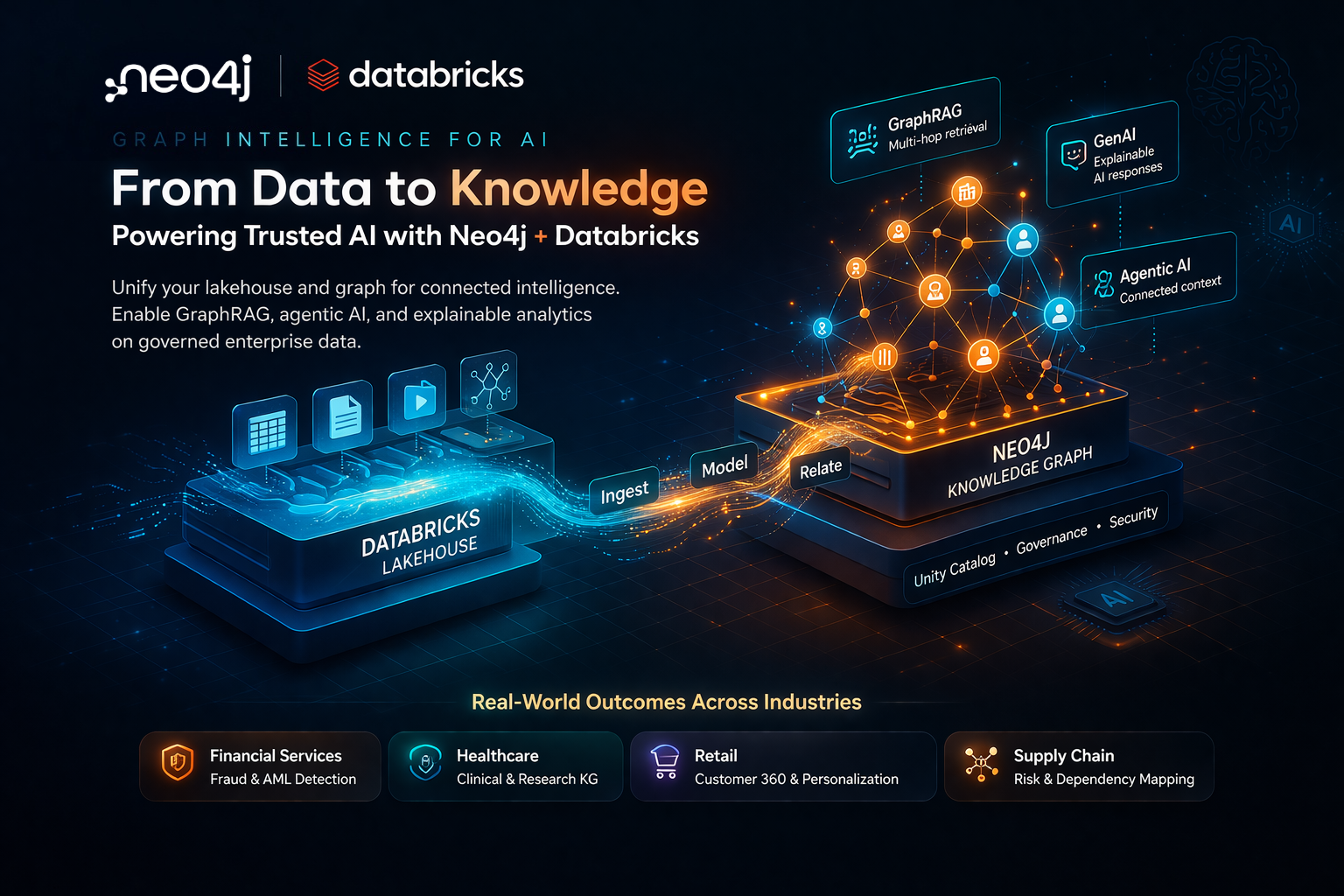
- Databricks as the system of record and AI platform
- Neo4j as the graph ontology and reasoning layer
- Unity Catalog as the governance foundation that ensures trust, lineage, and compliance across the data estate
This architecture aligns seamlessly with the joint Neo4j + Databricks partnership—extending lakehouse data into connected knowledge that powers analytics and AI. Relationship-enriched data materialized back to the lakehouse also becomes accessible to business users through Databricks AI/BI Genie, broadening the reach of graph intelligence beyond technical teams.

Building Knowledge Graphs and Ontologies That Evolve With the Business
Many enterprises already have vast amounts of data in the lakehouse—but the most valuable insights depend on understanding how entities connect: customers to transactions, suppliers to shipments, devices to failures, or accounts to risk exposure.
Capgemini helps organizations model these critical domains into graph-based knowledge assets using Neo4j. These graph ontologies go beyond conceptual structure—they store and compute over real relationships, optimized for traversal and reasoning.
By leveraging Neo4j Knowledge Graphs, organizations create reusable intelligence that:
- Accelerates insight across disconnected systems
- Enables domain-driven evolution of data products
- Provides a strong foundation for analytics and AI
Operationalizing GenAI With GraphRAG
As GenAI adoption accelerates, enterprises are discovering a familiar challenge: LLMs are powerful, but without context they can produce hallucinations, incomplete reasoning, and results that are difficult to audit.
Capgemini helps customers deploy GraphRAG architectures that combine:
- Databricks Mosaic AI for model development and serving
- Neo4j for relationship-aware grounding and reasoning
- Governed access via Unity Catalog
By grounding LLMs in structured enterprise relationships using Neo4j GraphRAG, organizations can reduce hallucinations, improve multi-hop reasoning, and deliver explainable AI outcomes—especially in regulated industries where transparency is essential. As AI agents move from analysis to action, they need more than just models and data. Context Graphs are the connective tissue that lets AI systems make informed & transparent decisions and achieve better outcomes over time. For customers building production agents, Capgemini helps integrate Neo4j with Databricks Agent Bricks, combining graph relationship traversal and connected context with automated agent optimization and evaluation to accelerate time to production.
“Graph intelligence is becoming foundational to enterprise AI,” said Mark Woodhams, Chief Revenue Officer, Neo4j. “With Capgemini and Databricks, we’re helping customers ground AI in connected knowledge—so models reason over real relationships, not just generate responses.”
Digital Twins and Intelligent Operations
For manufacturing, energy, logistics, and infrastructure customers, Capgemini is also helping build graph-based digital twins that model real-world systems as connected networks.
Using Neo4j alongside Databricks, organizations can:
- Map machines, materials, suppliers, and dependencies as a dynamic network
- Simulate cascading failures and disruptions
- Enable predictive planning and operational optimization
These capabilities align closely with Neo4j’s work in supply chain and logistics intelligence and related industry initiatives—demonstrating how graph-powered context drives resilience at scale.
Industry Impact at Enterprise Scale
Capgemini supports Neo4j + Databricks customers across industries, including:
- Financial Services: Fraud, AML, and AI-driven investigations powered by graph analytics
- Healthcare & Life Sciences: Clinical knowledge assets and compliant GenAI
- Retail & CPG: Customer 360, personalization, and AI-powered discovery
- Supply Chain & Manufacturing: Digital twins, resilience, and optimization
Across these domains, the common thread is clear: the most valuable AI outcomes depend on connected intelligence.
Why This Collaboration Matters
Technology alone doesn’t deliver transformation. Enterprises need trusted partners who can align platforms, people, and processes around real business priorities.
By combining:
- Databricks for data and AI
- Neo4j for graph intelligence and knowledge
- Capgemini for enterprise transformation and delivery
Organizations gain a proven path from data modernization to connected, contextual, AI-driven outcomes.
Learn More:
Looking to accelerate your journey from data to knowledge to AI impact? Read up on the Neo4j and Databricks partnership, and learn more at neo4j.com/databricks.
Share Article


Explore
Related Articles
Power Connected Intelligence for AI and Analytics with Neo4j and Databricks
How Graph Intelligence Drives Breakthroughs in Science and Society