
As we close the chapter on 2025, it’s clear that the enterprise landscape has reached a definitive turning point. For years, the industry’s focus was on data accumulation and management; today, that’s no longer enough. To thrive in the era of autonomous systems, organizations must transcend the “data layer” and embrace the “knowledge layer.” This past year marked a fundamental transformation for Neo4j, as we evolved from a graph database and analytics leader into the world’s premier graph intelligence platform. We recognize that for AI to move from experimental to essential, it requires more than just raw information—it requires context, relationships, and reasoning. By transforming fragmented data into structured, navigable knowledge, Neo4j is now providing the critical cognitive foundation that powers the next generation of agentic systems, enabling enterprises to turn the complexity of today into the autonomous decisions of tomorrow.
To support this evolution, we have architected the Neo4j Graph Intelligence Platform as a cohesive, three-tier ecosystem designed to bridge the gap between raw data and autonomous intelligence.
At its foundation lies the core Database & Graph Algorithms layer, powered by AuraDB, our fully managed graph database. This year, we achieved a milestone by offering a unified “Graph Engine” that runs seamlessly across all three major public clouds, featuring Infinigraph for horizontal scale-out to 100TB+ and a library of 65+ production-ready graph algorithms that deliver insights up to 2x faster than traditional methods.
The middle tier consists of AI-Powered Graph Tools that democratize knowledge creation. From the Neo4j Workspace for intuitive data modeling to AI-generated dashboards in Aura, these tools allow teams to transform fragmented documents and structured data into navigable graphs in minutes.
Finally, the Graph AI layer serves as the critical “reasoning” engine for the modern enterprise. Through Aura Agent, developers can now build and deploy context-aware, multi-hop agents in seconds, while our Agentic Brain provides the essential persistent memory and “Context Graphs” that autonomous systems require to make reliable, grounded decisions.
The Neo4j Graph Intelligence Platform can be integrated through an expansive, AI-native developer surface, including MCP, Agent Framework, and Platform integrations and agent tools using our drivers and GraphQL.
Database Scalability & Reliability
The introduction of Infinigraph marks a paradigm shift in how enterprises scale their most complex data networks. This breakthrough distributed architecture enables horizontal scaling to 100TB and beyond, allowing organizations to run massive operational and analytical workloads in a single, unified system.
Key features that define this new standard include:
- Massive Scale & Performance: Supports datasets exceeding 100TB with fast initial bulk loading and live incremental updates, eliminating the need for complex ETL pipelines.
- Integrated Intelligence: Natively sharded full-text and vector indexes enable embedding billions of vectors directly within the graph to power high-performance semantic search and AI applications.
- Enterprise Rigor: Remains fully ACID compliant and transactional, ensuring complete data integrity even across a distributed cluster.
- Unmatched Simplicity: Operates transparently to all API calls and standard Cypher, meaning existing applications and Neo4j tools—like Query, Explore, and Graph Analytics—work seamlessly without a single line of code being rewritten.
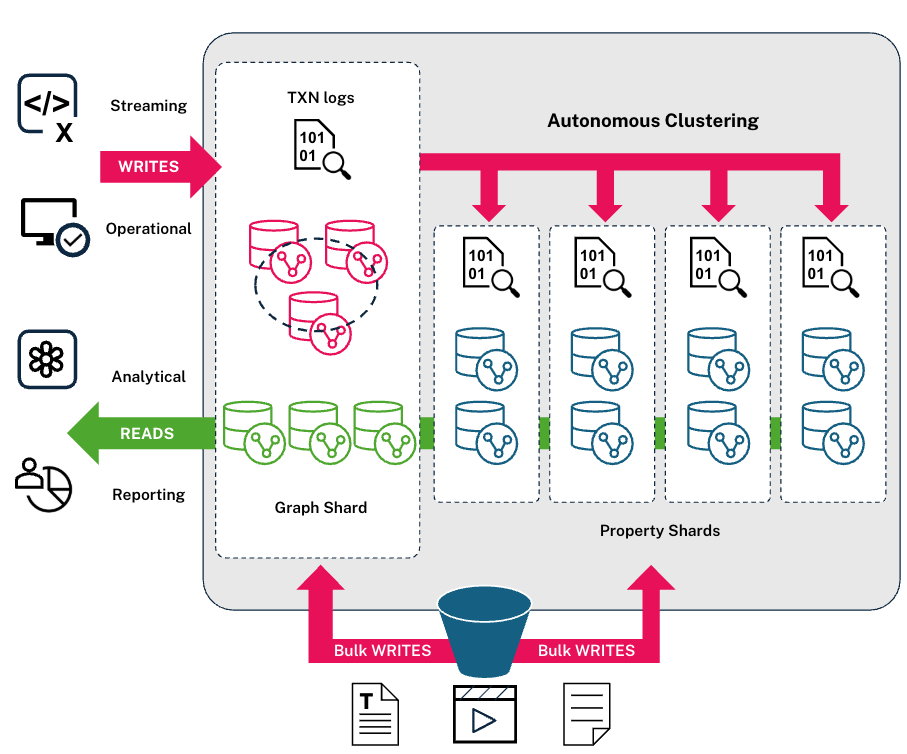
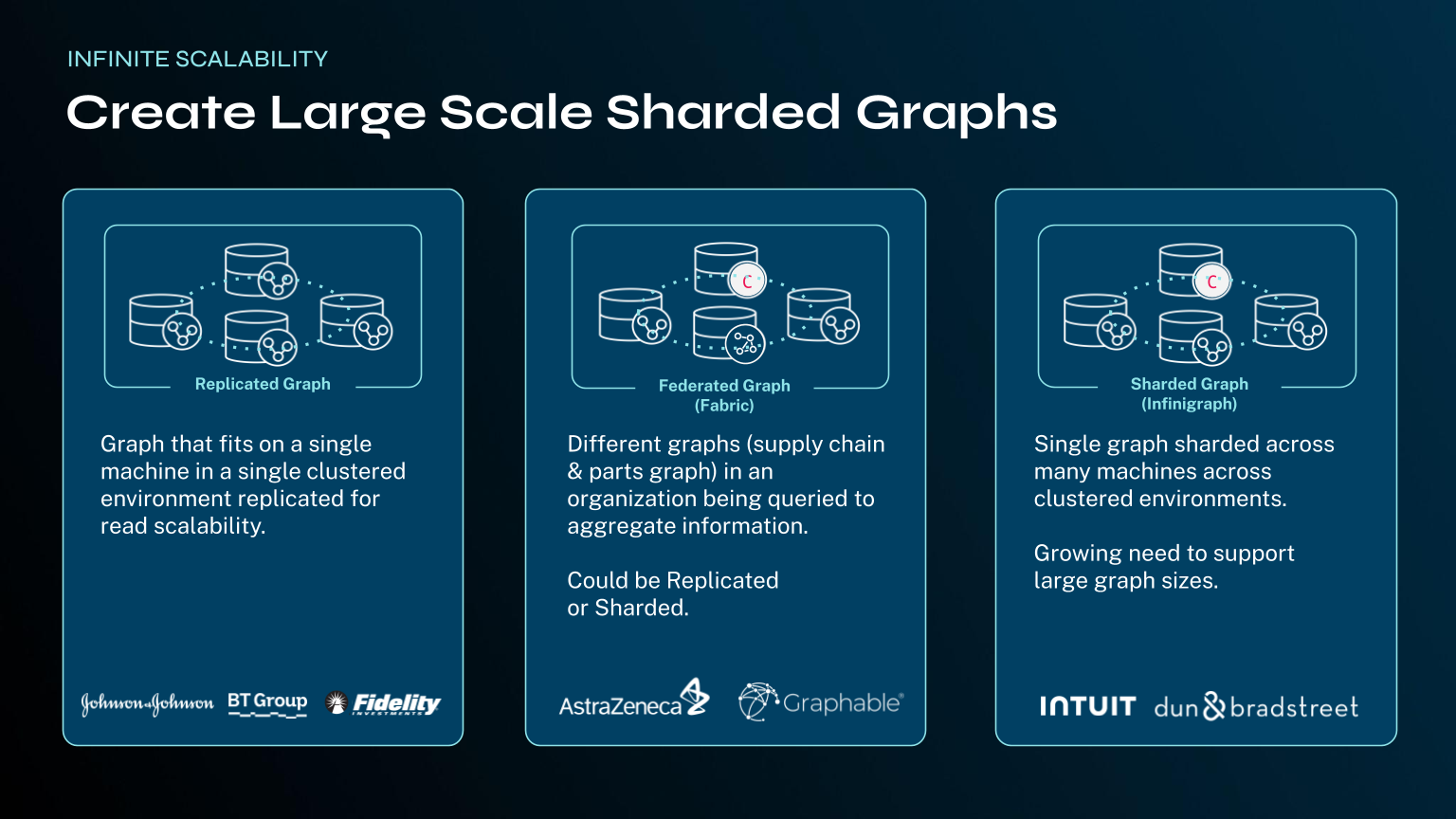
Neo4j empowers enterprises with flexible architectural options to handle growing data demands. For scenarios requiring high availability and read scalability, the Replicated Graph model allows a graph that fits on a single machine to be replicated within a single clustered environment. To address the need to support massive data volumes, Infinigraph will enable Sharded Graphs, where a single large graph is sharded across many machines in clustered environments. Furthermore, the Federated Graph (Fabric) capability allows users to execute queries across different, distinct graphs within an organization to aggregate information efficiently.
AuraDB: Your Fully Managed Cloud Platform
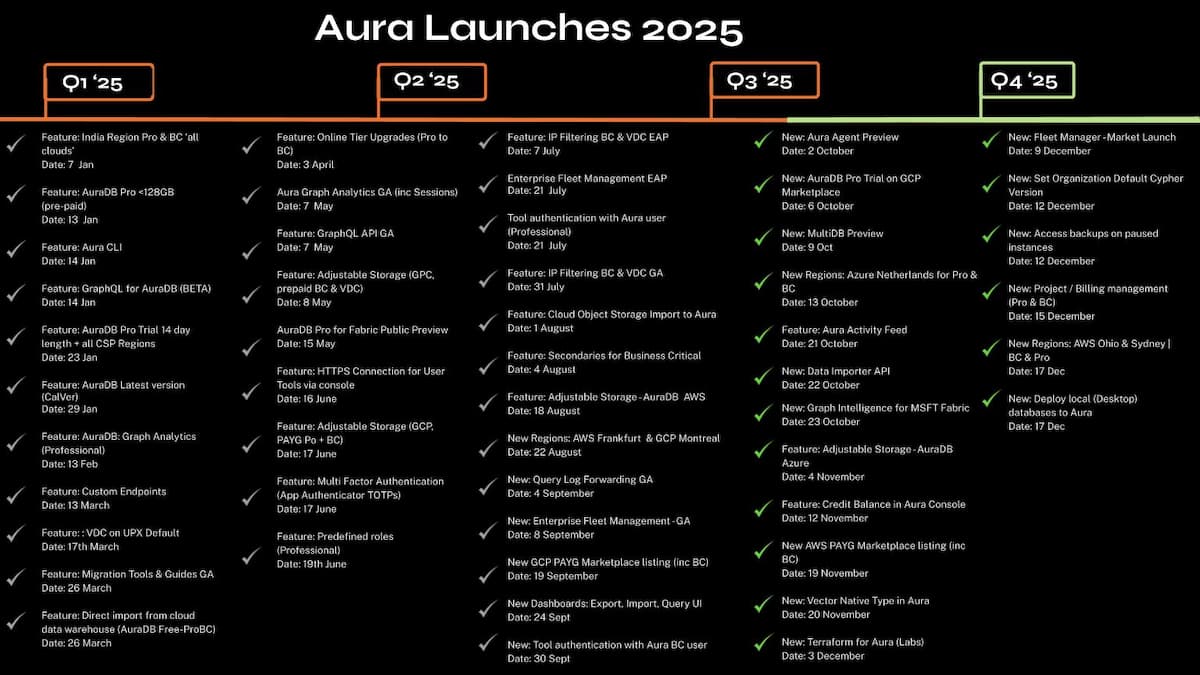
AuraDB continues to serve as the high-performance backbone of our cloud-first vision, now powering more than 30,000 databases globally. To better serve diverse enterprise requirements, we introduced three distinct SKUs—AuraDB Professional, Business Critical, and Virtual Dedicated Cloud—alongside a new Free Trial for AuraDB Professional and Graph Analytics to accelerate the “time to wow”.
This year, we prioritized operational flexibility and cost-efficiency with several major architectural updates:
- Resource Optimization: Our new Adjustable Storage capability allows organizations to scale storage and RAM independently, ensuring they pay only for the compute they need as data volumes grow.
- Enterprise Scalability & Performance: We introduced Secondaries to provide seamless scale-out for read-heavy workloads, ensuring consistent performance even under intense demand.
- Hardened Security & Compliance: Aura now supports SSO via Entra and Okta, CMEK, and private networking via VPC and Private Links, all backed by a new Activity Feed that captures comprehensive networking, security, and operational events for audit-ready compliance.
- Unified Management: New Project & Billing management tools allow customers to group projects by cost center or environment, track prepaid credits directly in the console, and manage flexible payments through marketplace upgrades.
These advancements ensure that AuraDB is not just a managed database but the most secure and flexible foundation for a graph intelligence platform.
Aura (Serverless) Graph Analytics
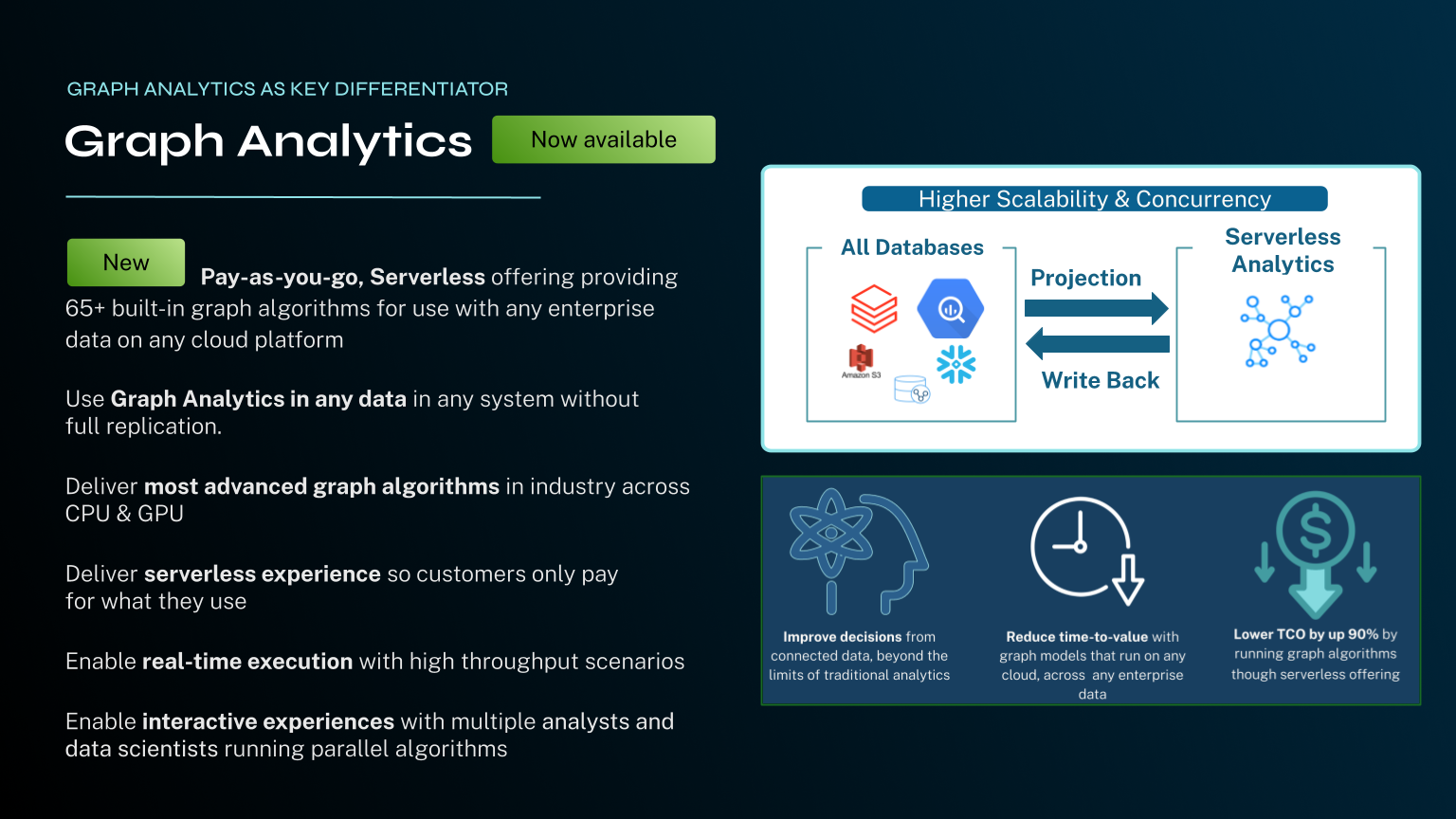
One of our proudest milestones in 2025 was the General Availability of Aura Graph Analytics, a breakthrough that fundamentally changes how businesses derive value from their data ecosystems. This serverless, pay-as-you-go offering provides over 65 built-in graph algorithms that can be deployed against any enterprise data, regardless of the cloud platform.
What sets this offering apart is its ability to deliver the industry’s most advanced graph algorithms without requiring full data replication. This means data scientists and analysts can:
- Work With All Enterprise Data: Effortlessly create an analytics session with relevant data from data lakes in AWS S3, Databricks, Snowflake, and BigQuery.
- Drive Real-Time Insights: Support high-throughput scenarios and real-time execution that powers critical business decisions as they happen.
- Enable True Collaboration: Facilitate interactive, parallel experiences where multiple users can run complex algorithms simultaneously without performance degradation.
- Close the Loop: Run sophisticated analytics and write results back directly to your own storage, ensuring that the “knowledge” generated remains an integrated part of your data estate.
By removing the friction of infrastructure management and data movement, Aura Graph Analytics ensures that the power of the graph is always just a session away.
AI-Powered Tools & Experiences
In 2025, we fulfilled our promise of the “5-5-5 experience” (5 seconds to sign up, 5 minutes to wow with your data, and 5 days to see real value) by transforming our unified experience in Aura, including all tools, into a natively AI-powered ecosystem. We have streamlined the end-to-end journey, allowing users to move from raw enterprise databases and data warehouses into a fully realized Neo4j graph model that can be analyzed and visualized—all in just a few minutes. Aura Console now also enables you to connect to any self-managed Neo4j database, deployed on-prem or in the cloud, and even on your local laptop.
The core of this transformation lies in making the “power of the graph” accessible to everyone, regardless of their technical background:
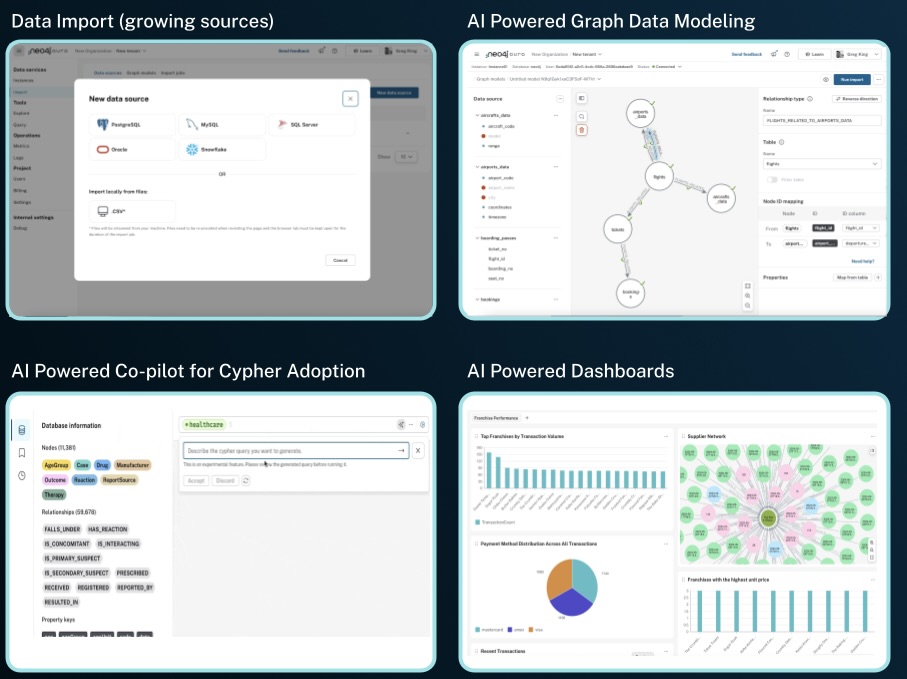
- AI-Powered Data Modeling: Our Data Import tool now features custom AI models that automatically transform complex columnar and relational data into optimized Graph Data models, eliminating the manual guesswork of schema design.
- Natural Language Discovery: We have integrated Co-pilot experiences directly into our Query tool and Explore (Bloom), enabling users to perform multi-hop analysis and complex graph queries using standard natural language.
- Zero-Knowledge Dashboards: Our new Dashboard tool (the official successor to NeoDash) allows for instantaneous visualization. Users can simply state a goal—such as “generate a dashboard to show product performance”—and the tool automatically interrogates the underlying schema to build professional-grade visualizations with zero prior knowledge of the dataset required.
While 2025 was about the tools themselves, we are already looking toward 2026, where we will launch a fully AI-powered onboarding journey to make the transition to graph intelligence even more seamless for every new user.
Unified Fleet Management for all Neo4j Databases
To address the growing complexity of modern multi-cloud environments, we have introduced Unified Fleet Management, a centralized command center that monitors and manages every Neo4j database across the global enterprise. This capability moves organizations beyond individual database maintenance to Proactive Monitoring, providing deep health insights and performance optimization while identifying potential security risks in real time.
By streamlining operations, we ensure seamless workload management across the entire fleet, significantly reducing the risk and downtime associated with critical enterprise data. Finally, we have simplified the path to the cloud; our fleet management tools now allow enterprises to migrate self-managed databases to Aura with just a few clicks, ensuring that existing investments can easily transition into our graph intelligence platform.
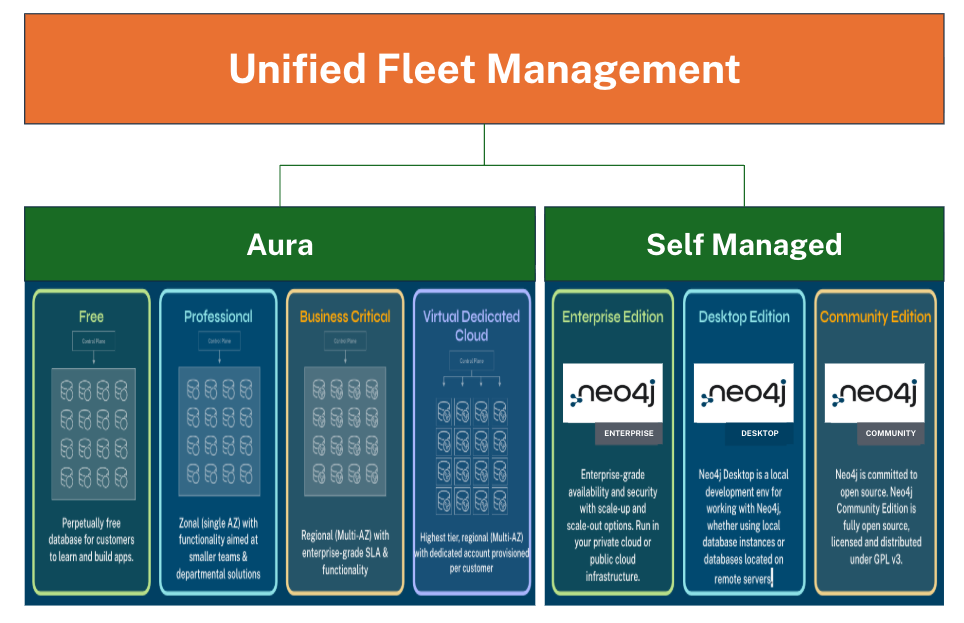
Neo4j Desktop V2: Empowering the Local Developer
The journey toward graph intelligence often begins on the developer’s workstation, and Neo4j Desktop V2 is architected to be the ultimate launchpad for that innovation. As part of our broader “Self Managed” ecosystem, Desktop V2 provides a unified local console that includes a full Neo4j Graph Database Enterprise Edition installation (Developer License), giving developers the power of the industry’s leading graph database with the convenience of offline working.
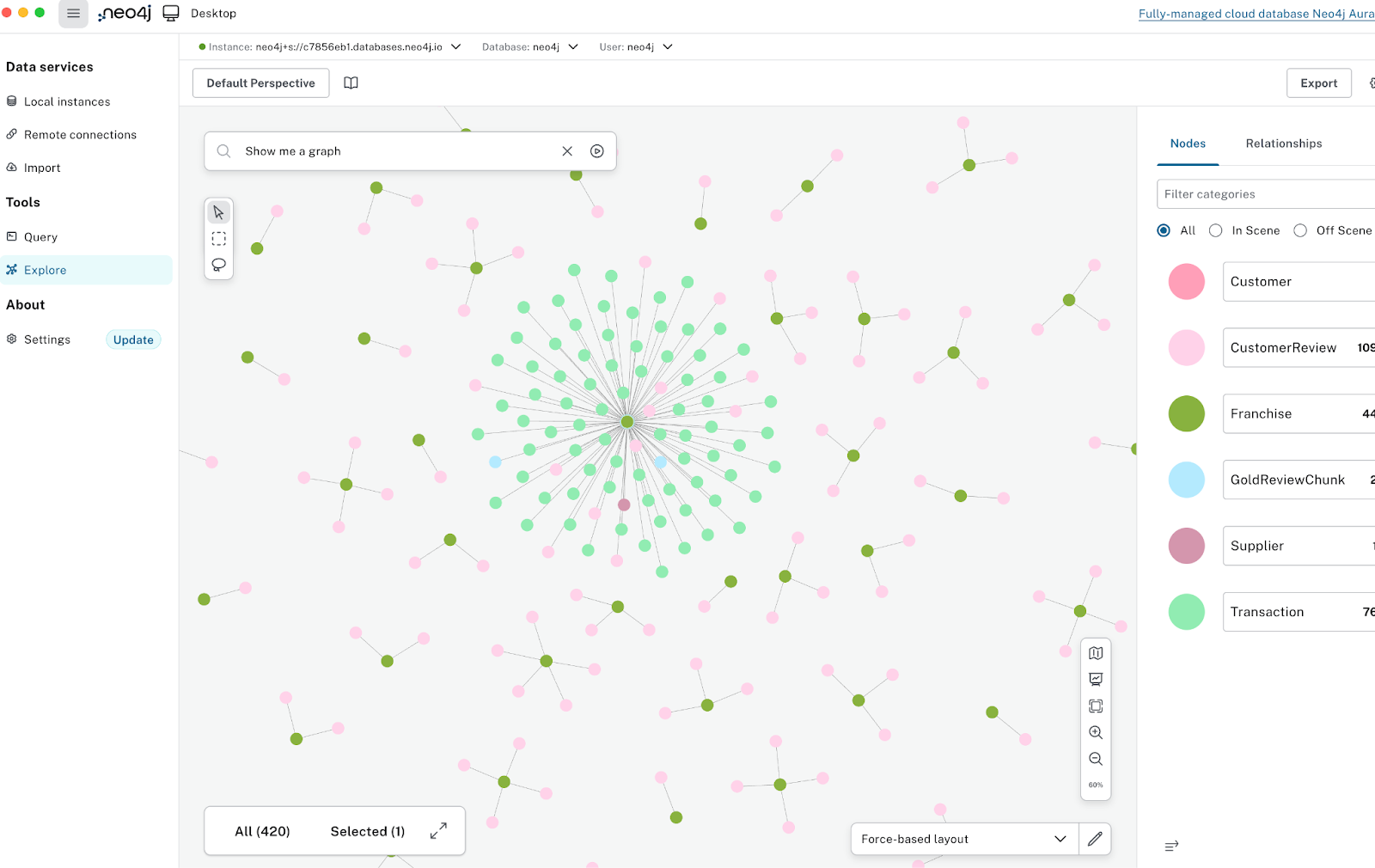
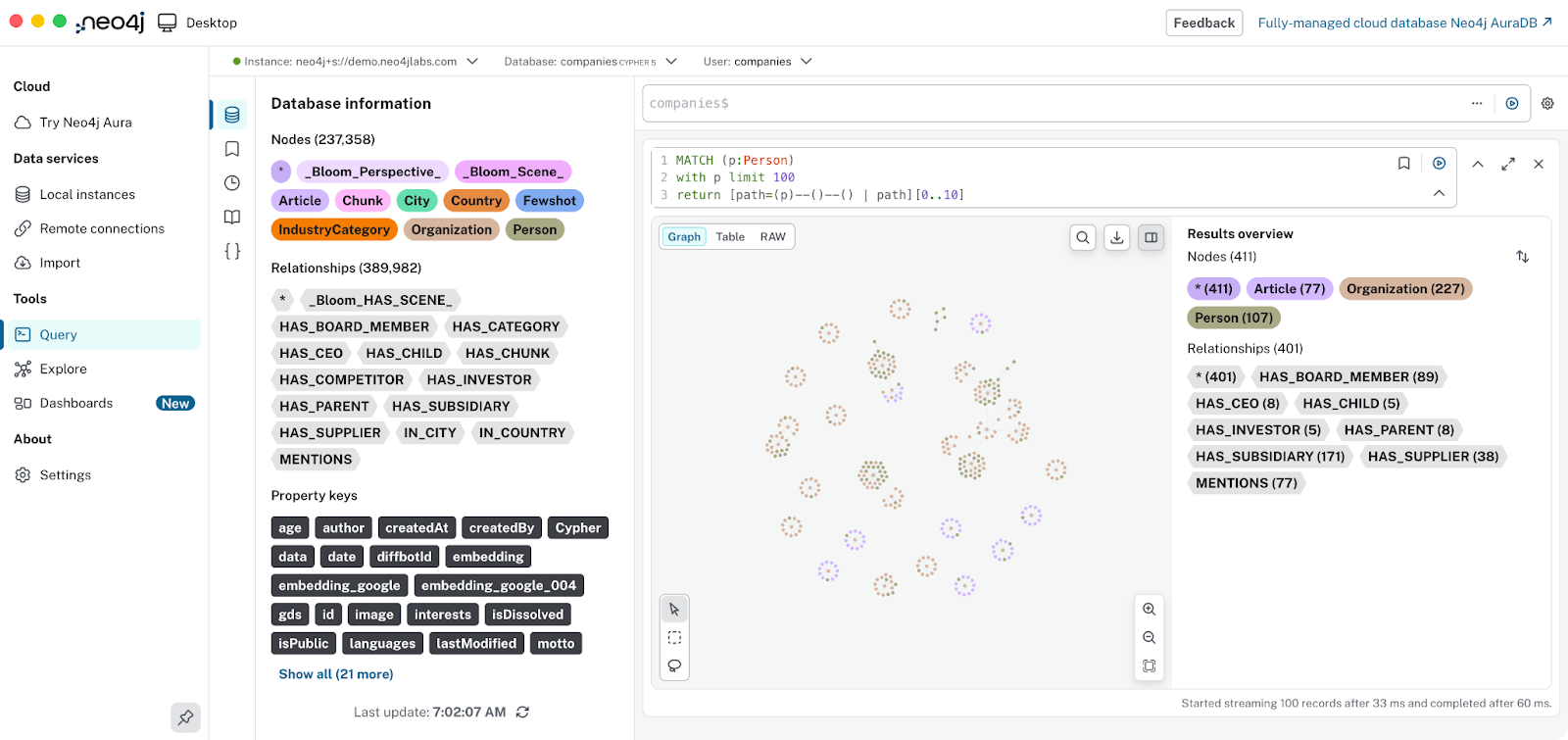
Neo4j Desktop integrates all the Graph tools you know from Aura—Query, Explore, Dashboards, and Import—to enable the same smooth local development experience.
Beyond local development, Desktop V2 serves as a critical bridge to the cloud. It enables seamless remote connections to any instance, including production AuraDB Databases, allowing for a consistent management experience across environments. To further accelerate time-to-value, we have integrated the ability to deploy to cloud and migrate local databases to AuraDB directly within the interface, ensuring that a prototype built on a laptop today can become a global “agentic brain” tomorrow.
Empowering Developers: Enhanced Developer Surfaces
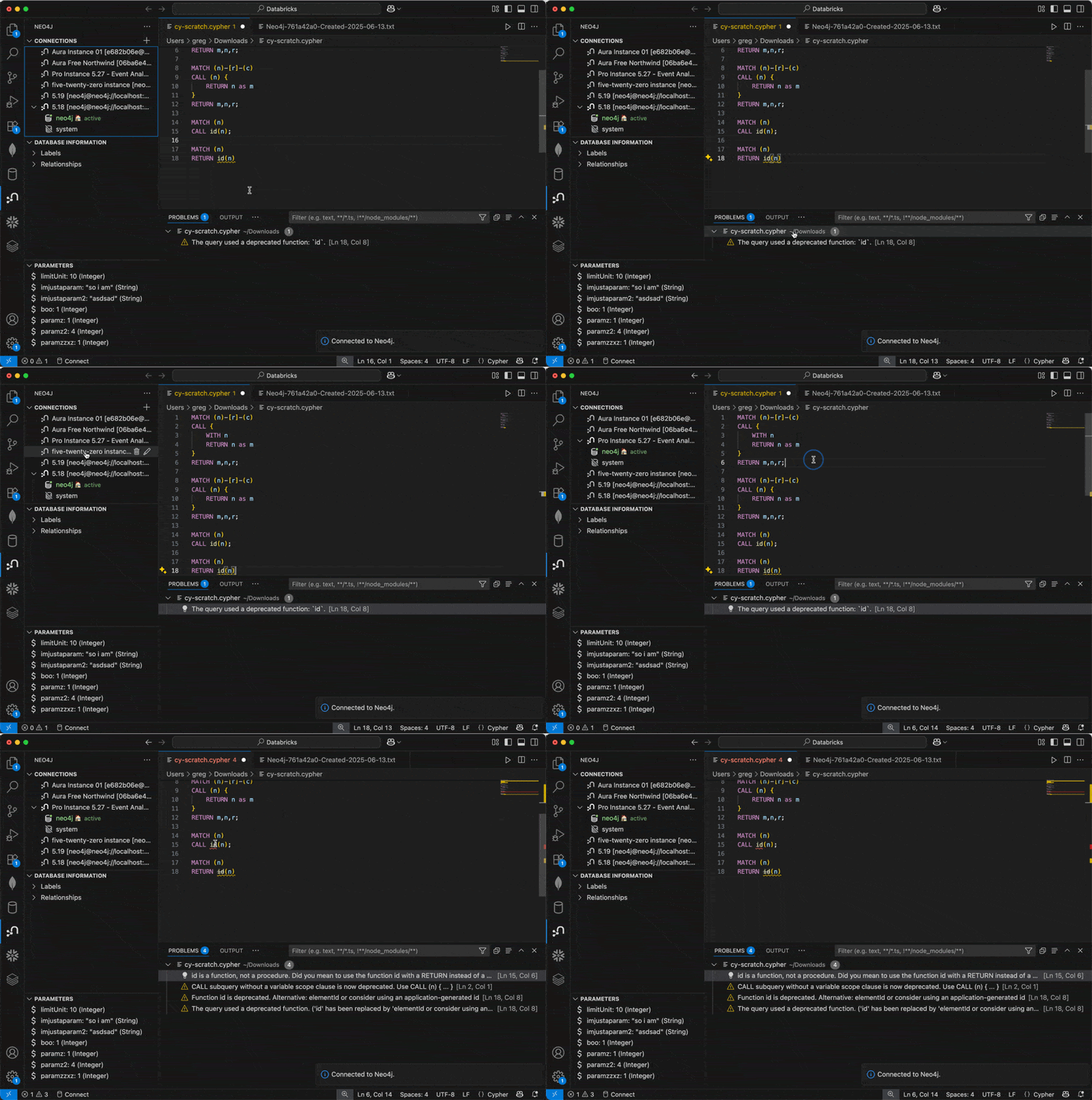
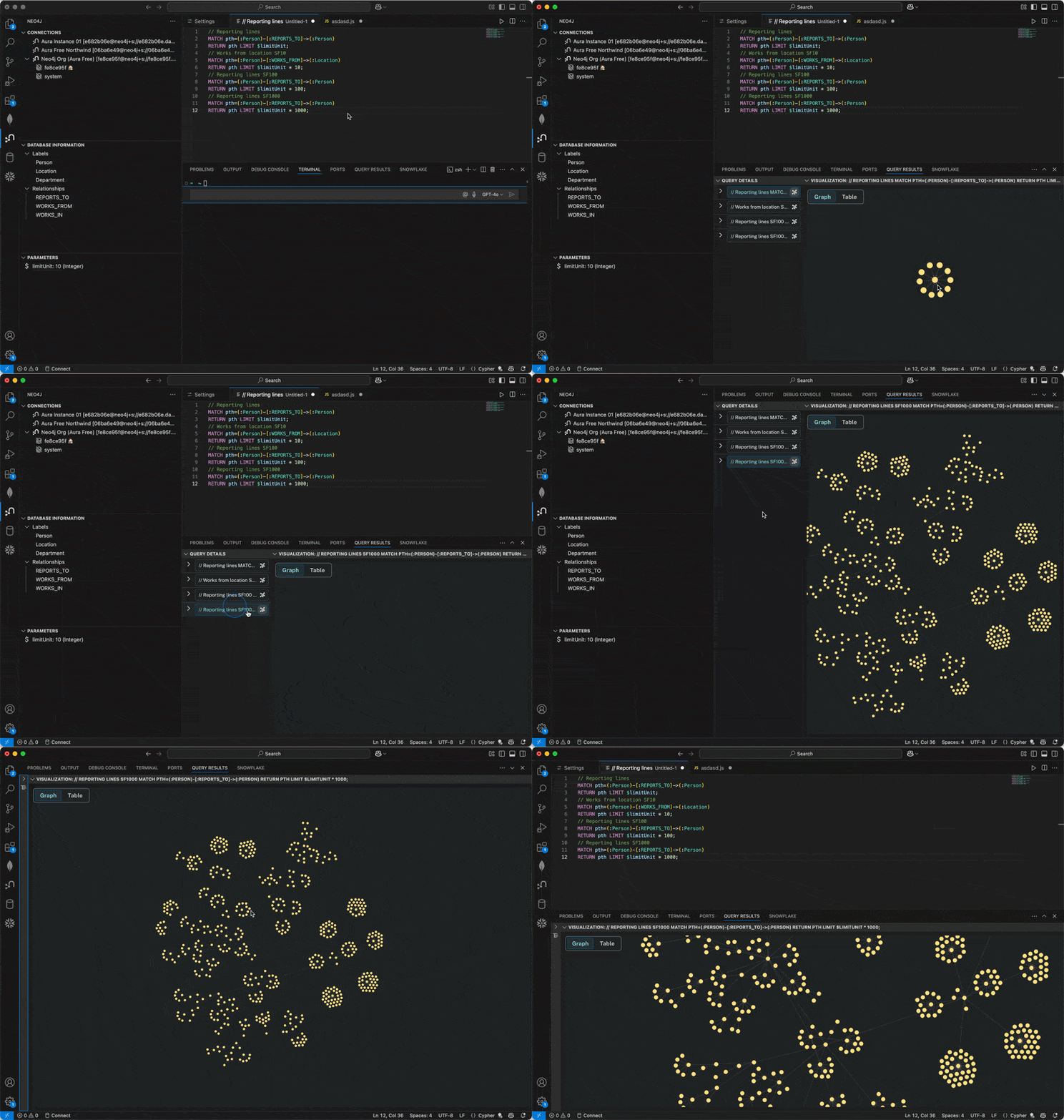
Our 2025 focus on developer productivity culminated in a suite of tools designed to make building with graph technology more intuitive and efficient than ever before. At the heart of this experience is our VS Code extension, which now supports a professional-grade development environment featuring version-specific linting, auto-completions powered by the latest Cypher grammar, and robust connection management. For the first time, developers can leverage a dedicated Query results panel within VS Code, providing the same rich graph and table visualizations they have come to rely on in Neo4j Query.
To ensure Neo4j integrates seamlessly into the broader enterprise stack, we have delivered critical updates across our API and driver landscape:
- Advanced JDBC Driver: This driver facilitates deep tool integrations by supporting SQL-to-Cypher translation and intelligent schema mapping, allowing traditional SQL-based tools to interact natively with the graph.
- Low-Code GraphQL Library: We have enhanced the Neo4j GraphQL library and service, enabling developers to deploy enterprise-ready APIs with minimal code, bridging the gap between front-end requirements and back-end graph power.
- High-Performance Query API: Our Query API (Cypher over HTTPS) provides a streamlined way to execute single Cypher requests with responses returned in standard JSON, making it ideal for modern web applications and serverless functions.
Graph AI Layer: Powering Agentic Systems through Graph Intelligence
Neo4j Aura Agent: Accelerating the Path to Multi-Hop Autonomous Intelligence
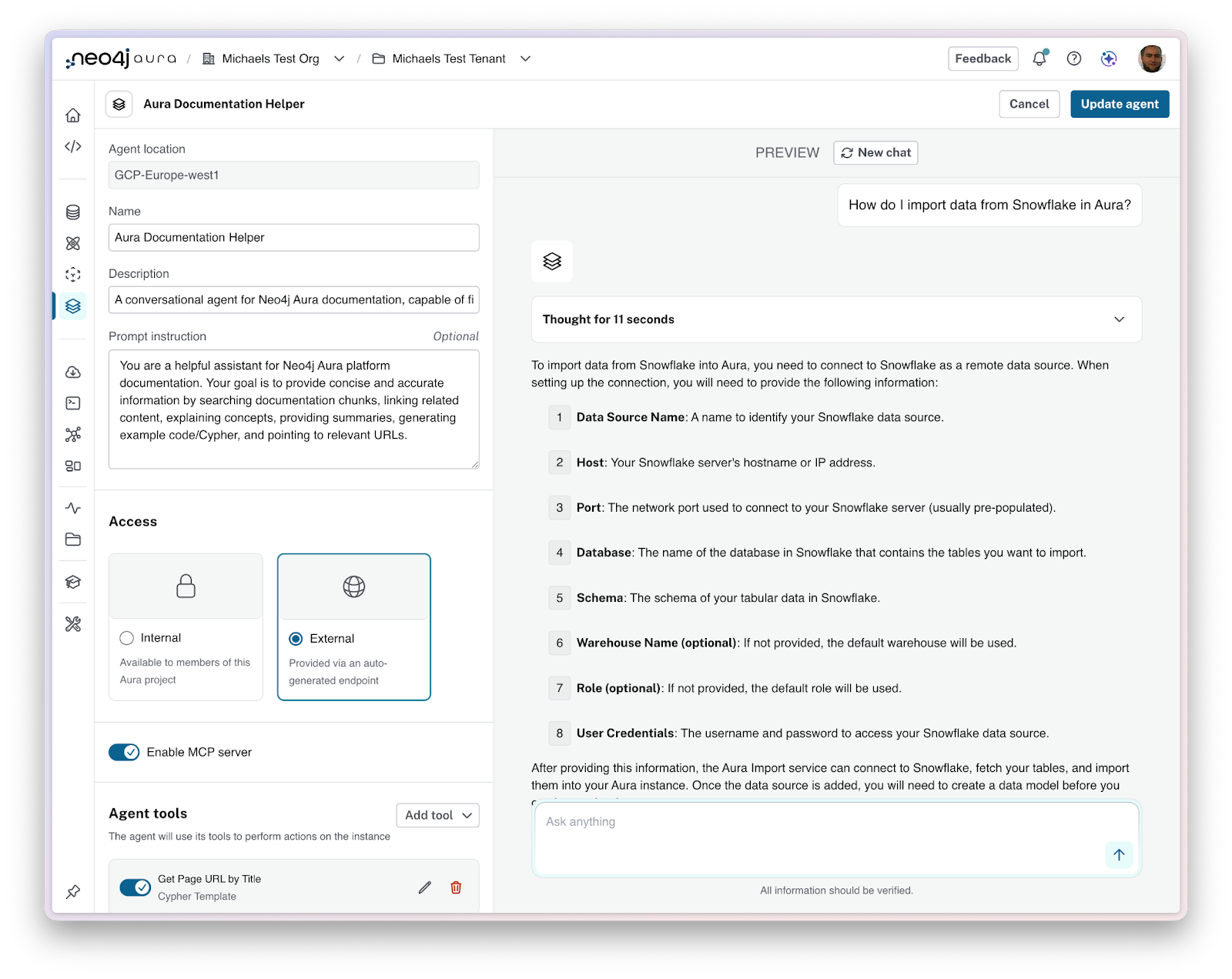
The centerpiece of our Graph AI layer is Aura Agent, a revolutionary no-code/low-code environment that enables developers to build and deploy sophisticated, multi-hop agents in seconds. This platform democratizes the creation of agentic systems by providing an intuitive Admin UI, including a create with AI feature that auto-constructs agents customized to your knowledge graph and use cases, while natively integrating powerful GraphRAG tools, including Cypher, Vector Search, and dynamic text-to-query execution.
For flexible vector search, Aura Agent supports embedding models from Azure OpenAI and Google Gemini, coupled with a built-in Agent Test UI for rapid prototyping and iteration through chat. Once ready, agents are immediately accessible via a hosted Model Context Protocol (MCP) Server and an AuraDB API REST endpoint, enabling seamless integration with any enterprise application. With availability across AuraDB Free, Professional, and Business Critical tiers, Aura Agent turns the vision of a self-reasoning enterprise into an accessible, scalable reality.
MCP Servers: Standardizing Agentic Integration
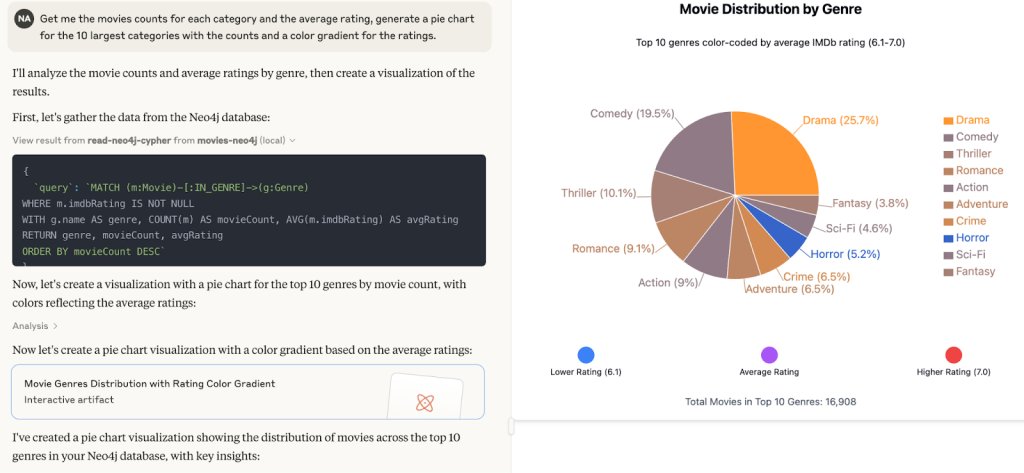
The Neo4j MCP Server allows agents to query and traverse knowledge graphs, reason over results, and trigger follow-up actions across services without manual “glue code”. Key capabilities enabled by this server include:
- Tools for Agent-Controlled Actions: Agents can now autonomously call functions like
get-schema,read-cypher,write-cypher, andlist-gds-proceduresto explore and manipulate graph data and project/execute graph algorithms. - Resources for Application-Controlled Context: MCP provides models with safe, read-only access to specific context—such as latest logs or user segments—ensuring security without sacrificing utility.
- Prompts for User-Controlled Templates: Predefined templates like
create_new_data_modelguide agent behavior, reducing prompt engineering overhead and ensuring consistent workflows. - Agent Integration: Aura Agents can be exposed as MCP servers to power integration with AI assistants and Agent Frameworks.
- Infrastructure Management: Beyond data queries, our Neo4j Labs Aura Management MCP server enables agents to list, create, or pause AuraDB instances directly from an IDE like Cursor, bridging the gap between development and infrastructure.
By treating the graph as a long-lived layer for agent knowledge, memory, and context, MCP transforms Neo4j into the backbone for reasoning, planning, and action in the next generation of agentic systems. A hosted MCP server will be available on Aura soon.
Vectors as First-Class Citizens
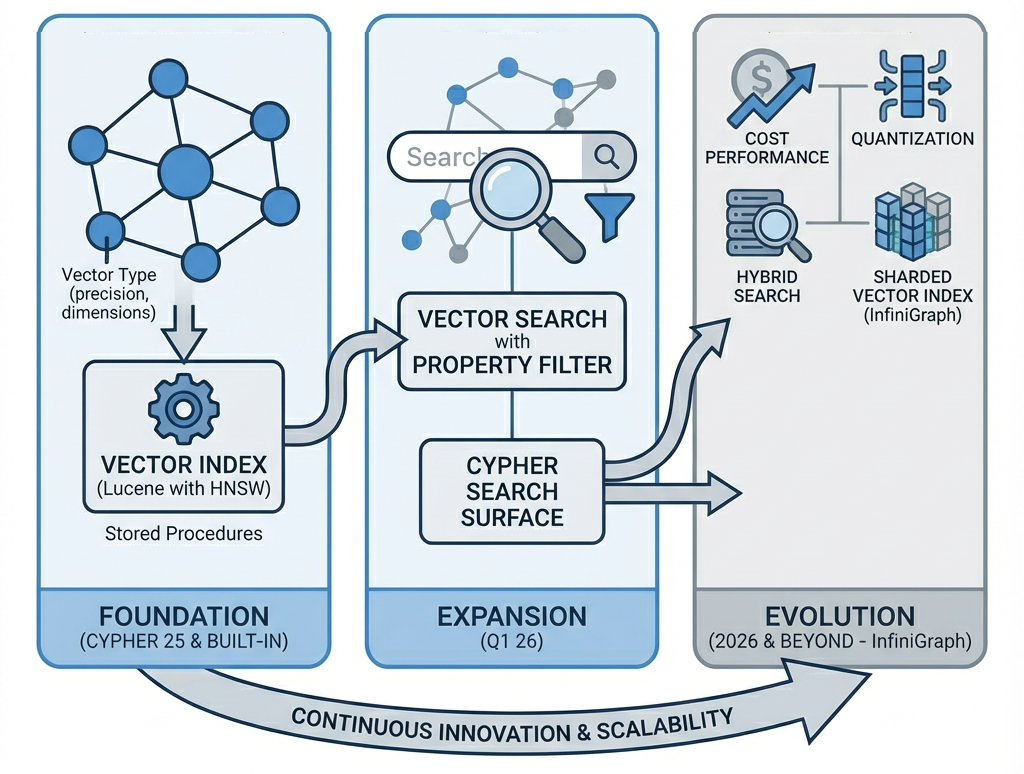
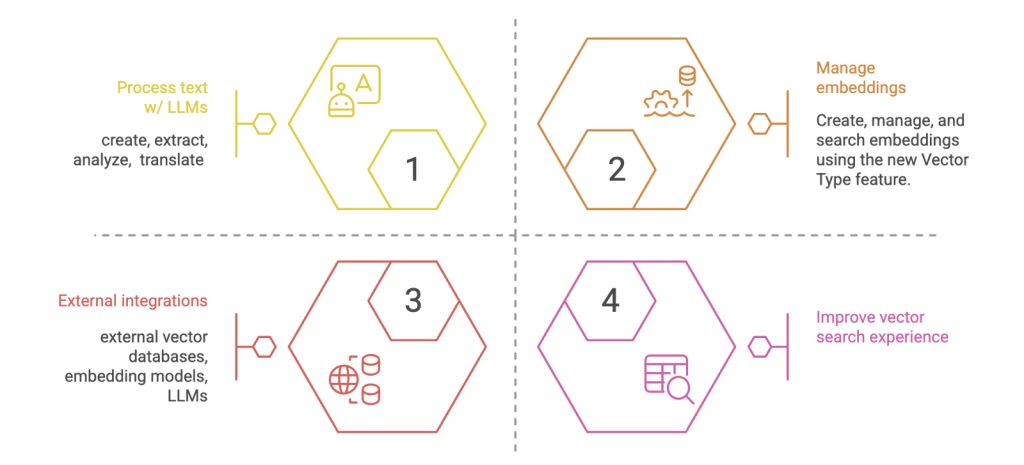
In 2025, Neo4j completed a foundational shift by introducing the native VECTOR data type, elevating embeddings from simple lists of floating-point values to first-class citizens within the database. This native integration, available in Cypher 25, ensures that embeddings are stored and processed with maximum efficiency and strict data integrity.
The core advancements with vectors as first-class citizens include:
- Native Storage and Type Safety: Embedding properties can now be stored on nodes and relationships as dedicated
VECTORtypes. Using property-type constraints, organizations can enforce specific dimensions (up to 4,096) and coordinate types (e.g.,FLOAT32,INT8), protecting indexes from malformed data. - Seamless Embedding Generation: Developers can generate embeddings directly within a query using the new
ai.text.embed()andai.text.embedBatch()functions. These functions provide native, streamlined connectivity to top-tier providers, including OpenAI, Azure OpenAI, Google Vertex AI, Amazon Bedrock, and local models. - Built-in Vector Indexing: Our vector indexes are now natively optimized for the
VECTORtype, utilizing Apache Lucene’s HNSW (Hierarchical Navigable Small World) implementation for high-performance approximate nearest neighbor searches, including quantization. - Advanced “In-Index” Filtering: A major breakthrough in Neo4j 2026.01 introduced vector search with filters, allowing users to apply metadata predicates (like
published_year >= 2020) inside the vector index during execution. This eliminates the need for costly post-filtering and ensures consistent low-latency retrieval for more complex GraphRAG queries at scale. - Unified Search Surface: Cypher 25 provides a powerful new syntax for combining vector similarity with rich graph traversals. Whether performing pre-filtering to identify a candidate subgraph or using the
SEARCHcommand for in-index filtering, Neo4j offers a single, cohesive surface for all semantic and symbolic search needs.
Cypher AI Functions: Delivering “Pure Cypher” GraphRAG
In December 2025, we officially moved from “almost” pure Cypher to a fully AI-native query language with the introduction of the ai.* namespace. This new suite of functions and procedures allows developers to execute the entire GraphRAG lifecycle—from generating embeddings to LLM text completion—entirely within Cypher.
- Integrated AI Functions: Key additions include
ai.text.embedandai.text.embedBatchfor high-efficiency embedding generation, as well asai.text.completionandai.text.chatfor direct interaction with LLMs like OpenAI, Vertex AI, Amazon Bedrock, and local models. - Native Vector Support: We introduced support for native vector data types with specific dimensions and precision, enabling more efficient storage and seamless interoperability between embedding outputs and vector indexes.
- New Namespace: The new API follows a consistent
ai.[noun].[action]naming scheme and requires explicit model definitions. This architectural choice prevents the silent failures common to default models and ensures that developers retain full control over their AI workflows as models evolve or are deprecated. - Advanced Logic: With the ability to run these procedures directly in CYPHER 25, users can now combine vector search, graph traversal, and LLM reasoning in a single query, significantly reducing the complexity of building intelligent, context-aware applications.
Bringing Graph Intelligence to the Ecosystem
When it comes to providing graph intelligence on your data assets, we don’t want to stop at the data that already lives inside a Neo4j database. In fact, our vision is to provide graph intelligence everywhere. To that end, we are really proud of these important milestones hit in 2025.
Neo4j Graph Intelligence for Microsoft Fabric
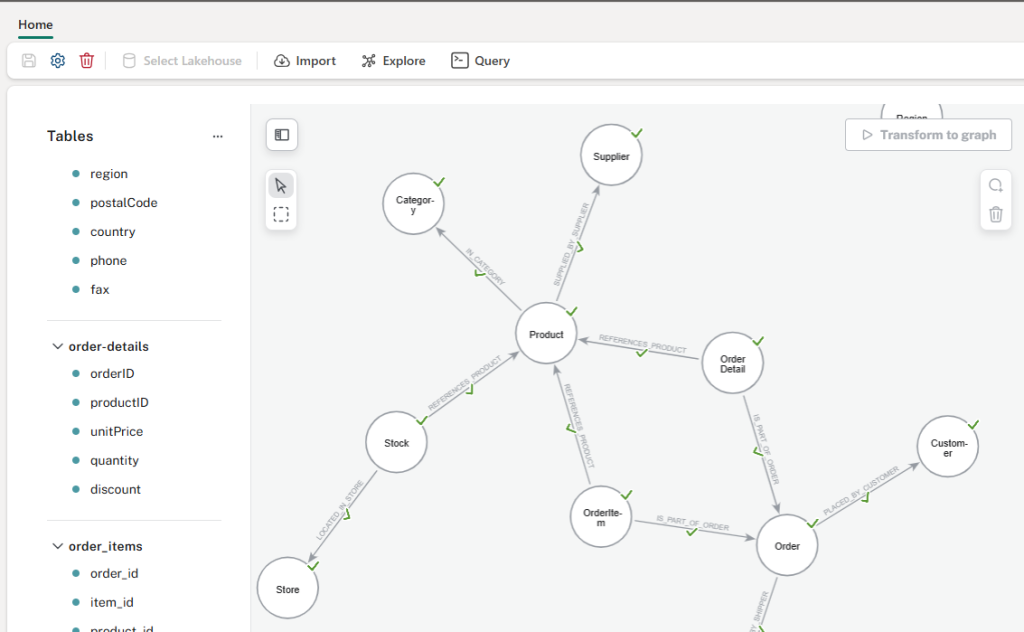
The Neo4j Graph Intelligence workload for Microsoft Fabric became Generally Available in Q4 2025. With this workload, Fabric customers can now easily uncover new connected insights from their OneLake tables. With zero administrative overhead, AI-assisted graph modeling, and seamless Fabric integration, you can harness the power of intuitive no-code exploration and advanced graph algorithms to enrich your OneLake tables with graph-powered insights—all in a fully managed, secure, and scalable Azure environment.
Graph Analytics for Snowflake
The Neo4j Graph Analytics application for the Snowflake AI Data Cloud was another incredible integration we delivered in the year 2025. Graph Analytics for Snowflake delivers highly optimized, enterprise-ready graph algorithms that can dramatically improve business outcomes across hundreds of use cases—including fraud detection, supply chain management, and customer 360—and you can use them to solve some of the most complex challenges in analytics and data science. A zero-ETL offering using serverless and elastic compute, Graph Analytics for Snowflake allows you to rapidly generate deeper insights from your Snowflake data using familiar SQL—no specialized graph expertise required.
Databricks Connector for Neo4j
The Neo4j Spark connector has seen incredible adoption in the Databricks ecosystem. We saw 200+ joint customers of Neo4j and Databricks make use of this connector to move data between Neo4j and Databricks in order to gain graph-y insights from the connections and relationships hidden in tabular data. The connector makes it seamless to set up data pipelines between the two systems, enabling customers to achieve the best of both worlds.
Committing to a Future of Innovation and Growth
As we begin 2026, we’re energized by our progress and committed to pushing the boundaries of what’s possible with the Neo4j Graph Intelligence Platform to transform data into knowledge for our customers. The top 5 capabilities I am most excited about for 2026 are:
- Cross-Cluster Replication (Scalability & Reliability) enables seamless data synchronization across any environment, including multiple data centers, cloud platforms, and hybrid self-managed to AuraDB configurations, establishing Neo4j as a Tier 1 enterprise platform capable of delivering a near-zero RPO and a 15-minute RTO.
- Multi-DB & Support for 2TB/5TB Databases (AuraDB Scalability) supports enterprise-scale workloads with database configurations up to 2TB of memory and 5TB of storage on Business Critical and Virtual Dedicated Cloud (VDC) tiers, while the new Multi-DB capability allows customers to consolidate multiple databases within a single instance to drive significant cost efficiency, accelerate growth through rapid scaling, and simplify resource management.
- Ontologies as 1st Class Citizen (Graph AI): The upcoming Ontologies as a First-Class Citizen feature introduces a top-level, independent modeling tool with a repository of use-case-specific samples and native graph schema enforcement, enabling teams to collaborate on, export, and strictly govern data models to ensure project success and seamless integration across external data pipelines.
- AI Memory and Context Graphs (Graph AI – Agentic Brain): We will launch dedicated capabilities to simplify the creation of Graph from unstructured documents at scale, AI memory, and Context Graphs, enabling developers to build sophisticated agentic systems that leverage Neo4j as a persistent, structured reasoning engine for long-term learning and grounded decision-making.
- Agent Ecosystem (Graph AI): Integrate with a modern AI ecosystem by providing seamless, bidirectional integration with leading AI Frameworks (such as LangChain and LlamaIndex), Agent Frameworks (like Strands, ADK, and LangGraph), and major Enterprise Agent Platforms (including AWS AgentCore, Salesforce AgentForce, Microsoft Foundry) to power advanced GraphRAG, persistent agent memory, and reasoning-capable autonomous systems.
Share Article



Explore
Related Articles

Why Healthcare CIOs Can’t Afford to Scale AI Without a Knowledge Graph Foundation