How QuantumSpace eradicates art forgery with graph-powered visual authentication
Startup extracts up to 60,000 data points from a single painting and maps them in Neo4j AuraDB, turning centuries of subjective connoisseurship into mathematical proof of authenticity.
60,000
Data points per artwork
50+
Distinct data sets per image
7 months
Hand-built schema design
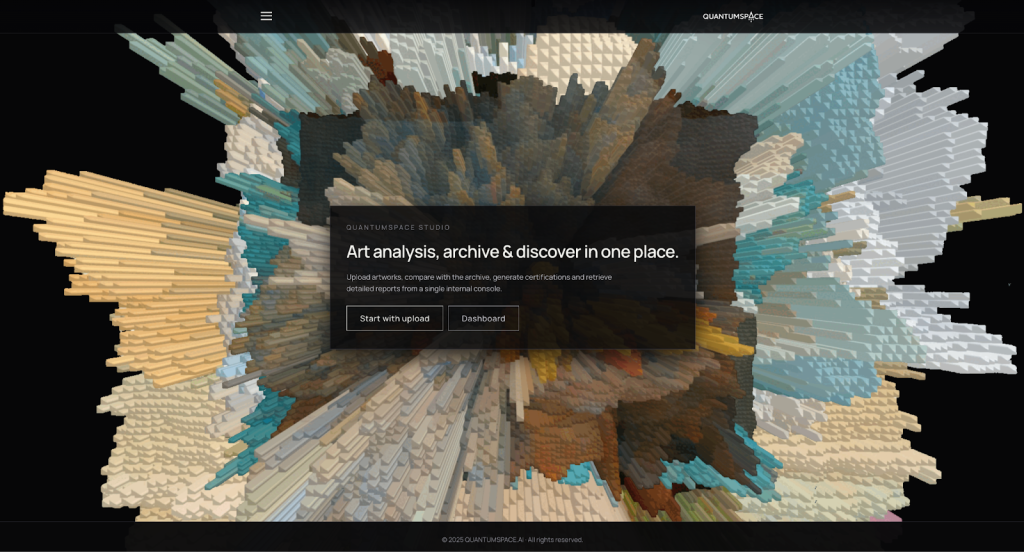
Above: QuantumSpace UI entry point.
QuantumSpace began as a master’s thesis. Francesco Rocchi, now COO, ran an experiment at Kingston University in London postulating that an artist’s cognitive process could be mapped by extracting data from their artworks. At the time it was purely theoretical — computational power was too limited and the tools did not exist. When the first wave of GenAI tools arrived, Rocchi and Head of Development Leonardo Viola started experimenting and realized they could extract far more structured data from images than anyone had anticipated. Today QuantumSpace pulls 50,000 to 60,000 data points per artwork across dozens of data sets: color, surface physics, condition, historical provenance, and more.
“We realized there were relationships we were not expecting—like colors that would not be used in a specific city in a specific year because the trading company did not import enough. You see currents shaping around the data.” — Francesco Rocchi, COO, QuantumSpace
QuantumSpace’s purpose is direct: quantify what human experts can only intuit. The global art market contracted 12% in 2024 to $57.5 billion, with AI-driven fraud surging 1,740% in North America. When human forgery detection hovers around 55–60%, the industry needs a system as sophisticated as the threat.
A relational database cannot provide it. Flattening into rows the rich, multidimensional relationships that define whether a brushstroke is genuine would make them unusable and require tens of thousands of JOIN operations to query and analyse. A brushstroke’s authenticity depends on its spatial relationship to neighboring strokes, the kinetic pressure of the artist’s hand, and the specific layering of semi-transparent pigments. The data is inherently a network, not a table. QuantumSpace needed a system where relationships carried the same weight as the data points themselves. That led to Neo4j.
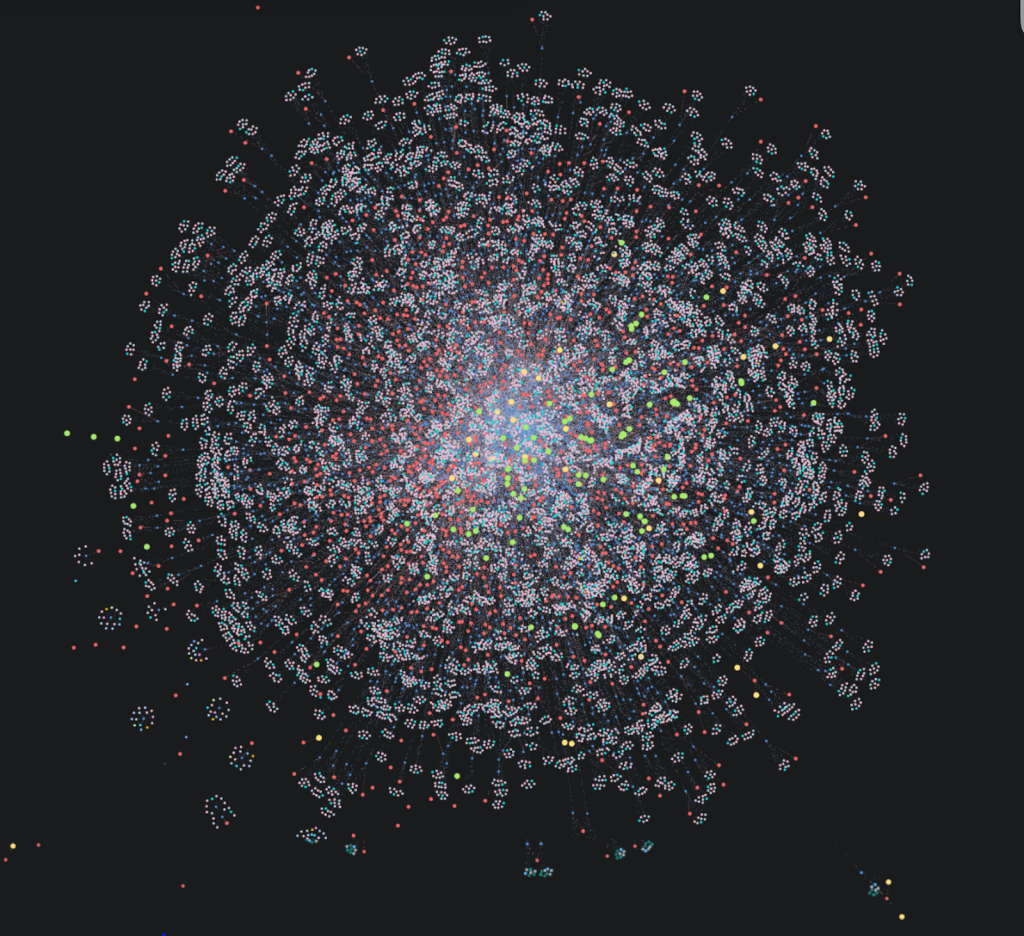
Above: Global context perspective.
Selecting Neo4j and building the solution
Viola and Data Lead Davide Chieregato had used Neo4j at a previous data company to map contract lineage. When they founded QuantumSpace, they knew graph would be central. The Neo4j Startup Program provided the credits and support to get started, and AuraDB eliminated infrastructure overhead.
Neo4j let the team see where data was dense and where unexpected relationships existed. Chieregato connected QuantumSpace’s color data to Neo4j’s node rendering, so the team could see pigment shades directly in the graph — transformative for a team analyzing color relationships.
“The main good thing we found was visually seeing where to put our attention. We can see distribution of nodes—here there’s more data, here there’s a relationship we don’t know what it is—and we start exploring.” — Francesco Rocchi, COO, QuantumSpace
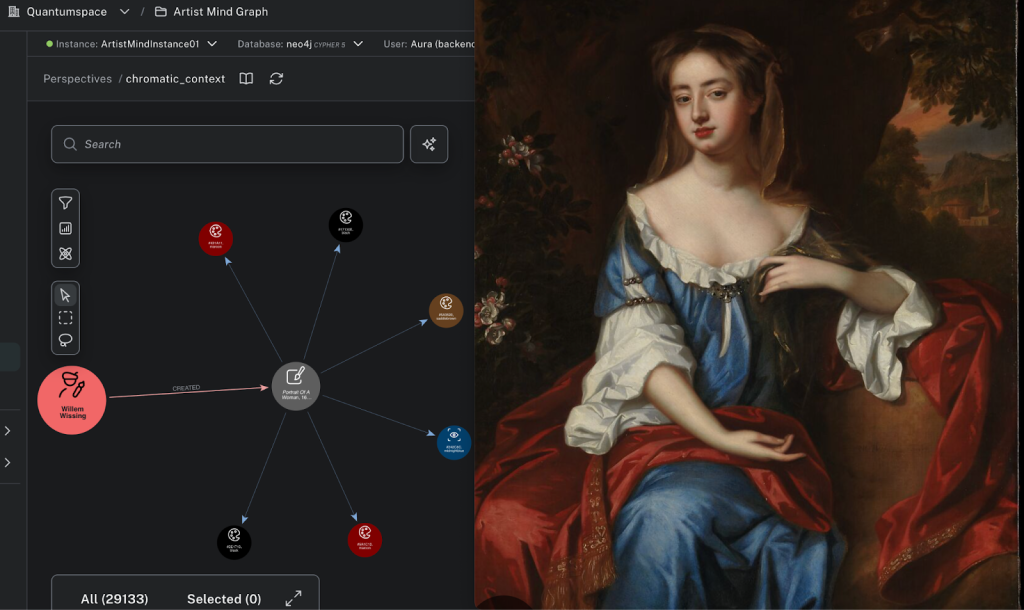
Above: Single artwork chromatic extraction visualized as nodes (most relevant and eye-catching shades) within the chromatic perspective.
Neo4j’s ability to layer relationship types proved decisive. Hard, canonical facts like artist, city, date coexist with softer inferred relationships like similar color profile or tonal pattern, all intersectable with period and geography.
“One of the greatest parts of Neo4j is the possibility to layer different types of relationship. We can have hard relations—artworks created by an artist, created in a city—and other types like similar color or similar tones, intersected with contextual information like period and location. Neo4j becomes the knowledge layer.” — Leonardo Viola, Head of Development, QuantumSpace
Neo4j’s pattern-based query language, Cypher, also proved critical. Chieregato noted that it helps describe how data is related in terms that even non-technical users can follow: essential for a team whose clients are art historians, museum directors, and investment bankers, not engineers. And as the number of artworks and extracted features grew, Neo4j’s scalability maintained high performance on both query execution and rendering across dense, complex networks.
The architecture now positions Neo4j as the knowledge layer atop a columnar data warehouse, with a RAG system using Vertex AI Search on top. The data warehouse stores all extracted features. Neo4j maps the relationships between them and powers inference. On top of this, QuantumSpace is building an AI layer that grounds answers in real, structured graph data rather than probabilistic guesswork.
The schema took seven months to build, entirely by hand. The team sat together and wrote every relationship, assigned weights, and estimated probabilities of meaningful connections. That painstaking work became their core intellectual property, and they refine it weekly as new data types appear.
Their most critical breakthrough: making data stable regardless of how an image is captured. Different cameras and lighting produce different raw values, but the relationships between adjacent data points remain constant. That insight validated graph as the right architecture and unlocked a quality-weighting system that adjusts confidence based on image fidelity.
“The yellow can be a different yellow. But if the relationship between that yellow and the one next to it is the same, the couple is the same. The relationships are stable. That’s what we found out.” — Francesco Rocchi, COO, QuantumSpace
Validating the model
A major institution submitted an attributed Caravaggio. Color density: 100% match. Physical layer and crack patterns: consistent with age. Brushstroke accountability: zero. The team feared an error—until the institution realized it had never recorded that the painting had been restored. The original brushstrokes were gone. The system was correct.
“We thought: oh my god, we have to tell them we made a mess, or it’s a fake. But what happened was they forgot to note in their archive that the painting had been restored. The system was correct.” — Francesco Rocchi, COO, QuantumSpace
That moment opened an entirely new line of work. QuantumSpace now receives scans before and after every restoration, grading exactly how a work has changed. When collections loan artworks, roughly 15% sustain damage in transport. A graph comparison pinpoints exactly where — information the lending institution often lacks.
Before Neo4j, the team struggled to explain their work to an industry that had never operated scientifically. The company now auto-generates 40-page PDF reports with AI-written explanations and graph visualizations for every analyzed artwork.
“As soon as we made them visualize it—that’s when they understood what a breakthrough this was. Some got scared. There is a lot in this market that is opaque willingly, and we are just exposing it.” — Francesco Rocchi, COO, QuantumSpace
Explore the Caravaggio use case or read the Caravaggio authentication report.
From oil paintings to earthquake prediction
QuantumSpace was originally built for museums, schools, and investment banks. That scope expanded almost immediately. The fashion industry approached them to authenticate luxury goods. The automotive industry sought visual damage tracking. Clients with massive image archives wanted to interrogate their own collections, asking questions of images as naturally as they would query a text database.
The most ambitious partnership under discussion involves a European space agency. QuantumSpace’s crack-mapping algorithms, originally built to track micro-fissures in aging oil paintings, may apply to satellite imagery, counting surface cracks in terrain to help predict seismic activity. A quantum computing firm is separately testing real quantum walks across QuantumSpace’s Neo4j-backed archive. The digital art authentication market is projected to reach $6.5 billion by 2034.
With graph data science now coming online, the team is shifting from exploratory analysis to structured, business-oriented analytics, converting the patterns they’ve been discovering visually into insights. The company is also building an inference engine to surface correlations not reachable through direct queries.
“The support from Neo4j was huge. The credits were fundamental—we didn’t have the resources at our starting point. And AuraDB allowed us to focus on data modeling and ingesting our data rather than controlling infrastructure.” — Leonardo Viola, Head of Development, QuantumSpace
Beyond art: The semantic layer
What began as a system for authenticating oil paintings quickly revealed a broader truth: the graph architecture underlying QuantumSpace is inherently domain-agnostic. The same approach that maps pigment relationships across the archive, or the geographical and chronological context of an artistic movement, can be applied to any visual content.
Neo4j’s flexibility allowed QuantumSpace to generalize their visual analysis engine beyond art, building a semantic layer capable of extracting and organizing objects, subjects, and their co-occurrence relationships from any source image. The resulting homogeneous graph maps what co-exists, and how often, and how strongly.
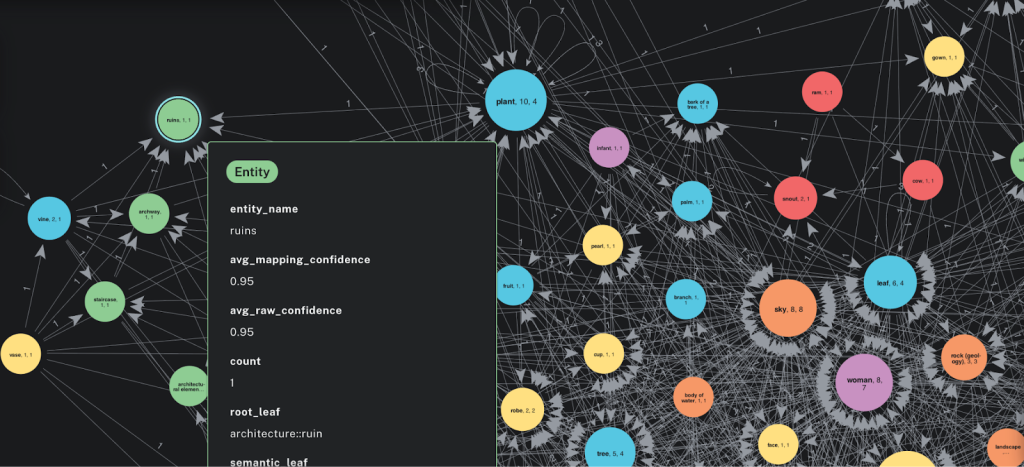
Above: Semantic graph perspective.
To make that knowledge accessible, QuantumSpace built a native graph agent on top of the AuraDB instance. Rather than requiring hand-crafted Cypher queries, the agent lets non-technical users ask questions in plain language, and returns not just data, but interpretation based on the context and instructions provided during creation. It navigates frequency, per-image occurrence, and co-occurrence intensity, surfacing statistical signals that separate meaningful patterns from noise. It identifies visual hubs, flags anomalous relationships, and suggests follow-on analyses rather than stopping at a table of results.
Beyond direct query and agent retrieval, Neo4j’s performance and graph structure allow QuantumSpace to run deeper downstream analysis pipelines, including optimization algorithms that work directly on the graph to shape the most probable solution from a given set of relationships. This feeds directly into QuantumSpace’s inference model, that grows more accurate over time, turning every analyzed image into a valuable asset for decision-making.
The knowledge layer for trustworthy AI
Your enterprise AI systems are only as good as the context behind them.

-
 Google Cloud Platform
Explore more