Connected Intelligence: Scaling Graph-Powered Reasoning Across the AI Ecosystem


6 min read
The question enterprises are grappling with right now isn’t whether to deploy AI agents — it’s whether those agents can actually reason.
While Retrieval-Augmented Generation (RAG) and vector search have moved the needle, many teams are hitting a “reasoning wall.” They’re discovering that agents often fail when they don’t understand how data points are connected or what those connections mean in a specific business context.
Graphs have always been the answer to that problem. What changed in Q1 2026 was the depth to which our partners helped bring that answer to market. The pattern is undeniable: when graph intelligence meets the platforms where enterprise data already lives, teams achieve results that they simply couldn’t before.
Here’s a look at the “Better Together” milestones that defined our first quarter.
Accelerating startup innovation on Google Cloud
Neo4j and Google Cloud have been working together to give high-growth startups a faster path from AI experimentation to production deployment. This collaboration provides early-stage companies with a production-ready graph architecture from day one so they can bypass the months of engineering toil usually required to build it from scratch.
This quarter, we highlighted the success of leaders like Arhasi, BenchSci, and Infinitus, who are leveraging our joint architecture to drive rapid customer outcomes. By grounding their AI agents in Neo4j on Google Cloud, Arhasi, an AI solutions company, delivered a 370% ROI and $1.2M in annual savings for its customers — while compressing time-to-value from 6 months to 6 weeks. The graph layer serves as the foundation of trust required to move these agents into production.
To make this kind of architecture more accessible, the Neo4j Startup Program is now listed on Google’s startup perks site. If you’re building on Google Cloud and want to explore how graph helps emerging leaders to build production-ready AI with context and accuracy, that’s a good place to start.
Growing customer value with AWS
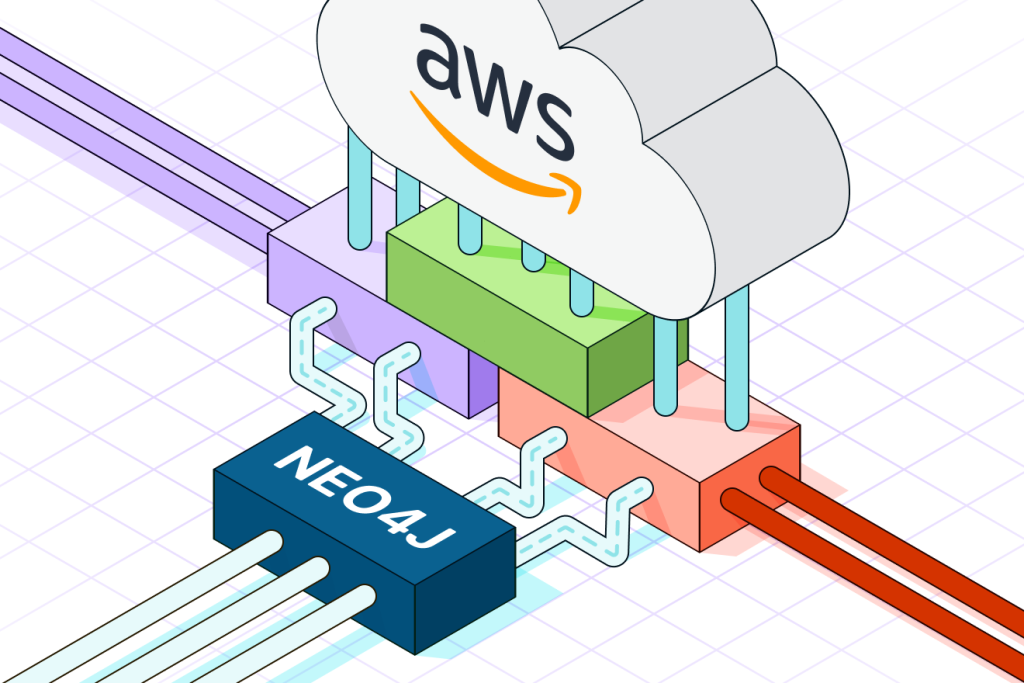
Neo4j has earned three new AWS specialization competencies: Government, Life Sciences, and the inaugural Agentic AI Specialization. These designations reflect tested, validated architectures for regulated and mission-critical environments where accuracy and auditability aren’t optional.
The U.S. Army‘s logistics modernization offers a concrete illustration of what that looks like at scale. Migrating from legacy infrastructure to a 3TB Neo4j graph database with over 14 billion relationships, the Army reduced data loading and analysis time from 60 person-hours to eight. Analysts who previously couldn’t run complex scenario modeling in real time can now do it on demand. And a maintenance team that required nine people to operate now runs on two.
By combining Neo4j graph intelligence with AWS-native services such as the new AWS Glue connector and Amazon EKS support, teams can deliver production-ready Agentic AI that solves the “reasoning gap” while leveraging frictionless procurement via pay-as-you-go billing on the AWS Marketplace.
Enhancing Azure AI agents with persistent graph memory
At the core of the latest AI wave is the need for agents to “remember” and reason through complex user interactions. In our latest technical collaboration with Microsoft, we’ve integrated Neo4j with the Microsoft AutoGen Framework to solve the persistent challenge of agentic memory.
By using a Neo4j knowledge graph as the persistent memory layer, developers can build agents that accumulate and reason over context across conversations — not just within a single session. For teams building on Azure OpenAI Service, this means agents grounded in structured, verifiable memory rather than ad hoc retrieval—fewer hallucinations, better reasoning, and behavior that’s easier to audit and explain.

Embedding native graph intelligence in Databricks Unity Catalog
For teams working in Databricks, accessing graph data has historically meant managing separate systems and building custom pipelines between them. A new Neo4j Connector for Databricks Unity Catalog — coming soon via Neo4j Labs — is designed to change that.
Once available, Databricks users will be able to discover and query Neo4j graph assets directly through Databricks Genie, treating them the same way they’d treat any other table in their Lakehouse. No separate query interface, no bespoke ETL. Just graph data, available natively inside their environment.
By leveraging the Neo4j Connector for Apache Spark, teams can bridge the gap between structured lakehouse data and graph-native insights. As outlined in Power Connected Intelligence for AI and Analytics, this synergy enables real-time traversal of relationships across billions of connections. A prime example of this in production is Capgemini’s approach to turning data into connected intelligence, which uses a specialized GraphRAG architecture to ground AI agents in trusted enterprise context.
Integrating Neo4j graph agent inside Snowflake Intelligence
For Snowflake users, a new frontier for graph-powered reasoning is now in public preview: the Neo4j Graph Agent for Snowflake Intelligence. Rather than routing queries to a separate system, this integration brings connected reasoning directly into the Snowflake environment. By achieving Cortex AI Ready status, Neo4j is now validated to power Snowflake’s Cortex agent experience—allowing users to ask natural language questions and receive answers grounded in complex, graph-structured data without ever leaving their data cloud.
This shift does more than just simplify the stack; by eliminating the friction of data movement, organizations can finally solve high-scale challenges with speed and accuracy. We’re already seeing this impact in use cases such as identity resolution, where identity provider Audience Acuity successfully resolved 3.8 billion records into unified profiles—slashing processing time from weeks to just hours. Similarly, teams are unlocking high-conversion recommendations by applying similarity algorithms directly to their Snowflake tables, turning static purchase history into predictive, relationship-aware intelligence in real time.
Announcing the Neo4j connected intelligence digital series
This quarter, we launched the Neo4j Connected Intelligence digital series. Every Thursday, we host a candid session with a different partner to showcase joint integrations, real-world use cases, and the technical “how-to” behind our biggest wins.
The path forward
As we look toward the rest of 2026, the transition from simple chatbots to autonomous Agentic AI is accelerating. But the success of these agents depends entirely on the quality of the context they are given.
The milestones from Q1 demonstrate that true intelligence is found in the links between information. Whether you are building on Google Cloud, AWS, Azure, Databricks, or Snowflake, the objective is the same: move beyond isolated data points and embrace the power of relationships. By grounding AI in a persistent, structured knowledge graph, enterprises are moving past the experimental phase. We are entering an era where AI agents are trusted, auditable, and capable of solving the world’s most complex logistical and analytical challenges.
The tools to achieve this level of sophistication are already integrated into the platforms you use every day. We invite you to explore these partnerships further, join our weekly sessions, and start building AI that does more than predict the next word—it understands the next connection.
Learn more about Neo4j and the data ecosystem.
Share Article


Explore
Related Articles
How to Set Up and Redeem Your Neo4j Startup Program Credits

New Ways to Scale and Apply Enterprise AI with Neo4j