Scalers
We offer a catalogue of well-known scalers for use across algorithms.
The catalogue of scalers
We have these scalers available (all case-insensitive):
| Scaler | Identifier |
|---|---|
Center |
|
Log scaler |
|
Max scaler |
|
Mean scaler |
|
Min-max scaler |
|
Standard score |
|
L1 norm |
|
L2 norm |
|
Details
The scalers are well understood, and are documented below.
Center
Transforms all properties by subtracting the mean.

The average value is reported as a statistic when this scaler is used.
Log scaler
Transforms all property values using the natural logarithm.
C denotes a configurable constant offset, which can be used to avoid negative values or zeros in the value space, as their logarithms are not finite values.

Max scaler
Scales all property values into the range [-1, 1] where the maximum absolute value(s) get the scaled value 1, according to this formula:
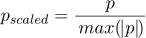
The maximum absolute value is reported as a statistic when this scaler is used.
Mean scaler
Scales all property values into the range [-1, 1] where the average value(s) get the scaled value 0.
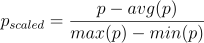
The minimum, maximum and average values are reported as statistics when this scaler is used.
Min-max scaler
Scales all property values into the range [0, 1] where the minimum value(s) get the scaled value 0 and the maximum value(s) get the scaled value 1, according to this formula:
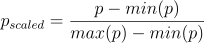
The minimum and maximum values are reported as statistics when this scaler is used.
Standard Score
Scales all property values using the Standard Score (Wikipedia).
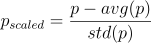
The average value and standard deviation are reported as statistics when this scaler is used.
L1 Norm
Scales all property values using the L1 Norm (Wikipedia), also known as Manhattan norm.
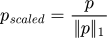
The L1 norm is useful for getting a discrete probability distribution of properties whose values are non-negative, such as PageRank or ArticleRank.
L2 Norm
Scales all property values using the L2 Norm (Wikipedia), also known as Euclidean norm.
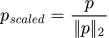
The sum of squares of scaled values will equal 1 when the L2 norm is used.