Label expression predicates
You can use a label expression predicate to verify that the labels of a node or the relationship type of a relationship match a given label expression.
Cypher® supports two label expression alternatives:
-
Colon form (
<expr>:<label-expression>) -
IS [NOT] LABELEDform Introduced in Neo4j 2026.04 Cypher 25 only
Syntax
Colon form
<expr>:<label-expression>Where <expr> is any Cypher expression and <label-expression> is any Cypher label expression.
IS [NOT] LABELED predicateCypher 25 onlyIntroduced in Neo4j 2026.04
<expr> IS LABELED <label-expression>
<expr> IS NOT LABELED <label-expression>
<expr> IS NOT <label-expression>-
If
<expr>evaluates tonull, the predicate result isnull. -
Otherwise, the label expression is evaluated against the node’s label set or the relationship’s single type, and the result is
trueorfalseequivalent to the colon form. -
IS NOT LABELED <label-expression>negates the result of the entire label expression. This is different from using!inside the label expression. For example:-
n IS LABELED !A&Bmeans the node has labelB, and does not have labelA. -
n IS NOT LABELED A&Bmeans the node does not have both labelAand labelB.
-
|
|
Example graph
The following graph is used for the examples on this page:
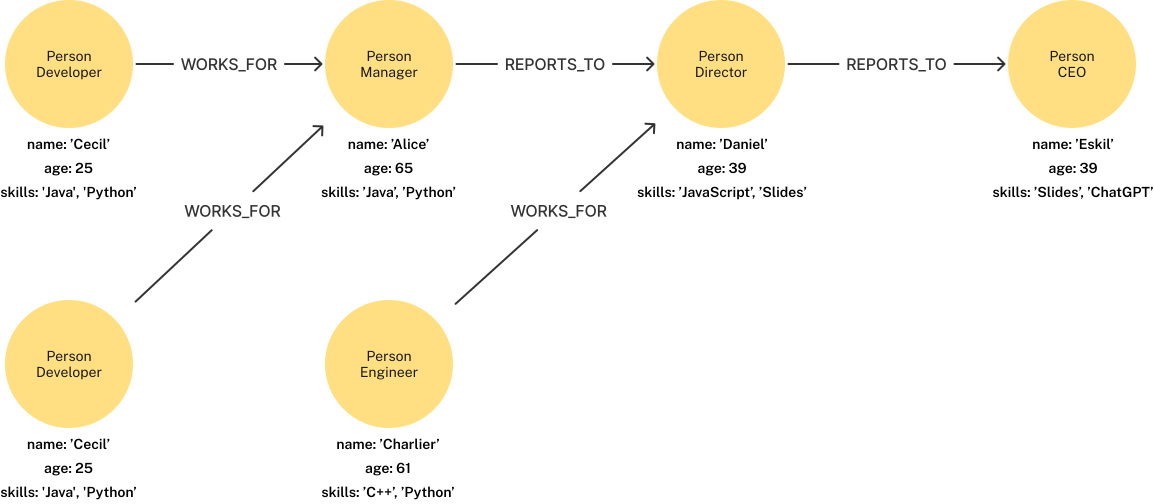
To recreate the graph, run the following query against an empty Neo4j database:
CREATE (alice:Person&Manager {name:'Alice', age: 65, skills: ['Java', 'Python']}),
       (cecil:Person&Developer {name: 'Cecil', age: 25, skills: ['Java', 'Python']}),
       (cecilia:Person&Developer {name: 'Cecilia', age: 31, skills: ['JavaScript', 'TypeScript']}),
       (charlie:Person&Engineer {name: 'Charlie', age: 61, skills: ['C++', 'Python']}),
       (daniel:Person&Director {name: 'Daniel', age: 39, skills: ['JavaScript', 'Slides']}),
       (eskil:Person&CEO {name: 'Eskil', age: 39, skills: ['Slides', 'ChatGPT']}),

       (cecil)-[:WORKS_FOR]->(alice),
       (cecilia)-[:WORKS_FOR]->(alice),
       (charlie)-[:WORKS_FOR]->(daniel),
       (alice)-[:REPORTS_TO]->(daniel),
       (daniel)-[:REPORTS_TO]->(eskil)
Test whether a node has a certain label
Given that p is a node, p:Manager tests whether p has the label Manager or not and results in true or false, respectively.
MATCH (p:Person)
RETURN p.name AS name, p:Manager AS isManager| name | isManager |
|---|---|
|
|
|
|
|
|
|
|
|
|
|
|
Rows: 6 |
|
Given that p is a node and a more complex label expression, e.g, Manager|Director|CEO, p:Manager|Director|CEO tests whether node p matches the label expression Manager|Director|CEO or not and results in true or false, respectively.
More specifically, p:Manager|Director|CEO tests whether p has at least one of the three labels Manager, Director, and CEO.
MATCH (p:Person)
RETURN p.name AS name,
p:Manager|Director|CEO AS isManager| name | isManager |
|---|---|
|
|
|
|
|
|
|
|
|
|
|
|
Rows: 6 |
|
p:!CEO tests whether p does not have the label CEO.
MATCH (p:Person)-[r]->(m)
RETURN p.name AS name,
m:!CEO AS doesNotWorkDirectlyForTheCEO| name | doesNotWorkDirectlyForTheCEO |
|---|---|
|
|
|
|
|
|
|
|
|
|
Rows: 5 |
|
When <expr> evaluates to null, the label expression predicate results in null; for example if p is null, then p:!CEO results in null.
MATCH (p:Person)
OPTIONAL MATCH (p)-[r]->(m)
RETURN p.name AS name,
m:!CEO AS doesNotWorkDirectlyForTheCEO| name | doesNotWorkDirectlyForTheCEO |
|---|---|
|
|
|
|
|
|
|
|
|
|
|
|
Rows: 6 |
|
The function coalesce allows to turn null into a default value:
MATCH (p:Person)
OPTIONAL MATCH (p)-[r]->(m)
RETURN p.name AS name,
coalesce(m:!CEO, false) AS doesNotWorkDirectlyForTheCEO| name | doesNotWorkDirectlyForTheCEO |
|---|---|
|
|
|
|
|
|
|
|
|
|
|
|
Rows: 6 |
|
Test whether a node matches a dynamic label expressionCypher 25 onlyIntroduced in Neo4j 2025.07
If you don’t know the manager labels, you can infer a list of managerLabels by collecting all non-Person labels from people with a direct report.
You can test nodes with the label expression predicate to match a dynamic label expression.
p:$any(managerLabels) tests whether a node p has at least on of the label in the list managerLabels.
MATCH ()-[r]->(p:Person)
UNWIND labels(p) AS label
FILTER label <> "Person"
RETURN COLLECT(label) AS managerLabels
NEXT
MATCH (p)
RETURN p.name AS name, p:$any(managerLabels) AS isManager| name | isManager |
|---|---|
|
|
|
|
|
|
|
|
|
|
|
|
Rows: 6 |
|
Examples using IS [NOT] LABELEDCypher 25 onlyIntroduced in Neo4j 2026.04
IS LABELEDMATCH (p:Person)
RETURN p.name AS name, p IS LABELED Manager AS isManager| name | isManager |
|---|---|
|
|
|
|
|
|
|
|
|
|
|
|
Rows: 6 |
|
CASE with IS LABELED branchesMATCH (p:Person)
RETURN p.name AS name,
CASE p
WHEN IS LABELED CEO THEN 'executive'
WHEN IS LABELED Manager|Director THEN 'lead'
ELSE 'ic'
END AS role
ORDER BY name| name | role |
|---|---|
|
|
|
|
|
|
|
|
|
|
|
|
Rows: 6 |
|
Test whether a relationship has a certain relationship type
Given that r is a relationship, r:WORKS_FOR tests whether r has the relationship type WORKS_FOR or not and result in true or false, respectively.
MATCH (p:Person)-[r]->()
RETURN p.name AS name,
r:WORKS_FOR AS isNotManager| name | isNotManager |
|---|---|
|
|
|
|
|
|
|
|
|
|
Rows: 5 |
|
If r is null, then the label expression predicate, e.g. r:WORKS_FOR|REPORTS_TO, results in null.
The function coalesce allows to turn null into a default value.
MATCH (p:Person)
OPTIONAL MATCH ()-[r]->(p)
RETURN DISTINCT
  p.name AS name,
coalesce(r:WORKS_FOR|REPORTS_TO, false) AS hasReports| name | hasReports |
|---|---|
|
|
|
|
|
|
|
|
|
|
|
|
Rows: 6 |
|