Match modes and path modes
Match modes
A match mode specifies whether or not a relationship can be matched more than once when matching graph patterns. Cypher® contains two match modes:
-
DIFFERENT RELATIONSHIPS(default) -
REPEATABLE ELEMENTSCypher 25 only Introduced in Neo4j 2025.06
Syntax
graphPattern ::=
  [ matchMode ] pathPattern [ "," pathPattern ]* [ graphPatternWhereClause ]

matchMode ::=
  { REPEATABLE ELEMENT[S] | DIFFERENT RELATIONSHIPS }
Rules
DIFFERENT RELATIONSHIPS
DIFFERENT RELATIONSHIPS is a restrictive match mode.
It requires that all relationships matched across all constituent path patterns in a graph pattern be unique.
More specifically:
-
A relationship may only occur once for a given
MATCHresult. -
A given relationship can only be bound to at most one relationship variable (e.g.
-[r]-) or an anonymous relationship pattern (-[]-). -
A relationship can only be bound once within a relationship group variable.
No solutions can be returned if a relationship variable occurs more than once across a graph pattern.
For example, the following patterns, where the r variable acts as an equijoin requiring all occurrences to match the same relationship, cannot return paths:
MATCH (a)-[r]-(b)-[f]-(c)-[r]-(d)  // r repeated twice
MATCH (a)-[r]-(b), (c)-[r]-(d)     // r repeated twice
The DIFFERENT RELATIONSHIPS keyword was released in Neo4j 2025.06.
It is only available in Cypher 25 and can be used to explicitly specify Cypher’s default match mode after MATCH.
Specifying the DIFFERENT RELATIONSHIPS keyword is functionally equivalent to not specifying a match mode.
For example, the following two MATCH clauses are equivalent:
MATCH (a)--{2}(b)
MATCH DIFFERENT RELATIONSHIPS (a)--{2}(b)
REPEATABLE ELEMENTSCypher 25 onlyIntroduced in Neo4j 2025.06
REPEATABLE ELEMENTS is a non-restrictive match mode.
It allows for relationships matched across all constituent path patterns in a graph pattern to be repeatedly traversed.
More specifically:
-
A relationship may occur more than once for a given
MATCHresult. -
A given relationship can be bound to more than one relationship variable or anonymous relationship pattern.
-
A relationship can be bound more than once within a relationship group variable.
Queries utilizing this match mode must add the keyword REPEATABLE ELEMENTS between the MATCH clause and the graph pattern.
Solutions can be returned if a relationship variable occurs more than once across a graph pattern.
For example, the following two graph patterns, where the r variable acts as an equijoin requiring all occurrences to match the same relationship, can return paths:
MATCH REPEATABLE ELEMENTS (a)-[r]-(b)-[f]-(c)-[r]-(d)  // r repeated twice
MATCH REPEATABLE ELEMENTS (a)-[r]-(b), (c)-[r]-(d)     // r repeated twice
Quantifier bounds
The following applies to the use of variable-length patterns quantifiers in different match modes:
-
DIFFERENT RELATIONSHIPSdoes not require an upper bound on a quantifier. The following are valid:+,{n, },{ , },*. -
REPEATABLE ELEMENTSrequires all quantifiers to have an upper bound. The following are not valid:+,{n, },{ , },*, but these are valid:{n},{n, m},{,m}. This restriction is required to prevent a a potentially infinite number of returned paths.
Clauses and subqueries
Match modes can only be specified after MATCH.
They cannot be applied to a MERGE clause.
Match modes are allowed in the COLLECT, COUNT, and EXISTS subqueries after a MATCH clause.
If so, the match mode applies to patterns matched within the subquery and is separate from that applied to the top level graph pattern.
In the following example, REPEATABLE ELEMENTS only applies to the pattern matched within the COUNT subquery:
MATCH (a)-[:R]->(b)
WHERE COUNT {
    MATCH REPEATABLE ELEMENTS (a)-[:S]-{,10}(b)
    RETURN *
} > 5
RETURN *
Selective path selectors
The following applies to match modes and the number of path patterns with selective path selectors (SHORTEST k, SHORTEST k GROUPS, ALL SHORTEST, and ANY k).
-
If the match mode is
DIFFERENT RELATIONSHIPS, there can only be one path pattern if it has a selective path selector. -
If the match mode is
REPEATABLE ELEMENTS, there can be multiple path patterns even if one or more have a selective path selector.
DIFFERENT RELATIONSHIPS with selective path selector and one path patternMATCH SHORTEST 2 ((a)--(b) WHERE a.p < b.p)+REPEATABLE ELEMENTS with multiple path patterns and selective path selectorsMATCH REPEATABLE ELEMENTS SHORTEST 2 (x) ((a)--(b) WHERE a.p < b.p){,10},
ANY (x)-->{,10}(:X)DIFFERENT RELATIONSHIPS with more than one path pattern and a selective path selectorMATCH ALL SHORTEST (x) ((a)--(b) WHERE a.p < b.p){,10},
ANY (x)-->{,10}(:X)Examples
This section uses the following graph:
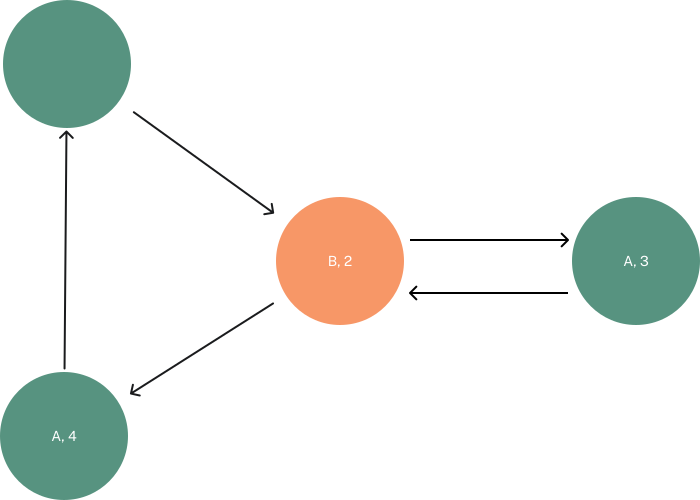
To recreate it, run the following query against an empty Neo4j database:
CREATE (n1:A {q: 1}),
       (n2:B {q: 2}),
       (n3:A {q: 3}),
       (n4:A {q: 4}),

       (n1)-[:R]->(n2),
       (n2)-[:R]->(n3),
       (n3)-[:R]->(n2),
       (n2)-[:R]->(n4),
       (n4)-[:R]->(n1)
To demonstrate the basic concept behind REPEATABLE ELEMENTS, and how it differs from the DIFFERENT RELATIONSHIPS match mode, consider the following pattern, which attempts to form a relationship equijoin: (a)-[r]-(b)-[r]-(c).
For this pattern to return any results, the same relationship must be re-traversed.
That is, the same relationship connecting a to b must be the same as that connecting b to c.
If tested using DIFFERENT RELATIONSHIPS, no results are returned due to the restrictions of the match mode.
DIFFERENT RELATIONSHIPSMATCH p = (:A)-[r]-(:B)-[r]-(:A)
RETURN [n IN nodes(p) | n.q] AS nodes(no results)However, if the same query uses the REPEATABLE ELEMENTS match mode, four paths are returned in which the same relationship is traversed more than once.
REPEATABLE ELEMENTSMATCH REPEATABLE ELEMENTS p = (:A)-[r]-(:B)-[r]-(:A)
RETURN [n IN nodes(p) | n.q] AS nodes| nodes |
|---|
|
|
|
|
Rows: 4 |
The DIFFERENT RELATIONSHIPS match mode allows only nodes to recur in a path.
5 relationships using the DIFFERENT RELATIONSHIPS match modeMATCH p = (:B)-->{5}()
RETURN [n IN nodes(p) | n.q] AS nodes| nodes |
|---|
|
|
Rows: 2 |
The REPEATABLE ELEMENTS match mode allows both nodes and relationships to be repeatedly traversed in paths.
5 relationships using the REPEATABLE ELEMENTS match modeMATCH REPEATABLE ELEMENTS p = (:B)-->{5}()
RETURN [n IN nodes(p) | n.q] AS nodes| nodes |
|---|
|
|
|
|
|
Rows: 2 |
Path modesCypher 25 onlyIntroduced in Neo4j 2026.03
Path modes define the uniqueness constraints for nodes and relationships within a single path pattern.
This contrasts with match modes which constrain relationship uniqueness across an entire MATCH clause.
Cypher supports three path modes:
-
WALK: no constraints imposed; both nodes and relationships can be repeated within the path. -
TRAIL: relationships cannot be repeated, but nodes can be repeated within the path. -
ACYCLIC: nodes cannot be repeated within a path. A node can be repeated across paths, enabling the formation of equijoins.
Syntax
pathModePrefix ::= pathMode [ pathKeywords ]

pathMode ::= WALK | TRAIL | ACYCLIC

pathKeywords ::= PATH | PATHS
Rules
The table below shows the effective uniqueness constraint for each combination of match mode and path mode.
| Match mode | Path mode | Effective uniqueness constraint | Notes |
|---|---|---|---|
|
|
Relationship uniqueness |
Constraint enforced by match mode. |
|
|
Relationship uniqueness |
Path mode does not alter the constraint imposed by the match mode. |
|
|
Node uniqueness and relationship uniqueness |
Path mode constraint stricter than match mode; prevents node repetition. |
|
|
No uniqueness |
Both match mode and path mode allow repetitions of nodes and relationships. |
Note that TRAIL and ACYCLIC cannot be combined with the REPEATABLE ELEMENTS match mode.
In practice, the syntax needed to achieve each uniqueness constraint is:
| Desired constraint | Syntax | Notes |
|---|---|---|
No uniqueness constraint |
|
|
Relationship uniqueness |
No keywords required |
|
Node uniqueness |
|
|
As the above tables show, ACYCLIC is the only path mode that alters the effective uniqueness constraint of the path pattern match.
For more information about ACYCLIC, see Acyclic paths.
All path modes in a MATCH must be the same
All path patterns in a single MATCH clause must use the same path mode.
For example, you cannot mix ACYCLIC with a pattern that uses the TRAIL mode:
MATCH p = ACYCLIC (a)-->(b), q = TRAIL (c)-->(d)
RETURN p, q42N61: error: syntax error or access rule violation - unsupported mixing of different path modes. Mixing ACYCLIC and TRAIL in the same graph pattern is not supported. Split the pattern into separate MATCH clauses instead. 42001: error: syntax error or access rule violation - invalid syntax |
Only WALK can be combined with the REPEATABLE ELEMENTS match mode
Explicit path modes like ACYCLIC or TRAIL cannot be used with the REPEATABLE ELEMENTS match mode.
For example:
MATCH REPEATABLE ELEMENTS p = ACYCLIC (n)-->{1, 10}(m)
RETURN p42N60: error: syntax error or access rule violation - unsupported combination of match mode and path mode. REPEATABLE ELEMENTS with ACYCLIC path mode is not supported. 42001: error: syntax error or access rule violation - invalid syntax |
Mixing restrictive path selectors and explicit path modes
| Neo4j versions | Behavior |
|---|---|
2026.03 - 2026.4 |
Explicit path modes cannot be combined with restrictive path selectors (e.g., |
2026.5 - current |
Explicit path modes can be combined with restrictive path selectors, but not with legacy shortest path functions. Supported
|
Path modes and variable-length paths
Explicit path modes cannot be used with the variable-length relationships syntax (e.g., -[*]->).
Use quantified path patterns or quantified relationships instead.
MATCH ACYCLIC (start)-[:R]->{4,7}(target)
RETURN start, targetMATCH ACYCLIC (start)-[*4..7]->(target)
RETURN start, target51N26: error: system configuration or operation exception - not supported in this version. Using explicit path modes on a pattern containing a variable-length relationship is not available. This implementation of Cypher does not support 42001: error: syntax error or access rule violation - invalid syntax |
Path modes cannot be applied to MERGE clauses
For example, this is not allowed:
MERGE ACYCLIC (robert:Critic)-[:P]->(c:Critic)42I04: error: syntax error or access rule violation - invalid expression. 'ACYCLIC' cannot be used in a MERGE clause. 42001: error: syntax error or access rule violation - invalid syntax |
Repeated node variables within a path pattern result in no matches
Declaring a node variable more than once within a single restrictive path pattern (like ACYCLIC) results in no matches.
Because the variable must bind to the same node element and the path mode forbids repeated nodes, there is no solution.
The below query finds no matches because the node x is repeated.
MATCH p = ACYCLIC (x:Router)-[:LINK]->(x)
RETURN p
Repeated node variables across different path patterns specify an equijoin
When a node variable is repeated in separate path patterns within the same MATCH clause, it specifies an equijoin.
In the below example, x is repeated across p and q, creating an equijoin between two acyclic paths.
This is allowed because each individual path pattern remains acyclic.
MATCH p = ACYCLIC (a:Router)-[:LINK]->+(x:Router),
  q = ACYCLIC (x)-[:LINK]->+(z:Router)
RETURN p, q
Path mode scope in subqueries
The path mode of a subquery (such as an EXISTS or COUNT expression) is independent of the path mode in the outer query.
This allows you to perform secondary checks with different uniqueness constraints.
In the below example, the outer query finds path using relationship uniqueness (default WALK path mode + default match mode DIFFERENT RELATIONSHIPS).
The subquery then checks for the existence of an ACYCLIC path connecting a and b.
MATCH p = (a:Router {name: 'A'})-[:LINK]->+(b:Router {name: 'D'})
  WHERE EXISTS { MATCH ACYCLIC (a)-[:LINK]->+(b) }
RETURN [n IN nodes(p) | n.name] AS route