Beyond the Banana: Driving real-time recommendations with graph-grounded Copilots in Microsoft Fabric


5 min read
Retailers rarely lack data. Between customer profiles, point-of-sale transactions, inventory levels, and promo schedules, modern enterprises generate terabytes of signals daily. The issue is that legacy relational architectures keep this information locked in siloed systems across POS platforms, inventory systems, and CRM applications.
When organizations deploy Copilots or AI agents to handle personalization, they naturally run into an architecture bottleneck: AI agents need rich, interconnected business context, not just isolated transactional rows. Relational tables are engineered for fast transactional logging, but they collapse under multi-hop queries, hiding nuanced customer habits and interdependent product relationships.
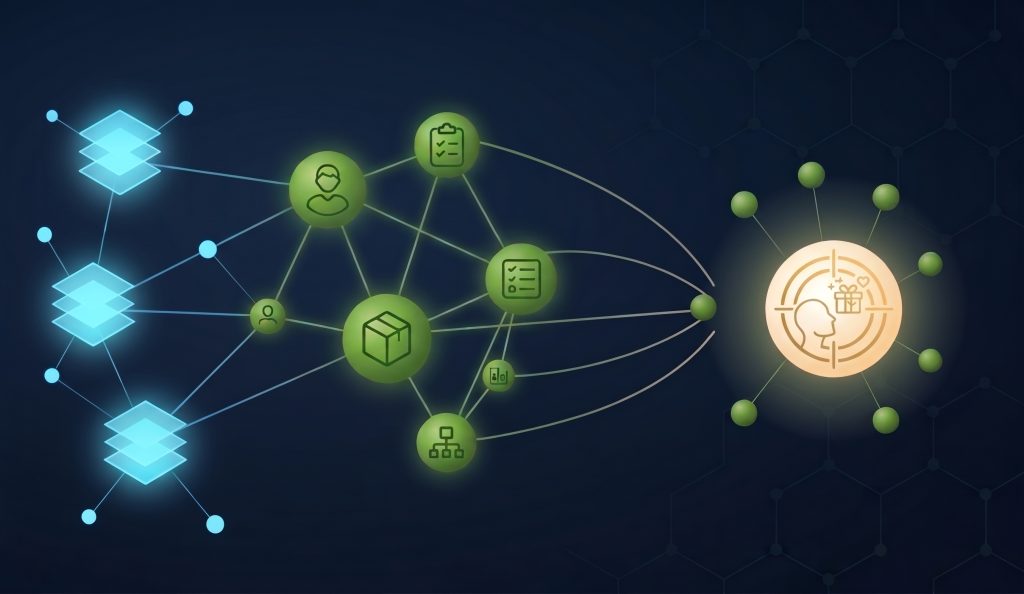
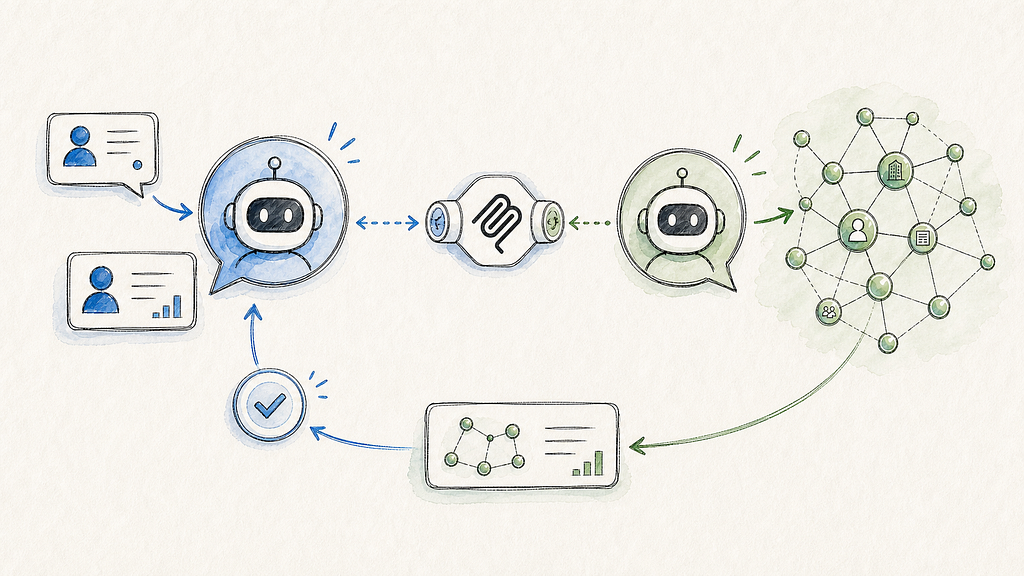
To eliminate these silos, Microsoft Fabric centralizes data in OneLake as open Delta tables, providing a unified foundation without requiring complex ETL pipelines or duplicate copies. Neo4j Graph Intelligence builds directly on top of that foundation, projecting those tables into connected models that expose relationships across customers, products, orders, and inventory. Together, this dual-engine architecture delivers multi-hop relationship intelligence so AI agents can access real-time business context and improve recommendation accuracy.
The cost of bad recommendations
When AI Copilots rely on simple relational queries or superficial semantic search, poor recommendations directly impact bottom-line margins and brand equity:
- Wasted promo spend: Standard queries offer discounts on high-volume staples that customers were already going to buy, cutting into margins without adding incremental sales or driving basket expansion.
- Missed cross-sell revenue: Irrelevant or generic suggestions cause shoppers to ignore recommendations altogether, leaving high-margin cart-building opportunities on the table and reducing Average Order Value (AOV).
- Failed AI queries: SQL queries fail and latency spikes occur when analyzing novel or unseen cart combinations, causing Copilots to hallucinate, time out, or return no answer.
To deliver truly high-converting personalization, AI tools need connected intelligence by understanding how items dynamically relate through shared shopper habits, localized trends, and product neighborhoods.
The “banana problem”: Why standard co-occurrence fails
Consider standard market basket co-occurrence. If a shopper adds organic spinach, avocado, and peanut butter to their cart, a standard SQL query examines historical co-purchases and recommends bananas.
Because bananas appear in nearly every cart, standard queries mistake popularity for true intent, drowning out genuine customer preferences. It is the retail equivalent of assuming everyone who buys coffee also wants bottled water; it might be frequent, but it fails to suggest what would actually complement that specific order.
To unlock true incremental revenue, AI agents must bypass high-frequency noise and identify the subtle “long-tail” affinity patterns that reveal what a customer actually needs next.
Surfacing true intent with Node Similarity
Instead of counting direct purchases, Neo4j looks at product neighborhoods using Graph Data Science (GDS). Node Similarity (using Jaccard or Cosine Neighborhood algorithms) compares the surrounding context of items, such as products frequently bought with cauliflower versus pepper jack cheese, to find genuine affinity regardless of total sales volume. By evaluating overlapping connections across the graph topology, the system uncovers non-obvious complements (i.e., artisanal hot sauce or specialty dip) rather than generic staples.
| Capability | Standard Relational SQL Agent | Neo4j Graph-Grounded Copilot |
|---|---|---|
| Data Structure | Flat transactional tables | Connected property graphs (:Customer, :Order, :Product, :Aisle) |
| Primary Logic | Direct co-occurrence counts (COUNT, GROUP BY) | Node Similarity & neighborhood overlap analysis |
| Noise Filtering | Over-indexes on high-volume staples (e.g., Bananas) | Filters out volume bias to find true product affinity |
| Unseen Carts | Fails, times out, or returns null for novel item combinations | Traverses multi-hop graph paths to find contextual substitutes & complements |
| Query Latency | Exponential degradation as joins increase | Constant millisecond traversal regardless of graph depth |
How Microsoft Fabric and Neo4j Power Contextual AI
By integrating Neo4j Graph Intelligence directly into Microsoft Fabric, teams connect relational storage with graph context to create an enterprise-grade retrieval and reasoning pipeline:
- Unified Foundation: Microsoft Fabric OneLake provides a unified, governed data foundation for sales, customer, and inventory data through open Delta tables, eliminating the need for duplicate data stores.
- Graph Grounding: Neo4j converts Delta tables into connected graphs in-memory, enabling Cypher pattern matching and Graph Data Science (GDS) algorithms to compute complex relationships across millions of nodes in milliseconds.
- Context-Aware Copilots: Fabric Data Agents query the graph to return recommendations based on real shopper affinity rather than raw counts, supplying the Copilot LLM with precise, deterministic context for natural-language interactions.
Fabric Data Agents make this graph intelligence accessible through natural language. Rather than requiring users to write complex graph queries, Data Agents can translate business questions into Neo4j Cypher queries behind the scenes, retrieving relationship-rich insights from the graph and returning them in a conversational experience. This allows retail teams to explore customer affinities, product relationships, and recommendation opportunities using familiar business language.
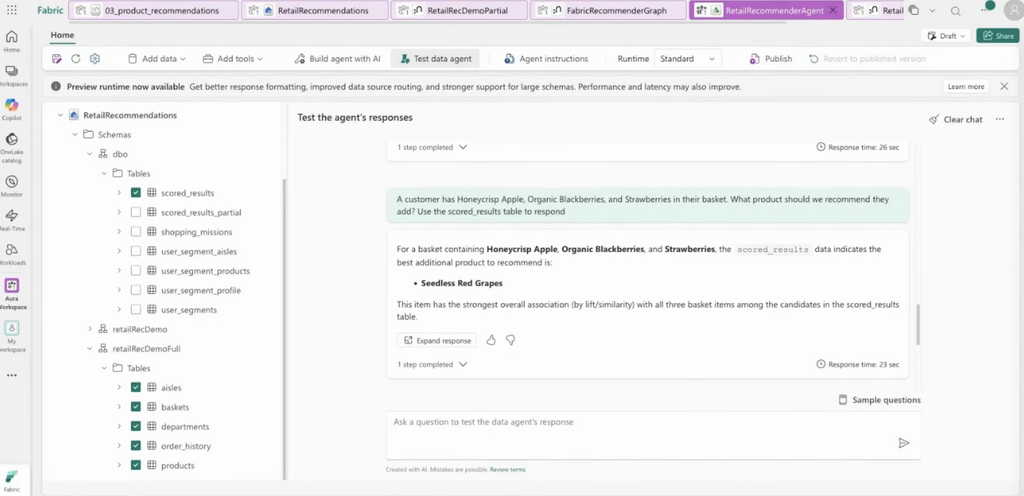
Because the integration runs directly within the Microsoft Fabric experience, organizations can leverage existing enterprise controls, including Microsoft Purview governance, native single sign-on (SSO), and tenant-level security boundaries. The result is a seamless, enterprise-ready architecture that enables teams to deploy graph-grounded AI safely within their existing Fabric environment, without managing separate infrastructure or disconnected security models.
Getting started with graph-grounded Copilots
Transforming your retail recommendations doesn’t require managing external infrastructure or leaving your existing workflow. You can enable Neo4j Graph Intelligence directly inside the Fabric Workload Hub for native single sign-on and unified workspace management or deploy directly through the Azure Marketplace.
From there, you can map OneLake data into graph models, run GDS workloads, and power Fabric Data Agents and Copilot experiences that deliver more contextual recommendations and high-lift cross-sell opportunities.
Explore joint enterprise resources and launch your workspace today.
Share Article


Explore
Related Articles
Graphs, knowledge graphs, & context graphs: Which one do you need?
What are decision traces in a context graph? How they reveal agentic reasoning
Grounding Salesforce Agentforce with Neo4j — multi-agent setup over MCP