
The knowledge layer for trustworthy AI
Your enterprise AI systems are only as good as the context behind them.
The missing ingredient in enterprise AI
“Without relationships at the center, AI will remain what it is for most organizations today: an expensive experiment.”
Gartner analyst Georgia O’Callaghan,
March 2026
Organizations invest in AI to drive better decisions, lower costs, reduce risk, and improve customer experiences.
But most AI initiatives never reach production. Models trained on clean pilot data struggle with fragmented real-world systems and hidden relationships, leading to inconsistent results and low trust.
The problem isn’t data access, it’s understanding. AI lacks the context behind how and why things connect, behave, and matter.
The knowledge layer fills that gap.
What is a knowledge layer?
It’s the glue that connects your generative AI and agentic systems to your data so AI can understand not just individual facts, but how they relate to each other, what has changed, and what has been decided before. Without it, AI looks things up. With it, AI reasons.
The knowledge layer is a set of capabilities: the semantic models that define what your data means, the connected data itself, the memory that enables AI to reason across interactions, and the business rules that govern what AI can and cannot do.
Neo4j brings these capabilities together in a flexible platform that works with your existing data infrastructure and puts the investments you’ve already made to work.
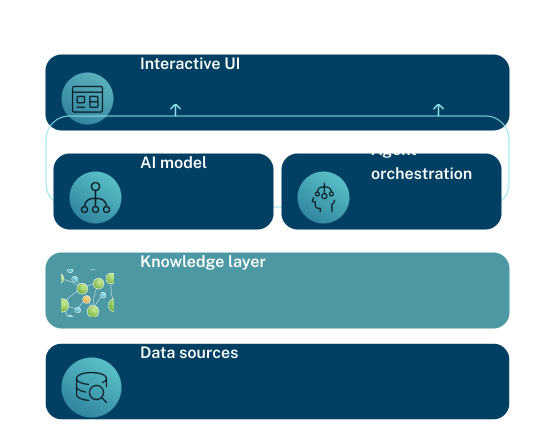
What organizations get from a knowledge layer
For business leaders
Trustworthy AI that stands up to scrutiny.
- Trust every AI answer, traced back to your source data
- Prove every AI decision with a complete audit trail
- Synthesize intelligence across disparate data systems and teams
- Make use of your existing data investments instead of replacing them
For technical teams
Infrastructure and tools to build AI agents and systems that work in production.
- Generate grounded answers by combining semantic search with graph retrieval
- Build agents that remember, with native short-term, long-term, and reasoning memory
- Leverage integrations with the AI, infrastructure, and tools you already use
- Access data where it lives, unified by a semantic model across sources
The Neo4j Graph Intelligence Platform
The knowledge layer is the foundation your enterprise AI needs.
The Neo4j Graph Intelligence Platform is how you build it.
A single platform that brings together the graph database, agent memory, knowledge graph construction, GraphRAG, semantic search, and enterprise governance capabilities that make a knowledge layer a reality in your environment.
Trusted by the Fortune 500
Where the knowledge layer meets the real world
Organizations across every industry are focused on AI investments. The difference between AI that reaches production and AI that stays in pilot depends on having the underlying knowledge layer in place.
Enterprise automation and agentic workflows
An agent that is asked to onboard a new team member, process a contract, or resolve a service ticket needs to know how your organization actually works: who owns what, which policies apply, which systems are involved, and what has been done before in similar situations. That organizational knowledge lives across dozens of systems and was never designed to be queried by an AI.
The knowledge layer captures and connects it into a single, structured foundation so agents can act on what your organization actually knows, not just what they can find.
Customer experience and personalization
A customer calling support has a history: purchases, past issues, preferences expressed, and interactions across every channel. That history is what makes the difference between a response that feels relevant and one that feels generic. The knowledge layer connects that history into a single, current picture so that AI agents and customer-facing teams can respond to who the customer actually is, not just the ticket in front of them.
Risk, fraud, and cybersecurity
Fraud does not occur through a single account. It happens through networks: shared devices, linked identities, coordinated transactions, and layered relationships designed to hide activity. Detecting it requires understanding those connections even as bad actors work to keep them hidden. The knowledge layer defines how AI and graph technologies work together in real time to uncover the relationships, not just flag suspicious transactions.
Supply chain and operations
When a supplier introduces a delay or a shipment is rerouted, the question is never just what happened—it’s what else does this affect, how far does it reach, and what are the alternatives? Supply chains are networks of dependencies, and the knowledge layer helps keep that network current and queryable, by drawing on relevant information from disparate systems so teams and AI agents can answer questions in real time, before the impact reaches the business.
Product and R&D acceleration
Getting a product from concept to market requires drawing on knowledge that’s spread across an organization, including research, prior decisions, specifications, regulatory requirements, and domain expertise. The knowledge layer helps map relevant information from those systems into a connected, queryable foundation so AI can help teams build on what’s already known rather than rediscovering it.
Forecasting and decision intelligence
Business outcomes are driven by relationships between variables, not single data points. A sales forecast, a risk assessment, or a resource plan is only as good as the relationships it accounts for: how customers, markets, competitors, and past decisions connect to the current situation. The knowledge layer helps AI reason across those relationships so that forecasts and decisions reflect a more complete picture of what is actually happening.
Go deeper on the knowledge layer
Knowledge layer architecture
What a knowledge layer is, how it works, and why graph is the right foundation for enterprise AI.
Knowledge Graph Builder
See how Neo4j’s LLM Knowledge Graph Builder turns unstructured data into a queryable knowledge graph.
Context graphs and autonomous agents
See how Electronic Arts achieved 10× faster time-to-insight and improved agent reliability by adopting a graph-based approach to context engineering.
Build your knowledge layer
Neo4j provides the platform, tools, and architecture to move your AI from pilot to production.