Connected Intelligence: Operationalizing secure, cost-optimized graph architectures across multi-cloud AI


6 min read

Enterprise AI has reached a critical turning point. As organizations move beyond basic generative AI experiments and shift into production, engineering teams face two core challenges: keeping token costs under control for complex queries while enforcing strict data security across multi-cloud setups. Traditional methods, like copying data or stuffing full schemas into LLM context windows, are proving too expensive, slow, and risky for enterprise environments.
In Q3, Neo4j focused on eliminating these operational barriers through close collaboration with our strategic partners. Together, we expanded zero-copy graph reasoning directly into major cloud data warehouses, engineered per-user identity controls down to the database level, and drove significant co-sell momentum across our joint ecosystem. These efforts deliver the enterprise knowledge layer required for trustworthy, cost-effective AI. This blog highlights our core technical breakthroughs, joint co-sell milestones, and field enablement initiatives as we head into Q4.
Driving Strategic Co-Sell Momentum Across Google Cloud, AWS, and Microsoft
Enterprise demand for connected context is translating into record joint co-sell momentum across our strategic cloud alliances. In Q3, Neo4j teamed with Google Cloud, AWS, and Microsoft to accelerate co-sell execution, delivering repeatable architectures across enterprise data modernizations and production GenAI scale-ups:
Google Cloud
- Enterprise Knowledge Layer Modernization: A multi-year commitment with a global leader in property data and intelligence. Originally initiated to eliminate real-time query bottlenecks, the joint team expanded the footprint across multiple business units. By deploying 2 TB of Aura VDC on GCP, the customer unified fragmented property and tax datasets into a single Enterprise Knowledge Layer, resolving core operational friction and establishing the foundational context required for enterprise AI.
- Codebase AI Scale-Up Expansion: A multi-year Google Cloud Marketplace private offer with a fast-growing AI software provider. Expanding from an initial startup footprint across seven environments (~1.9 TB) to an enterprise production deployment, the platform uses Neo4j knowledge graphs to model complex software dependencies, providing AI agents with the contextual grounding needed to safely modify enterprise codebases.
Amazon Web Services
- Financial Services AI Sales Automation: A major AWS Marketplace expansion with a premier US mortgage and financial services lender. Scaling their initial investment into an 8 TiB Aura VDC deployment on AWS high-memory instances, the customer pairs Neo4j Graph Data Science and GraphRAG with Amazon Bedrock. The platform powers sub-second context retrieval for autonomous AI sales agents, automated client outreach, and real-time next-best-action recommendations, achieving a 20% lift in borrower follow-ups.
Microsoft
- Telecommunications Security and Customer Intelligence: A multi-year early renewal and expansion transacted through the Azure Marketplace with a major telecommunications carrier. Using dedicated Microsoft incentives, the organization expanded its Neo4j footprint on Azure to operationalize connected graph context across enterprise security workflows and customer churn prediction models, demonstrating how graph-grounded architectures drive AI readiness at network scale.
Neo4j Virtual Graph Enters Public Preview across Snowflake, Databricks, and Google BigQuery
Moving massive enterprise datasets to secondary databases for graph analytics introduces unnecessary costs, data drift, and governance complexity. Neo4j Virtual Graph solves this trade-off by bringing advanced graph reasoning directly to where data already lives. Now in Public Preview, Virtual Graph expands its zero-copy architecture to support Snowflake, Databricks, and Google BigQuery.
Virtual Graph enables organization teams to create working knowledge graphs in minutes. Built-in AI tooling analyzes existing data warehouse tables and automatically proposes a graph schema. When an AI agent or user executes a Cypher query, Virtual Graph deterministically translates the request into optimized SQL and pushes the heavy compute down to the underlying cloud warehouse engine. Data remains governed by existing perimeter controls, while results are served back in graph form over the Bolt protocol.
As we approach General Availability (GA), Virtual Graph provides system integrators and partners with an immediate, zero-ETL entry point to deliver high-value GraphRAG and relational reasoning without requiring costly data migrations.
Secure GraphRAG: Wiring Microsoft Copilot Studio to Neo4j with Per-User Okta SSO
When AI agents query databases using a single shared service account, they introduce a critical security vulnerability known as a “confused deputy,” in which they hold broader authorization than the end user and may return confidential data in response to an unpredictable prompt.
To eliminate this risk, Neo4j has published a multi-cloud reference architecture that connects Microsoft Copilot Studio to Neo4j using per-user Okta SSO. By routing agent requests through a Neo4j Model Context Protocol (MCP) server hosted on Google Cloud Run, individual Okta OAuth access tokens are passed directly down to the database. Neo4j validates the signed token against Okta and maps user groups directly to database-level roles.
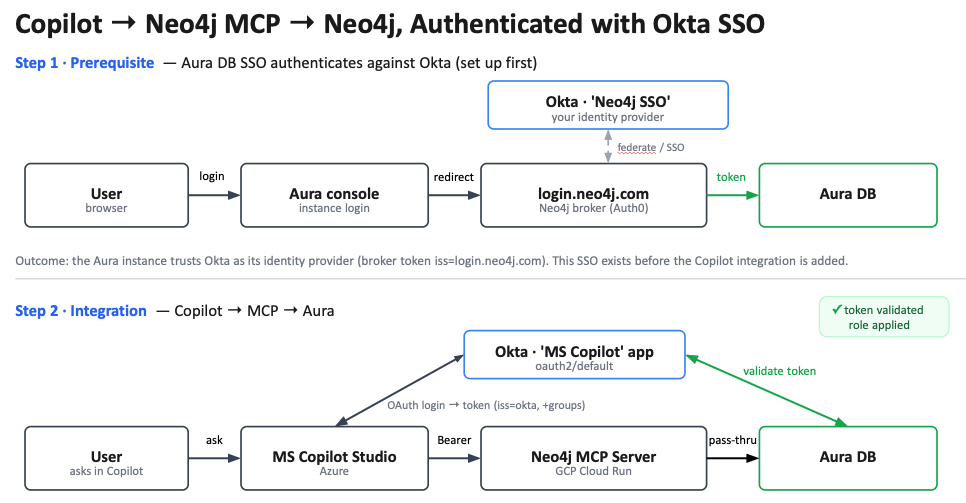
Even if an LLM generates a wide, multi-hop Cypher query, Neo4j enforces access at the database level, ensuring users retrieve only the context they are explicitly permitted to see. This per-user identity framework provides partners with a secure, auditable architecture to deploying enterprise-grade Copilots across Microsoft, Okta, and Google Cloud environments.
Cutting Text2SQL Token Costs up to 81% and Fixing Accuracy Gaps with Neocarta
Pointing Text2SQL agents straight at large, opaque data catalogs causes two major problems: massive token consumption from pasting raw schemas into prompts, and frequent hallucinations as agents guess which tables to join.
A recent benchmark published on the Neo4j Developer Blog demonstrates how a Neo4j semantic layer built with Neocarta solves this context bottleneck across Google BigQuery and Databricks Unity Catalog. By harvesting catalog schemas, business terms, and real join paths into a metadata knowledge graph in Neo4j, agents perform a quick semantic search over MCP to retrieve only the exact tables, columns, and certified join paths required.
Across a 278-table BigQuery schema and a 264-table Databricks catalog, adding the Neo4j semantic layer:
- Cut token usage by 45% to 81% across multiple model families.
- Lifted cheap models (like GPT-4o-mini) from failing dead-end loops to 100% accuracy.
- Doubled execution speed while saving hundreds of dollars per month in API token costs.
For enterprise partners building GenAI data applications, this graph-backed semantic layer offers a concrete blueprint to drastically reduce client operating costs while improving query accuracy.
Driving Partner Momentum Through Hands-On AI Workshops and Field Activations
To convert these technical innovations into Q4 deal momentum, Neo4j is executing an aggressive schedule of joint field activations alongside AWS, Google Cloud, Microsoft, Snowflake, and Databricks.
Throughout October and November, we are hosting a major series of hands-on, regional AI workshops in key enterprise markets. These interactive sessions bring customer data and engineering teams together with Neo4j and cloud provider specialists to build practical, graph-grounded GenAI applications.
In parallel, our Connected Intelligence digital series continues to highlight priority joint use cases, from graph-grounded Copilots in Microsoft Fabric to zero-copy fraud detection in Snowflake.
ICYMI Digital Events & Technical Briefings:
- Better Enterprise AI with AWS (On-Demand)
- Zero-Copy Advanced Graphs: How Virtual Graph Accelerates Fraud Detection in Snowflake
- Building Graph-Grounded Copilots in Fabric: Real-Time Recommendations & Substitutions
Heading into Q4
As we enter the final quarter of 2026, the mandate for enterprise data strategy is clear: deliver secure, low-cost graph architectures that enable AI agents to perform complex reasoning over connected enterprise data. The zero-copy capabilities, multi-cloud security integrations, and co-sell wins achieved this quarter provide our partner network with a strong foundation to close out the year.
Share Article


Explore
Related Articles

Easily build a knowledge graph from your existing documents with Document Intelligence