Exploring Databricks System Tables with Neo4j
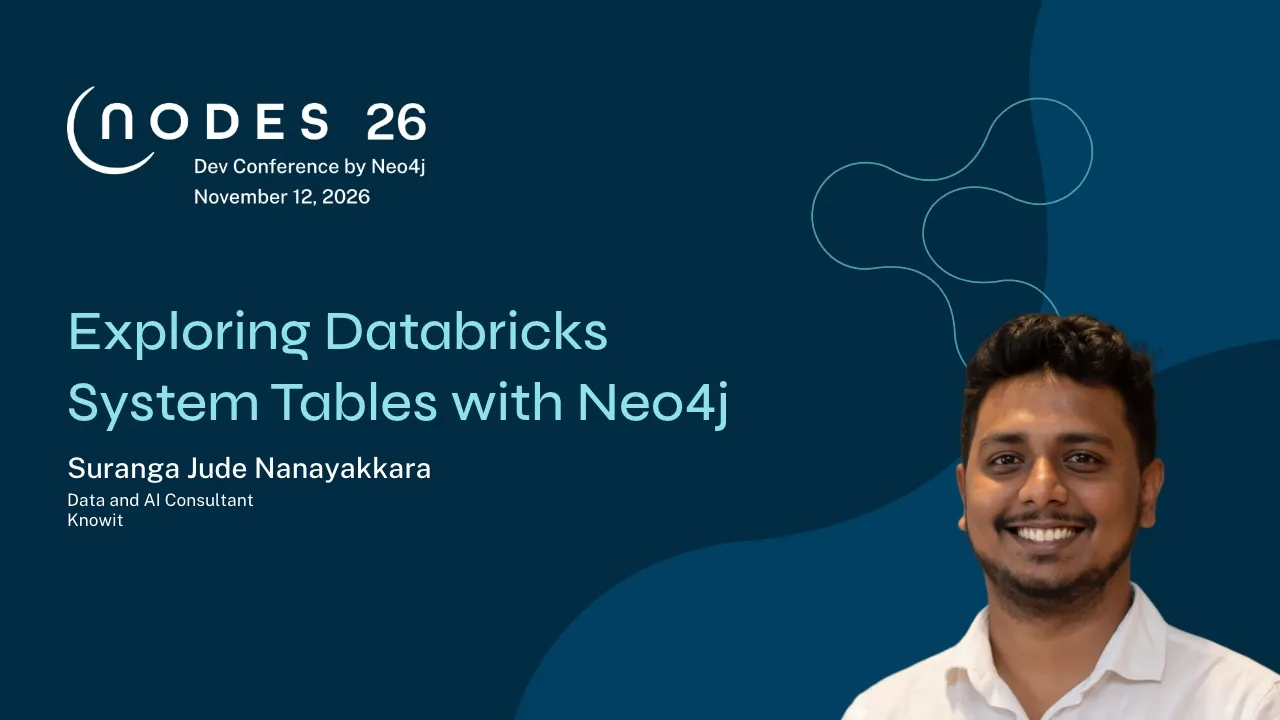 Play video on YouTube: Exploring Databricks System Tables with Neo4j
Up next

NODES AI 2026: Lakehouse + Graph: Delta Lake, Unity Catalog and Neo4j for Governed AI Pipelines


Suranga Jude Nanayakkara is a Databricks Solution Architect Champion who will show how metadata captured in Databricks can become far more explorable and actionable when modelled as a knowledge graph in Neo4j. Unity Catalogue automatically captures lineage across data assets, including table-level and column-level relationships, and Databricks exposes lineage through system tables that teams can query for governance, troubleshooting, and impact analysis.
In this session, he will demonstrate how a Databricks engineer can take lineage metadata from system tables, transform it into a graph model, and load it into Neo4j to create a connected view of pipelines, tables, columns, and downstream dependencies. He will explain the graph modeling choices behind the approach, how Neo4j helps surface upstream and downstream impact, and why graph structures are a natural fit for metadata and master data problems that are difficult to understand in flat tables alone.
You will learn how to think about lineage as a graph, how Databricks and Neo4j can work together in a practical architecture, and how this pattern can support use cases such as impact analysis, root-cause investigation, governance visibility, and trusted data discovery. By the end of the session, you will leave with a concrete design pattern for turning lakehouse metadata into a navigable knowledge graph that brings operational and business context together in one place.
Speaker: Suranga Jude Nanayakkara
Resources mentioned
Resources
- Watched Duration: 14:45

- Watched Duration: 15:14

- Watched Duration: 28:33

- Watched Duration: 11:26

- Watched Duration: 31:35

- Watched Duration: 21:08