
Self Learning Agentic Workflows: Using Neo4j to Build a Reusable Network Validation Layer
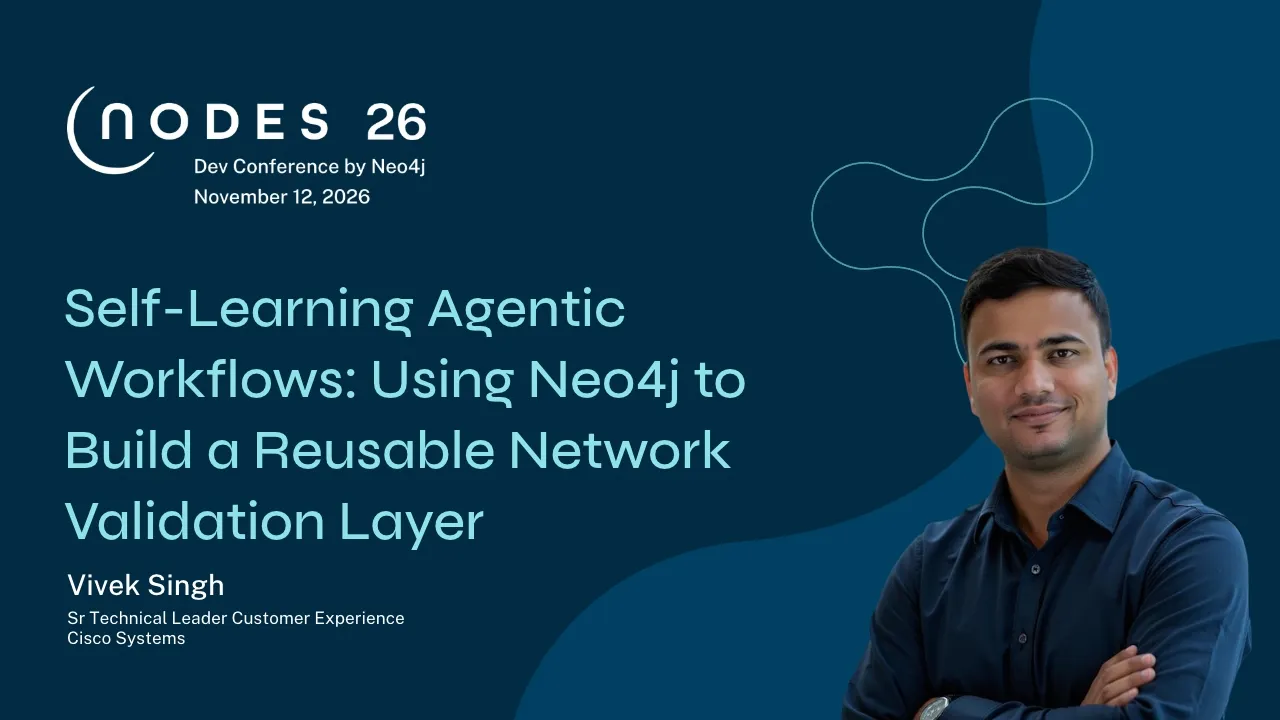 Play video on YouTube: Self Learning Agentic Workflows: Using Neo4j to Build a Reusable Network Validation Layer
Up next

Road to NODES AI: Graph-Based Long-Term Memory: How Agentic Workflows Adapt Through Experience





Why let your AI agents reinvent the wheel every time a system configuration needs validation? While LLM agents are brilliant at dynamic problem-solving, they lack an innate, structured memory to reuse previously validated execution steps across varying product versions.
Enter the Neo4j-backed Validation Layer. In this session, we will demonstrate how to move away from open-ended agentic research and toward structured graph traversal. We will explore how to model system components, product versions, validation commands (CLI/UI/API), and agentic sub-tasks into a highly optimized Knowledge Graph. This graph serves as an operational harness: bifurcating complex issues, dynamically spinning up specialized sub-agents on demand, and pinning their execution to verified historical data.
Key Takeaways
1. How to replace costly LLM search steps with efficient Neo4j path finding for system validation.
2. Designing a schema where nodes represent environment states and edges represent validated transitions or agent skills.
3. Strategies for scaling a multi-agent system’s memory so it becomes smarter and faster with every command it executes.
Speaker: Vivek Singh
Resources
- Watched Duration: 1:43:28

- Watched Duration: 28:43

- Watched Duration: 27:07

- Watched Duration: 29:59

- Watched Duration: 24:56

- Watched Duration: 30:02

- Watched Duration: 7:20

- Watched Duration: 20:40
