Neo4j Context Engine: Rapidly build dependable enterprise agents


5 min read
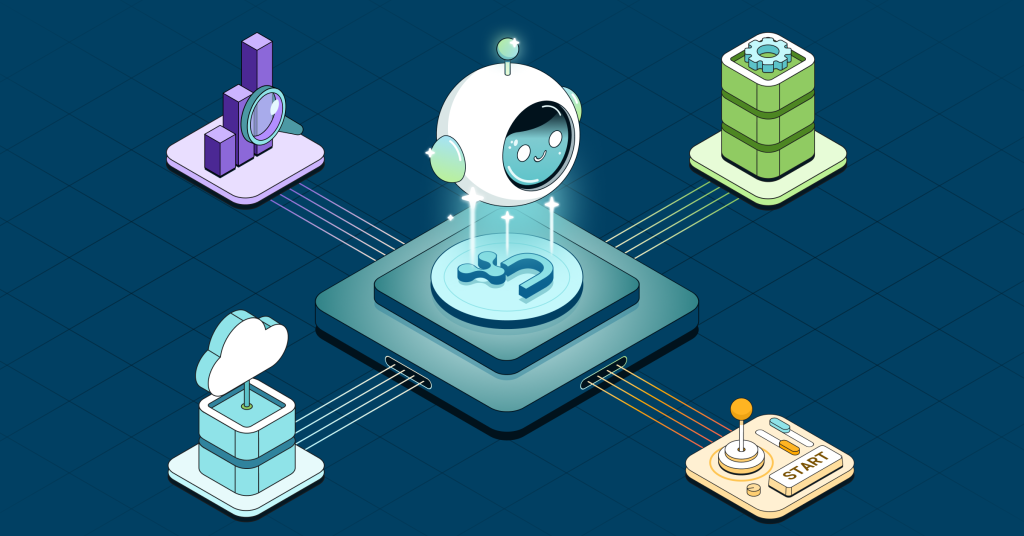
Today we’re announcing Neo4j Context Engine, which enables AI agents to accurately answer questions about your business and reliably execute its processes, with every answer and step governed and explainable.
Neo4j Context Engine, part of the Neo4j Graph Intelligence Platform, connects business knowledge, processes, policies, enterprise data, and operational context to provide agents with the understanding they need to reason, decide, and act. The graph explicitly models relationships, so agents can reason across them and show how and why they reached an answer. You keep the LLM and agent framework you already use while dramatically reducing the risk of agent failure.
We developed Neo4j Context Engine in response to rising demand, as AI vendors and users converge on the agent knowledge problem: Agents can’t act reliably at scale if they don’t understand how your organization works. This is the trillion-dollar AI bottleneck.
The agent knowledge problem, and how to overcome it
AI agents are an entirely new kind of data consumer. For decades, only applications and people consumed data, and its meaning still lives in programming languages and human memory. Applications know that an account status of “2” means “suspended pending review” because it’s in the code. People know it from experience, because they wrote it on a Post-it, or because it’s in a BI tool.
Agents have no idea what it means. And the definition of business terms and concepts varies across organizations. “Customer” might mean one thing in Marketing and another in Finance. Data fragmentation deepens the problem, as agents often can’t access the knowledge they need.
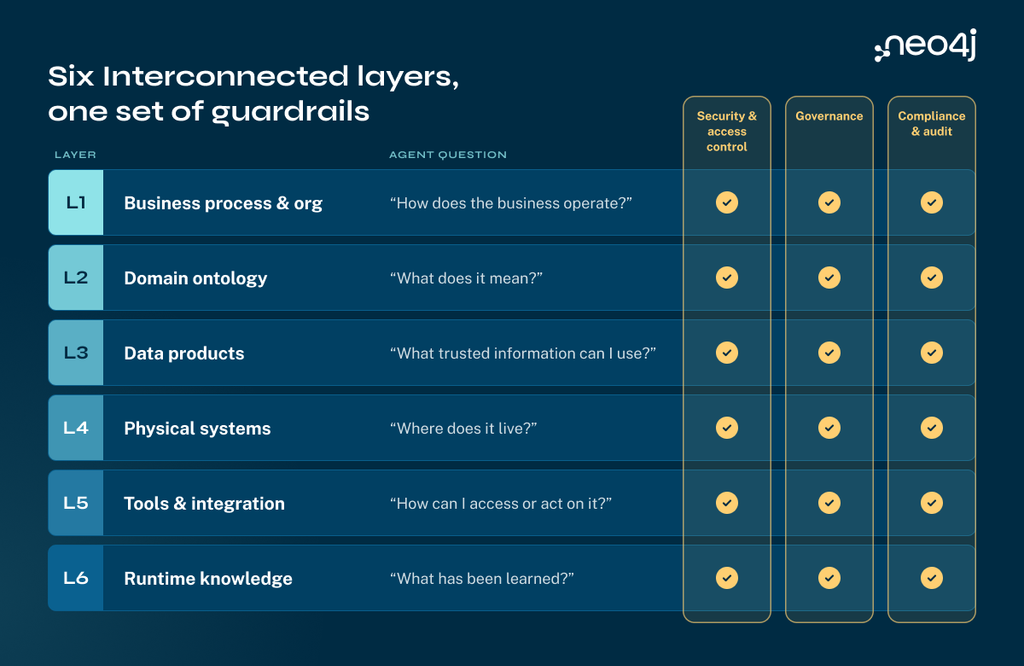
We built Context Engine to solve the agent knowledge problem. Its core technology is an interconnected six-layer business ontology. The ontology gives agents exactly what they need to succeed in production by enabling them to:
- Understand business concepts and how data entities relate to one another
- Find the right data wherever it lives, across clouds, platforms, and vendors
- Learn from every decision, so agents get smarter the more your enterprise uses them
These three capabilities enable agents to act reliably at scale across a landscape of disparate, heterogeneous data sources—the enterprise vision for agentic AI.
A comprehensive business ontology for every agent and use case
From an agent’s perspective, these three capabilities address six fundamental challenges agents encounter when operating in complex enterprise environments. Context Engine provides the interconnected six-layer business ontology that solves these fundamental challenges.
Layers 1 and 2 for agent understanding
The business process and domain layers give agents the meaning they currently lack. The former describes the rules and processes that determine how the organization operates, while the latter defines key terms and concepts. Agents now know how things work and how to interpret specialized vocabulary.
Layers 3, 4, and 5 for connecting agents to enterprise data
The data products layer, physical systems layer, and tools and integration layer enable agents to connect to your enterprise data. They determine what information can be used, where it lives, and how to connect to it. Agents now know how to interact with enterprise data—what to access, what not to, and how.
Layer 6 for continuous learning
Runtime knowledge allows agents to remember and learn. They can now store past decisions and actions, learn from them, and get smarter and more capable over time.
Powering the ontology: Context Engine’s core components
The Context Engine has three core components that create and manage the business ontology: Business Ontology for Agents, Context Build and Runtime, and Memory and Learning. They map to the three essential agent capabilities and support different layers of the business ontology.
1. Business Ontology for Agents
Business Ontology for Agents is a graph model that an enterprise defines, stores, and enforces in Neo4j. The graph captures what business concepts mean, how business processes work, and how both concepts and processes relate to each other. Agents use it to understand the nature of questions and tasks, including highly complex ones.
2. Context Build and Runtime
Context Build and Runtime enable agents to access the information they need across the enterprise, no matter where data lives. Built-in governance ensures that they can only access data they’re authorized to access. And they retrieve information using GraphRAG, a more accurate and cost-effective technique than vector-only RAG.
3. Memory and Learning
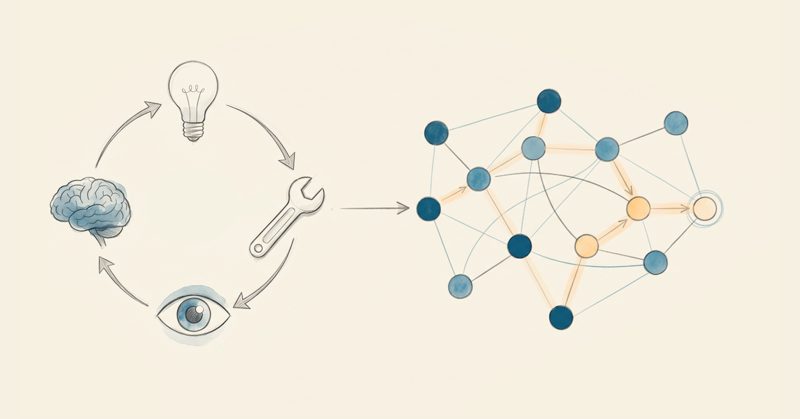
Memory and Learning capabilities ensure agents get smarter over time, which is critical in fluid enterprise environments. Short-term, long-term, and reasoning memory are connected in the same graph as business meaning. Every agent decision and decision path is tracked and stored, so agents learn from everything they do.
Easy to build, easy to manage
Context Engine’s core components are designed to work together so your team spends less time building and maintaining fragmented context infrastructure for enterprise agents. And Context Engine includes the Context Studio UI, which allows you to manage and govern your business ontology from a single control plane.
Get started with the Neo4j Context Engine
Neo4j Context Engine is currently in private preview. Contact us here to become a design partner.
If you’re interested in getting started with Context Engine, please reach out to sales here.
Share Article



Explore
Related Articles


Connected Intelligence: Accelerating Enterprise AI throughout the cloud ecosystem