Modern face recognition systems are evolving beyond embedding generation and similarity search. In production environments, the real challenge is identity management at scale: persisting identities, resolving duplicates, handling metadata, and enabling efficient retrieval across millions or even billions of faces.
In this talk, I present a graph-native approach to face recognition using DeepFace and Neo4j. DeepFace is a widely adopted open-source framework with 23K+ GitHub stars, 11M+ downloads, and 1000+ academic citations. It provides state-of-the-art face recognition and analysis in Python, which we extend into a persistent identity system.
Using Neo4j, we model identities as graph nodes and store face embeddings as vector properties, enabling both structured relationships and high-performance similarity search. Additionally, facial attributes such as age and gender can be represented as first-class properties in the graph, enriching identity resolution and enabling more structured querying.
With Neo4j’s vector index capabilities, approximate nearest neighbor search operates at millisecond latency even at large scale.
What makes this approach powerful is its simplicity at the interface level: a production-grade identity system—combining registration, search, and graph-based reasoning—can be implemented with only a handful of lines of code. This dramatically lowers the barrier between machine learning models and deployable identity systems.
Beyond similarity search, graph structure enables richer intelligence. Temporal and co-occurrence relationships can be modeled explicitly, allowing graph algorithms such as centrality and community detection to improve clustering quality and detect false positives.
The key idea is that face recognition becomes significantly more powerful when treated as a graph problem rather than an isolated ML task. This talk demonstrates how DeepFace inference, Neo4j graph storage, and vector search can be unified into a minimal yet scalable architecture.
Speaker
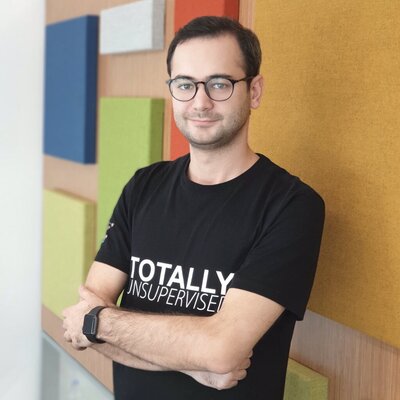
Sefik Serengil
Software Engineer, Neo4j
I received my MSc in Computer Science from Galatasaray University in 2011.
I am a software engineer at Neo4j.
My research interests are Machine Learning and Cryptography.
I am a Microsoft Most Valuable Professional (MVP) for developer technologies since ’24.