We present a modular, four-layer biological knowledge graph (BKG) framework for predicting clinical phenotypes from multiomic data without requiring labeled training data, supporting precision medicine applications across novel pathogens, drug safety, and rare disease research. The architecture separates curated biological knowledge from population-level experimental observations, individual subject measurements, and computationally inferred relationships, enabling flexible data integration without graph reconstruction. The computationally inferred relationship layer is populated through a deterministic reasoning engine designed to produce outputs that are both interpretable and independently verifiable. We train a path-based graph neural network on the Neo4j BKG, validated through perturbation controls, to turn raw model output into trustworthy, decision-grade reasoning. Its traceable, multi-hop gradient paths form a deterministic backbone that steers the stochastic LLM agents layered above it. A multi-phase verification machine then reads those paths and independently scores each hypothesis across multiple public databases, with no LLM in the validation loop. By keeping reasoning and validation epistemically independent, the framework delivers a GNN backbone that is reproducible, auditable, and resistant to the hallucination failures of LLM-only systems. We present this as an open framework that extends into an agentic, self-improving loop—swarms of reader and verifier agents governed by a shared adversarial critique layer and anchored by the deterministic GNN prior—delivering a scalable, cost-efficient, and governable path to production.
Speaker
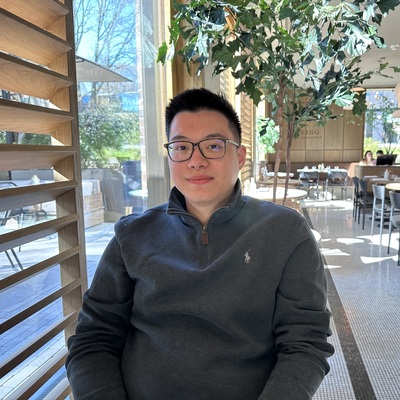
Yucheng Lo
PhD Student, George Mason University School of System Biology
Yu-Cheng (Roger) Lo is a PhD student at George Mason University, where he builds graph-based AI systems for biomedical discovery. His work centers on path-based graph neural networks trained on Neo4j knowledge graphs, paired with a verification framework that makes agentic, LLM-driven reasoning reproducible, auditable, and resistant to hallucination. He has applied these methods to Protein-to-GO and GO-to-symptom prediction tasks on large biomedical knowledge graphs, and is now extending them into orchestrated multi-agent systems that scale discovery while keeping it trustworthy. He is passionate about bridging deterministic graph learning with trustworthy, deployable agentic AI.