
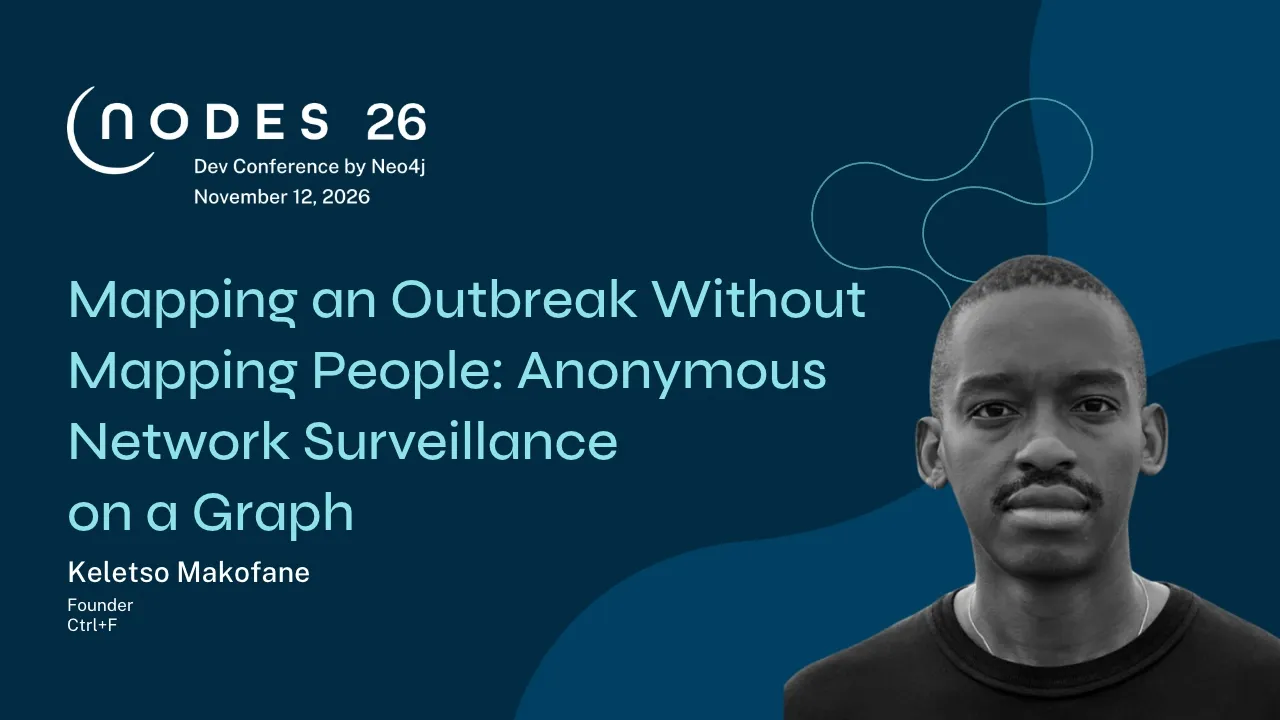
Mapping an Outbreak Without Mapping People: Anonymous Network Surveillance on a Graph
 Play video on YouTube: Mapping an Outbreak Without Mapping People: Anonymous Network Surveillance on a Graph
Up next

NODES 2024 – Combating Gun Trafficking and Gun Violence With Graph Analytics and Visualization




When the 2022 mpox outbreak hit New York City, vaccine was scarce and conventional surveillance couldn't answer the question that mattered: where were people being exposed, and how were they connected? Residence-based case counts miss the places people gather — and the communities most affected distrusted any system that asked for names and locations.
In this session, Keletso will walk through how he and his team operationalized two mechanisms on Neo4j as part of the RESPND-MI / MPX NYC response. First, the person-place mapper: participants tap locations on a map, coordinates are resolved to census tracts in the browser before anything is sent, and each tap becomes a typed person-place edge — without raw location ever leaving the phone. Second, the link tracer: a native share-sheet referral that carries a token in the URL, recording an anonymous referral edge when a friend enrolls, so the network grows without storing a single contact.
You will see the graph data model these pipelines build, and the Cypher that reads insight off it: movement matrices between community districts and mixing matrices across populations — queries that are natural on a graph and painful anywhere else. You will leave with a reusable pattern for turning sensitive surveys into graphs without touching personally identifiable information.
He will close with GraphHealth, which productizes this approach so any health department can run network surveys with graph analytics out of the box.
Speaker: Keletso Makofane
Resources
- Watched Duration: 7:29

- Watched Duration: 28:12
- Watched Duration: 14:06

- Watched Duration: 3:00

- Watched Duration: 38:17

- Watched Duration: 24:36

- Watched Duration: 9:10

