Introducing Neo4j GraphAware Financial Crime Intelligence

GraphAware Field CTO, Neo4j
8 min read
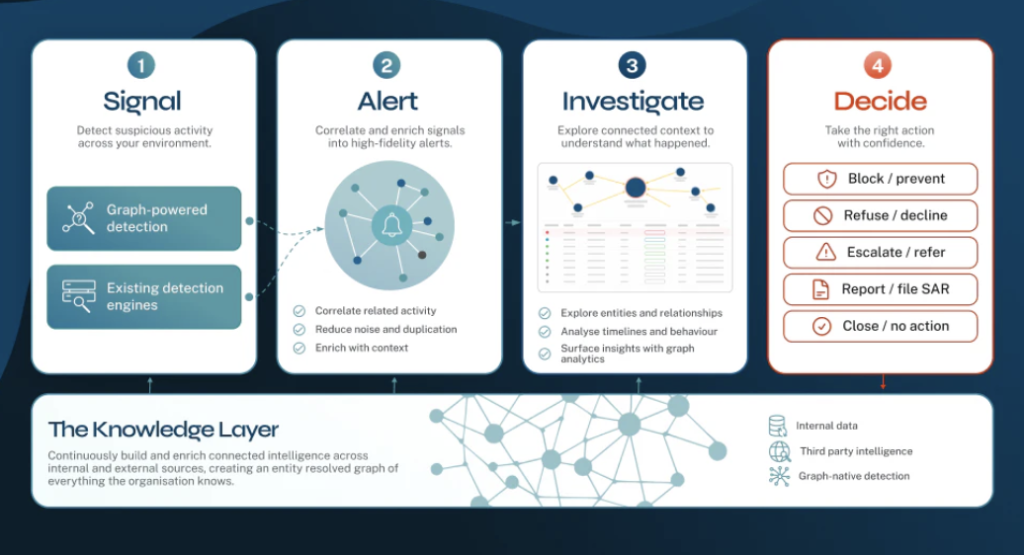
Move from fragmented data to connected intelligence, for better detection, deeper investigations, and defensible decisions.
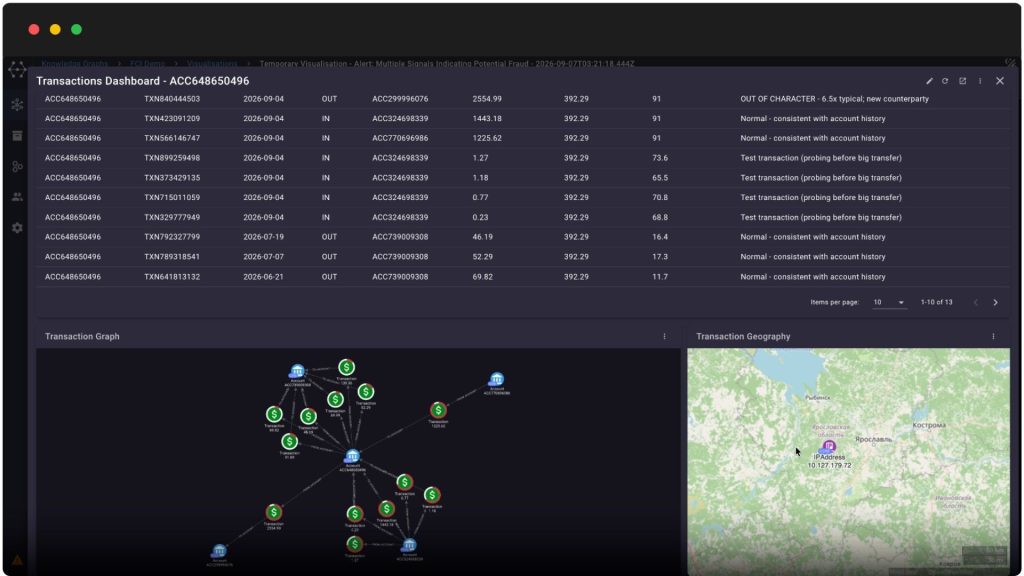
Financial crime is connected. The teams fighting it are not.
Fraudsters operate as connected networks. They layer activity across accounts and transactions, move between identities and devices, and adapt as soon as controls catch up, hiding their behavior across weak, distributed signals.
But financial crime teams work with incomplete data in siloed tools. They see isolated events, not the whole scheme, and lose the intelligence picture across system and team boundaries. The result? Important signals go unnoticed until after the damage is done.
That’s the problem Neo4j GraphAware Financial Crime Intelligence is designed to solve.
One connected foundation for modern financial crime operations
GraphAware Financial Crime Intelligence provides one connected, graph-native foundation for modern financial crime operations.
It unifies data and intelligence across teams and systems, detects connected behavior across entities, transactions, and relationships, and gives investigators the context they need to follow the evidence wherever it leads.
At its heart is the knowledge layer: an entity-resolved graph that continuously integrates and enriches connected intelligence from internal and external sources. Human-led, AI-accelerated investigations let teams understand financial crime alerts in the context of everything the organization knows.
What does this change for financial crime teams?
This solution changes what teams can detect, how deeply they can investigate, how quickly they can make decisions, and how confidently they can act.
GraphAware Financial Crime Intelligence helps teams:
- Detect beyond the obvious red flags to identify risk patterns that conventional approaches miss.
- Investigate the bigger picture, exploring alerts in the context of everything the organization knows.
- Focus on the most important threats, closing clear false positives faster, and spending more effort on complex, high-risk activity.
- Make evidence-based, defensible decisions, preserving evidence, provenance, rationale, and the path from signal to outcome.
Connected intelligence sits at the core of the entire flow: the connections teams detect are the connections they investigate, preserve as evidence, and use to improve future monitoring.
Who is this for?
GraphAware Financial Crime Intelligence is built for banking and insurance teams who manage high-stakes financial crime investigations where speed, depth, and judgment matter.
It’s ideal for complex financial crime investigations involving multiple connected parties, events, and data sources, including:
- Fraud investigations
- AML and transaction monitoring
- KYC and customer due diligence
- Sanctions and screening
- Mule detection
- Insurance claims investigations
Different alerts, different regulations, but the same institutional stakes: identifying exposure sooner, understanding the evidence behind a risk, and making fast decisions that can be explained and defended.
How does it work?
Neo4j GraphAware Financial Crime Intelligence is built around a knowledge layer that continuously connects and enriches data from internal systems and third-party intelligence into a single, entity-resolved graph. The graph model isn’t bolted on or constructed on the fly at query time. It’s the foundation of the entire solution.
Because each stage works from the same connected foundation, every alert arrives with context, every investigation builds on the same evidence picture, and every confirmed pattern can sharpen what gets detected next.
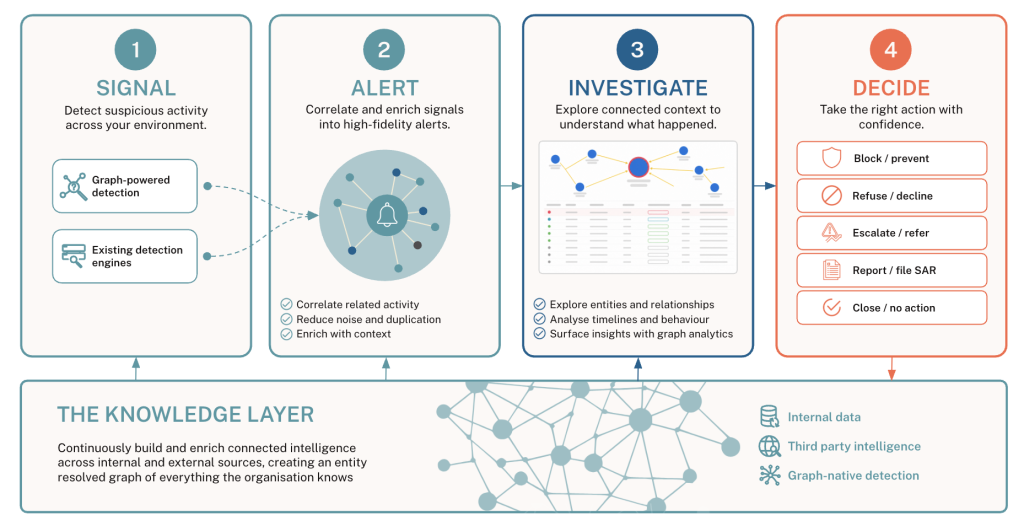
Unify: Build the knowledge layer for every investigation
Every investigation starts with a connected intelligence picture.
Teams use predefined schemas and data connectors as a fast starting point. They then integrate, enrich, resolve, and connect data from internal and external sources, creating a knowledge layer that mirrors their financial crime domain.
That might include customers, accounts, transactions, devices, cases, watchlists, OSINT, corporate information, and the relationships between them. And as new questions emerge, investigators can bring in third-party and case-specific data to fill gaps in their intelligence picture.
The result is a graph-native, persistent, entity-resolved foundation that gives teams a connected view of what’s happening.
Signal: Detect the risk hiding in connections
Isolated events often look legitimate. Risk only becomes visible when they’re viewed in the context of a broader pattern.
GraphAware Financial Crime Intelligence comes with a library of predefined graph-powered detection models that teams can use, customize, and extend. By looking across entities, transactions, systems, and relationships, graph-powered detection focuses on the connections between events rather than any single one, surfacing patterns like shared infrastructure, identity reuse, circular flows, and layering as they emerge, rather than after the fact.
This works alongside the detection tools already in place, not necessarily instead of them. Existing detection engines can continue to generate signals, while graph-powered detection adds another way to identify connected behavior.
Alert: Turn signals into investigation-ready work
An alert should not be the beginning of a data hunt.
Neo4j GraphAware Financial Crime Intelligence can correlate related activity and enrich signals with the knowledge layer, creating higher-fidelity alerts with more of the relevant context already attached.
Investigators can immediately understand why an alert was triggered, see the relevant signals and risk indicators, and understand who and what is involved.
Instead of piecing together the intelligence picture from scratch, every alert arrives ready to investigate.
Investigate: Follow the evidence wherever it takes you
The system that produces the alert should not define the limits of the investigation.
Investigators can explore entities and relationships, analyse timelines and behavior, trace transactions, accounts, devices, and links across multiple degrees of separation, and use graph analytics to surface additional insight.
If the investigation raises new questions, they can bring in third-party or case-specific data and continue following the evidence.
That helps straightforward false positives close faster while giving investigators the depth they need for the complex threats that genuinely require judgment.
Human-led, AI-accelerated ways of working can further speed up this analysis. Investigators and agents can reason over the same knowledge layer, using the same connected organizational context while keeping human judgment at the centre of the investigation.
Decide: Turn connected evidence into defensible decisions.
The outcome might be blocking a transaction, refusing or declining activity, escalating a case, filing a SAR, or closing the case with no further action.
Whatever the decision, teams need to be able to explain it.
Neo4j GraphAware Financial Crime Intelligence keeps evidence, relationships, provenance, and decisions connected. Investigators can preserve the path from signal to decision, making even complex investigations easier to reconstruct, explain, review, and defend.
And every investigation makes the next one sharper: new behaviors and patterns uncovered during an investigation can be translated into new or refined monitoring, improving future detection.
Use cases across financial crime
Transaction monitoring and fraud investigation
Existing detection systems generate enormous volumes of signals and alerts. For teams investigating them, the challenge is understanding which ones matter and how they connect.
Neo4j GraphAware Financial Crime Intelligence correlates and enriches those signals with the knowledge layer, helping investigators move from an isolated alert to the wider intelligence picture.
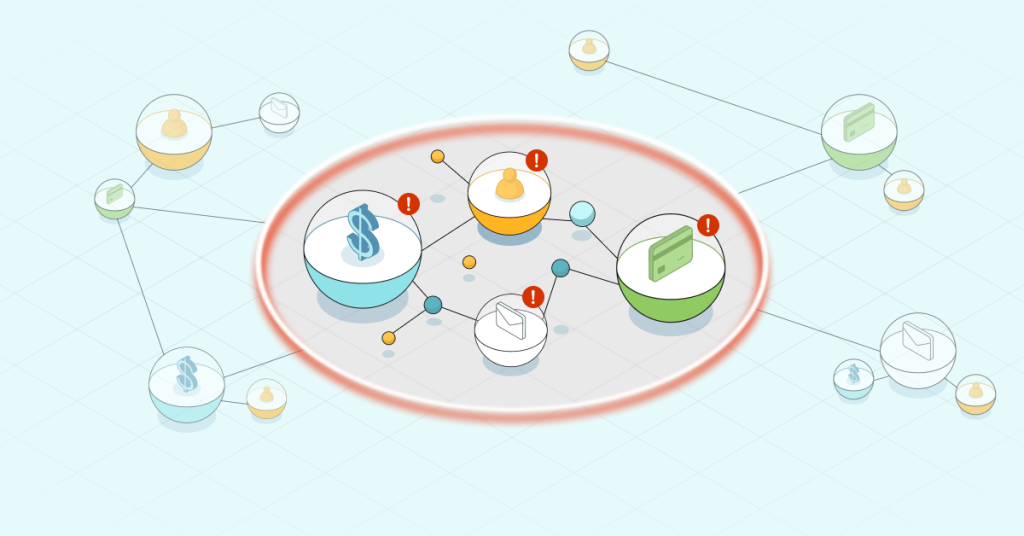
That can expose patterns such as the same device, address, identity information, or infrastructure appearing across apparently unrelated accounts.
The same logic applies to money mule networks. Individual accounts may make modest transfers. Viewed as a connected network, however, investigators can see funds converging on common destinations or moving through a wider chain.
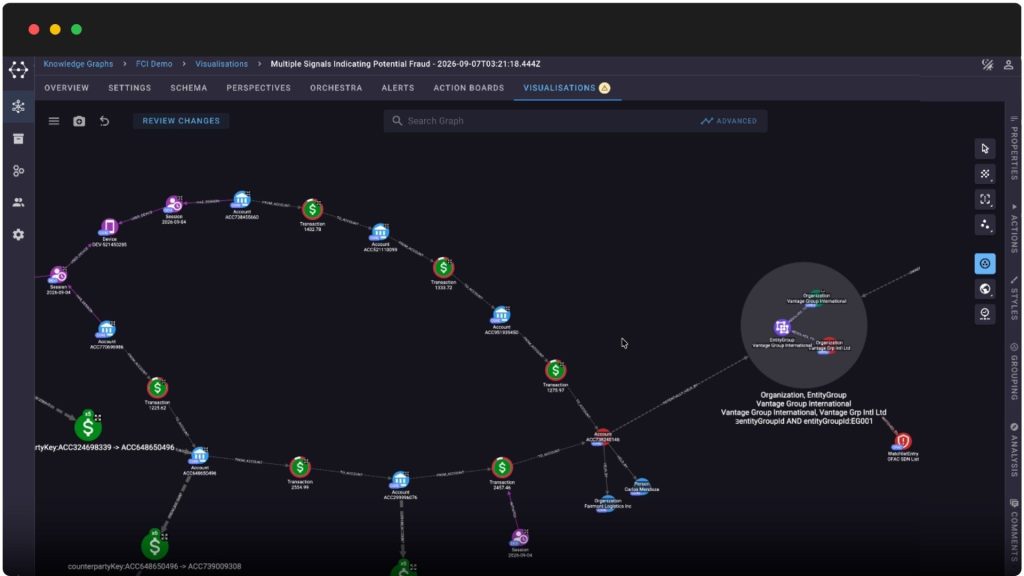
Anti-money laundering, know-your-customer, and watchlist screening
Anti-money laundering and customer due diligence require more than checking a customer or transaction in isolation.
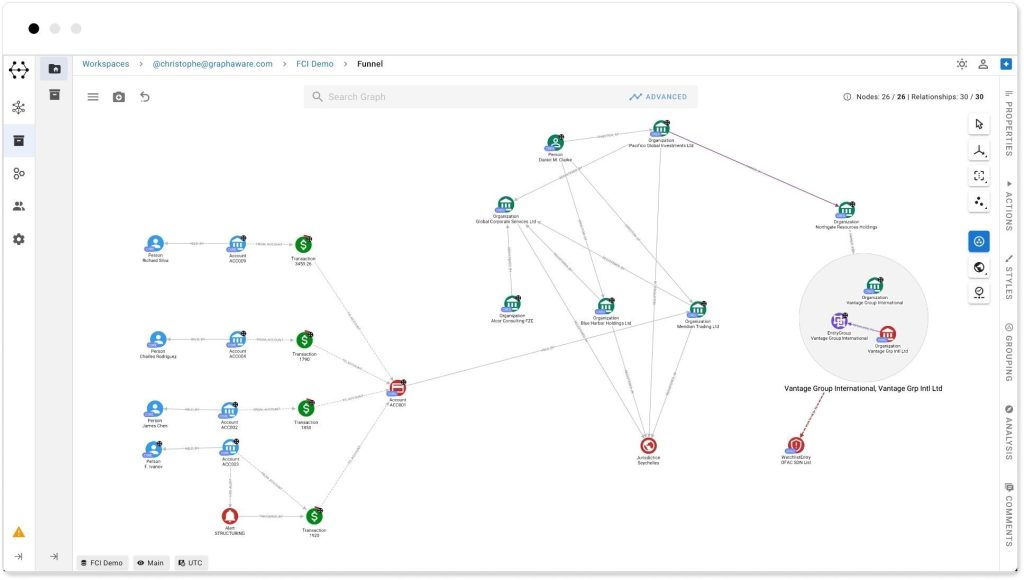
Investigators may need to understand ownership and control, trace ultimate beneficial ownership through corporate structures, connect customers to related parties, and combine sanctions, PEP, adverse media, and corporate registry intelligence.
Bringing those sources into the same knowledge layer means that screening and investigation become part of the same evidence picture rather than separate exercises.
Insurance claims fraud
The same principle applies in insurance.
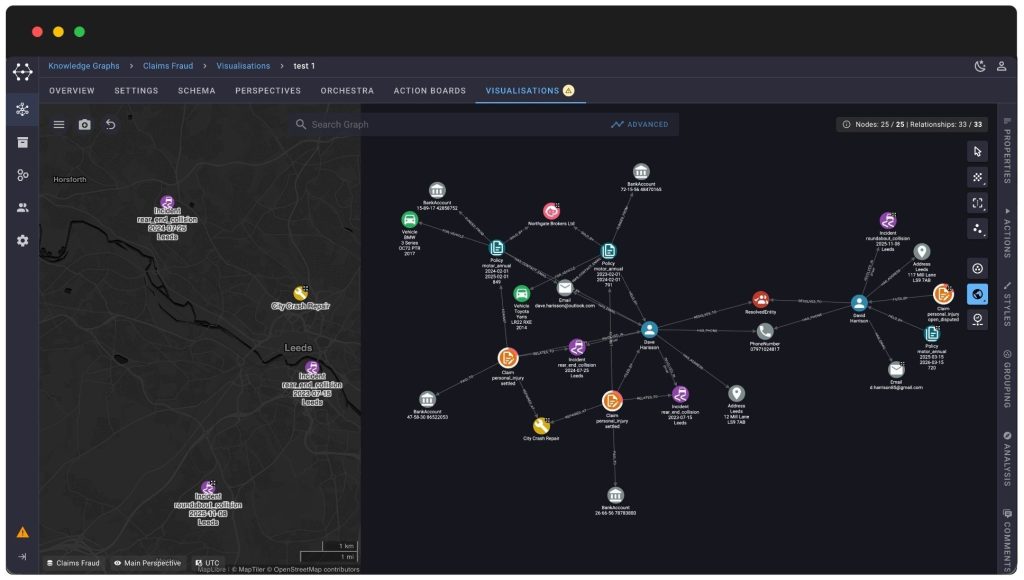
People, addresses, providers, vehicles, accounts, or other entities may recur across claims that appear unrelated when viewed individually.
Exploring those relationships across multiple degrees of separation can reveal whether apparently separate claims form part of a wider organized fraud network.
Open, extensible, and built to be owned by you
A financial crime intelligence foundation also needs to change as the organization changes.
With GraphAware Financial Crime Intelligence, teams control the data, model, pipelines, and workflows, and adapt them as their risks, processes, and priorities change. They can bring data in from any source, build on our predefined financial crime models and detection patterns, and extend the same connected intelligence foundation into new use cases over time.
Build once, then expand the model, data, and workflows as needs evolve.
Keep what works, prove value, then expand
None of this requires ripping out existing detection engines, case management tools, or data infrastructure.
Neo4j GraphAware Financial Crime Intelligence connects to the data, systems, and detection engines already in place, providing the knowledge layer and investigation environment that brings them together. It can work alongside existing case management systems and enterprise knowledge stores.
Teams can start with a familiar, high-value problem. Predefined schemas, connectors, models, detection rules, and graph patterns help put connected intelligence into analysts’ hands quickly, without requiring a major transformation of the existing environment.
Financial crime doesn’t stay in one system, one team, or one use case. Your intelligence foundation shouldn’t either.
To learn more, visit the webpage.
See it in action
Join us for a LinkedIn Live on October 13th at 8 a.m. PT, noon ET, 6 p.m. CET
Share Article


Explore
Related Articles
Fraud rings hide in the connections: Graph-Enriched Detection for Databricks Genie with Neo4j
APRA just put the financial sector on notice over AI. Government agencies need to take notes.
Detect fraud faster with a Transaction Graph
GraphRAG in action: A simple agent for know-your-customer investigations