Agentic AI in Cybersecurity

Senior AI Solutions Architect, Neo4j
10 min read
Consolidate tribal and enterprise knowledge to succeed
Your Security Operations Center (SOC) is overwhelmed and security professionals can’t cope with the myriad of inputs and signals they are faced with. A heavily studied concept is cybersecurity fatigue (or cyber fatigue), which is the emotional and cognitive strain caused by prolonged exposure to cybersecurity demands.
Cybersecurity professionals operate in a state of continuous vigilance, dealing with high volumes of false positive alerts, malware warnings, and compliance demands. A 2025 study by Mizrak et al. found that this constant activation of the brain’s threat response exhausts cognitive resources. This fatigue directly reduces a professional’s ability to focus, slows their response times, and increases their error rate when assessing genuine threats.
Organisations try to solve for this by deploying cybersecurity automation, where Agentic AI has become the go-to toolset of choice. In fact, a recent paper by Guy Waizel shows that heavily regulated sectors like healthcare remain hesitant, but Security Operations Centers (SOCs) and software engineering are experiencing some of the most rapid uptake.
However, simply dropping an AI agent into a SOC is not a silver bullet. While Agentic AI can process massive amounts of enterprise data, it inherently lacks access to tribal (or tacit) knowledge — the unwritten, localised context that veteran analysts carry in their heads. A standard AI model might flag a sudden spike in server traffic as a critical anomaly, whereas a seasoned professional instinctively knows it is just the legacy payroll system running its poorly optimised weekly batch job.
To truly alleviate cyber fatigue and make automation effective, organisations must bridge this gap.
They need to extract the undocumented intuition, historical workarounds, and environmental nuances from their analysts’ heads and consolidate this tribal knowledge alongside formal enterprise data and knowledge into a shared, centralised layer that AI agents can actually understand and reference.
When Agents Fail
When Agentic AI fails in a Security Operations Center (SOC), it does so time and time again because the AI model lacks the specific context of the environment it is defending, and the agentic harness has no means to provide it in an organised and intelligible way.
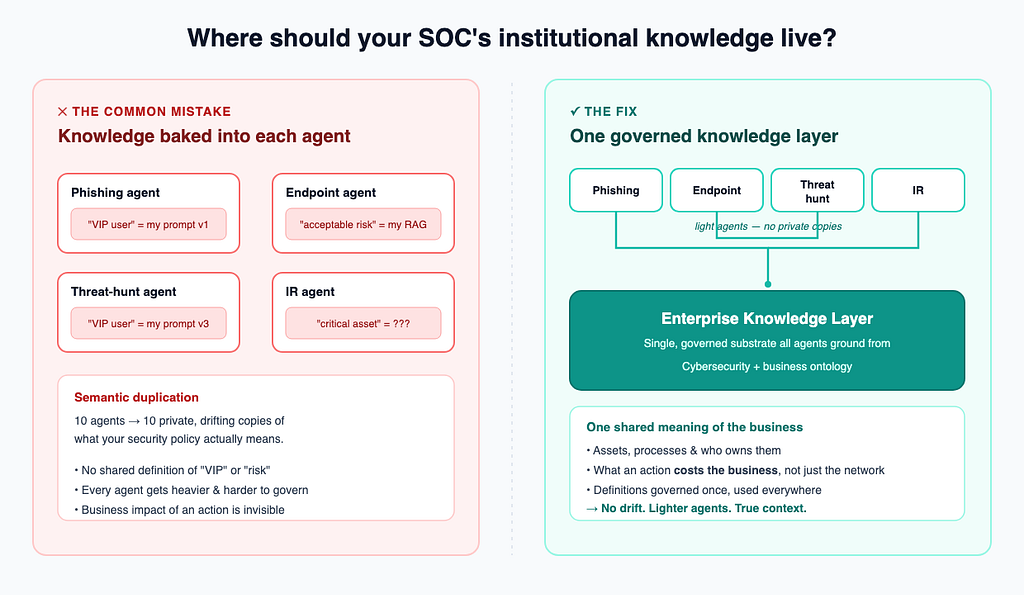
Security teams are rushing to deploy AI agents for threat hunting, phishing analysis, and incident response. But they often make a critical architectural error: they build the institutional knowledge into the agents themselves. A custom prompt for the phishing agent to define a “VIP user.” A specific Retrieval-Augmented Generation (RAG) pipeline for the endpoint agent to understand “acceptable risk.”
This creates semantic duplication. You end up with ten different agents holding ten private, drifting copies of what your security policies actually mean.
The fix is not to make individual agents heavier. The fix is to make them lighter by building a single, governed substrate they all get their grounding from: an Enterprise Knowledge Layer which contains the necessary cybersecurity and business ontology to guide your agents.
The knowledge layer for enterprise AI – Neo4j Graph Intelligence Platform
This must include enough information to guide the agent not just on what to do, but also the business impact of its actions: it needs the true context of the business and the assets and processes involved, not just an understanding of the infrastructure or the network.

Sometimes Agents Disagree on Reality
Enterprise data was built for applications and human analysts, who naturally supply the missing context. A human analyst knows that a vulnerability on a “Dev-Test” server doesn’t warrant waking up the CISO, but the same vulnerability on the core payment gateway is a critical incident.
When you hardcode this meaning into individual AI agents, the definitions inevitably drift. The Identity and Access Management (IAM) agent might redefine an “inactive account” as 30 days of no login, while the firewall agent assumes it means 90 days. Nothing breaks loudly, but the enterprise loses a single, consistent understanding of its own security posture.
The Cybersecurity Knowledge Layer (CKL)
Adapted or included in the broader concept of an Enterprise Knowledge Layer, the CKL is a shared, actionable substrate where an organisation’s security context lives. It sits between your raw telemetry (SIEM logs, asset inventories) and your AI agents.
Instead of agents rebuilding their understanding of the network from scratch every time they execute a task, they query the CKL continuously as they work. The CKL operates on three foundational pillars:
The Security Ontology (Context)
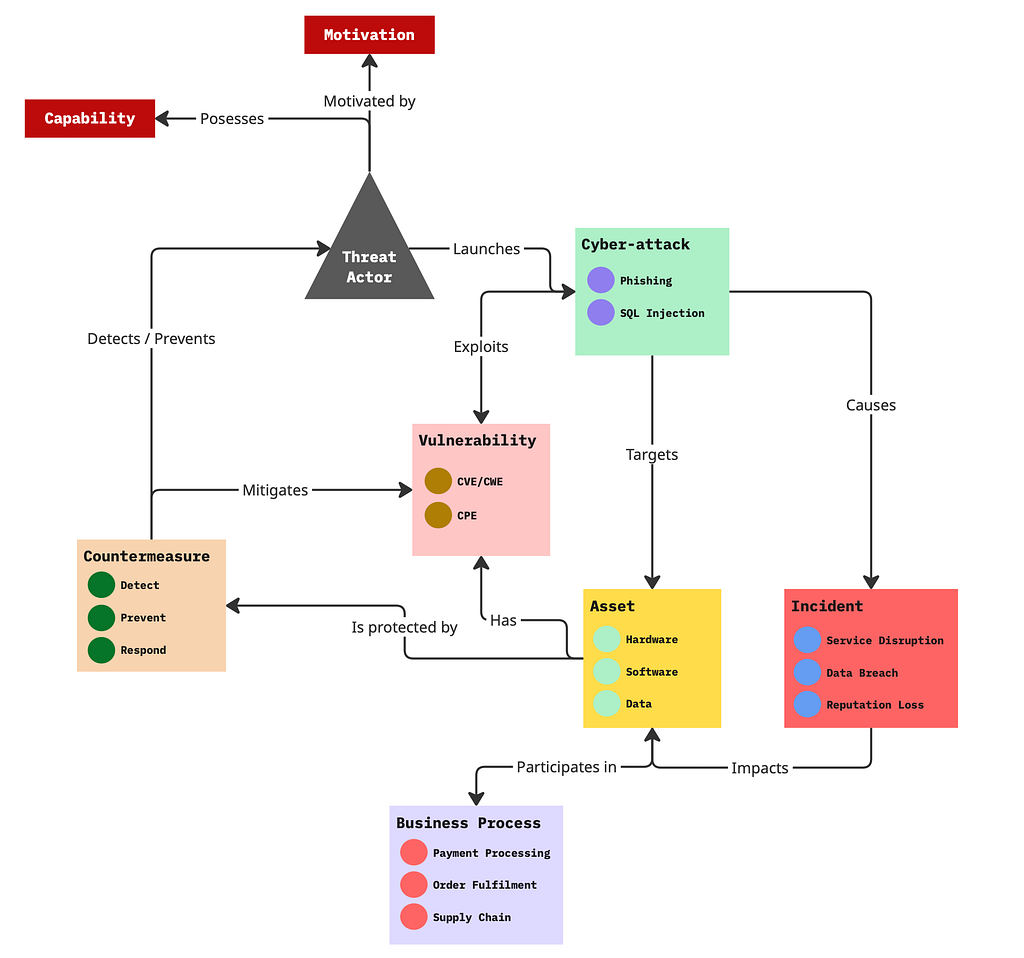
This is the live map of your environment and how it operates. It defines the formal relationships between business assets, technical infrastructure, and security concepts.
- What it holds: The mapping of the MITRE ATT&CK framework to your specific controls, the definition of a “critical asset,” the hierarchy of incident response teams, and constraints (e.g., “an automated agent cannot isolate a domain controller without human approval”).
- Why it matters: It provides the rules of engagement and the structural reality of the business.
Cybersecurity Data (Grounding)
This is the raw material that instantiates the ontology.
- What it holds: Active directory logs, threat intelligence feeds, vulnerability scans, and CMDB (Configuration Management Database) records.
- Why it matters: It grounds the agent’s actions in real-time facts rather than model hallucinations. The ontology says what a firewall is; the enterprise data says where the firewalls currently are and what traffic is hitting them.
Contextual Memory
This is the part that compounds and learns over time, capturing the decision traces of past events.
- What it holds: The history of false positives, successful remediation paths, and historical analyst notes.
- Why it matters: If an endpoint agent flags a suspicious PowerShell script, the memory layer remembers that this exact script is run every Tuesday at 2 AM by the finance automation tool. The ontology knows what the script does; the memory knows why it’s safe in this context. The next agent starts from everything the last thousand executions already learned.
How Neo4j Helps power the Cybersecurity Knowledge Layer
Building a Cybersecurity Knowledge Layer (CKL) requires an engine designed for context, not just scale. Traditional relational databases choke on the complex, multi-hop queries required to trace an attack path across an enterprise. Vector databases are great for finding similar text, but they cannot inherently understand the physical or logical topology of a network.
This is why Neo4j has become the foundational infrastructure for agentic AI in cybersecurity. It treats the relationships between data points as first-class entities, allowing AI agents to navigate your environment exactly like a human analyst would.
Here is how Neo4j’s ecosystem brings the CKL to life:
Multi-Hop Reasoning via the Native Graph Engine
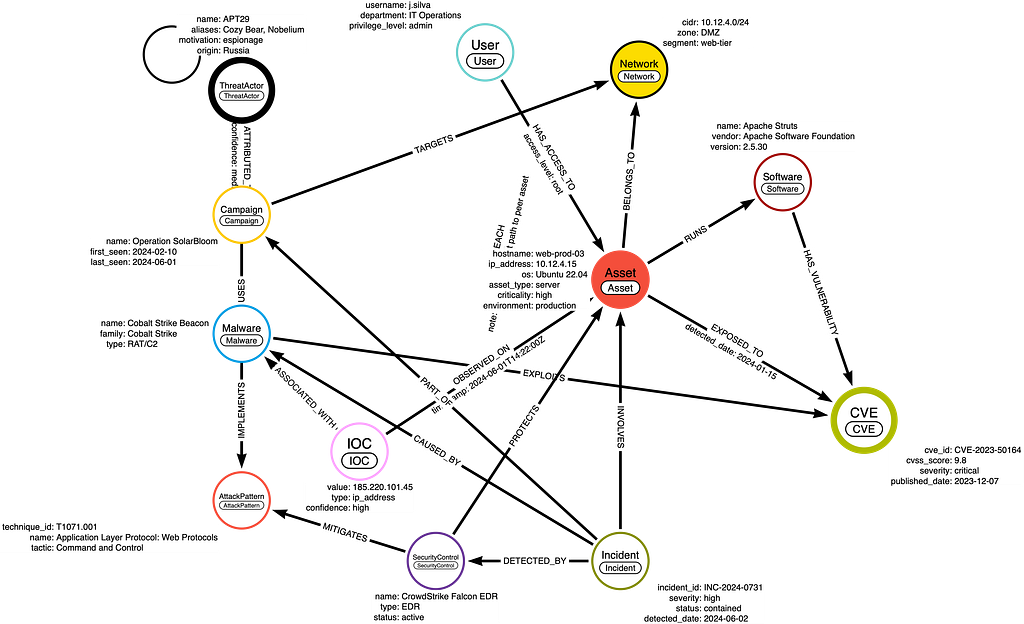
When investigating a threat, a standard AI agent might ask, “Is this user account compromised?” An agent connected to Neo4j asks, “If this user account is compromised, what specific servers do they have access to, and do any of those servers connect to our customer database?”
Neo4j traverses millions of interconnected nodes (users, devices, IPs, vulnerabilities) in milliseconds. This allows the AI to perform deep, multi-hop reasoning to instantly calculate the “blast radius” of a security event — a task that would require computationally crushing JOIN operations in a standard SQL database.
GraphRAG: Context-Aware AI Grounding
Standard Retrieval-Augmented Generation (RAG) often fails in cybersecurity because it relies on semantic similarity. If an agent searches for a specific malware hash, vector RAG might return paragraphs from a threat intel report.
Neo4j utilises GraphRAG, which combines vector search with graph traversal. When the agent asks about the malware, GraphRAG returns the text report plus the structural reality: “This malware exploits CVE-2024–1234, which currently exists on three active machines in your DMZ.” GraphRAG grounds the LLM in the exact topology of the threat, reducing hallucinations and making the AI’s recommendations immediately actionable.
Temporally-Aware Agent Memory
Enterprise environments are dynamic. IP addresses change, users log in and out, and cloud containers are spun up and destroyed. If a knowledge graph is purely static, the AI’s context becomes stale immediately.
Neo4j supports and can power real-time, temporally-aware memory layers (like Graphiti, a framework built on Neo4j). Instead of forcing the system to recompute the entire network graph every time a DHCP lease expires, the graph incrementally updates. This provides agents with a living history: they can query what the network looks like right now or rewind to see exactly what access a user had during an intrusion window last Tuesday at 3:00 AM.
Seamless Integration via Model Context Protocol (MCP)
The final piece of the architecture is connecting the agents to the graph, or other sources of data, securely. Through integrations with open standards like the Model Context Protocol (MCP), Neo4j acts as a governed, plug-and-play semantic substrate. Security teams can build specialised micro-agents (e.g., an IAM auditor, a phishing analyser) that all plug into the same Neo4j backend.
Because the definitions, schemas, and historical memory are held centrally in the graph, you can update your underlying AI models at any time without losing a drop of your organisation’s institutional knowledge.
Thinner Agents, Smarter Substrate
By extracting the meaning and context out of individual prompts and placing it into a centralised Cybersecurity Knowledge Layer, security teams can scale their automation safely.
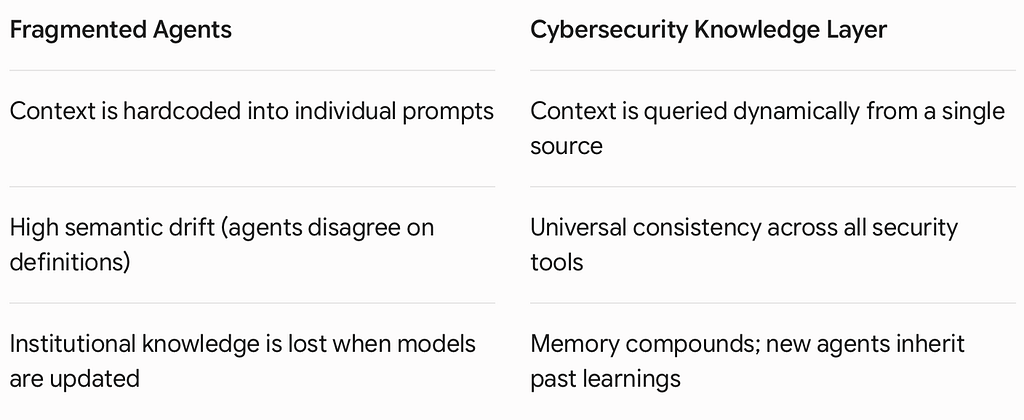
The cybersecurity industry is at an inflection point. We are moving from an era of alert fatigue into an era of AI-driven automation, but the rush to deploy Agentic AI has led to brittle, fragmented architectures. We have to stop treating AI agents as isolated brains that must be taught the intricacies of our networks from scratch, prompt by prompt.
The true power of AI in the Security Operations Center (SOC) isn’t unlocked just by using faster or larger models; it is unlocked through better architecture. By decoupling the “thinking” (the agent’s reasoning capabilities) from the “knowing” (the environment’s context), we create a defense system that is fundamentally more resilient. In this model, agents become agile, interchangeable workers. You can upgrade them, swap them out for newer models, or spin up highly specialised micro-agents without ever losing a drop of institutional memory.
This centralised approach unlocks the most critical asset in cyber defense: human competence and compounding learning. When an incident response agent successfully navigates a novel lateral movement technique and verifies it was a false positive driven by a misconfigured backup script, that context is written back to the memory of the Cybersecurity Knowledge Layer (CKL). Instantly, every other agent in the ecosystem inherits that exact operational reality. The business gets smarter with every execution.
Ultimately, agents should be dedicated to what they do best: interpreting complex intent, dynamically planning, and taking decisive action at machine speed. Leave the heavy lifting of contextualising the business, mapping relationships, and holding historical memory to the Knowledge Layer. Only by transitioning from siloed, hardcoded bots to a unified, governed semantic substrate can Agentic AI deliver on the promise of an autonomous, trustworthy, and scalable defense.
Agentic AI in Cybersecurity was originally published in Neo4j Developer Blog on Medium, where people are continuing the conversation by highlighting and responding to this story.
Share Article


Explore
Related Articles
Massive Parallel Imports in Neo4j Without Deadlock and Lock Contention
Auditing AWS infrastructure with Neo4j: questions inventory cannot answer