
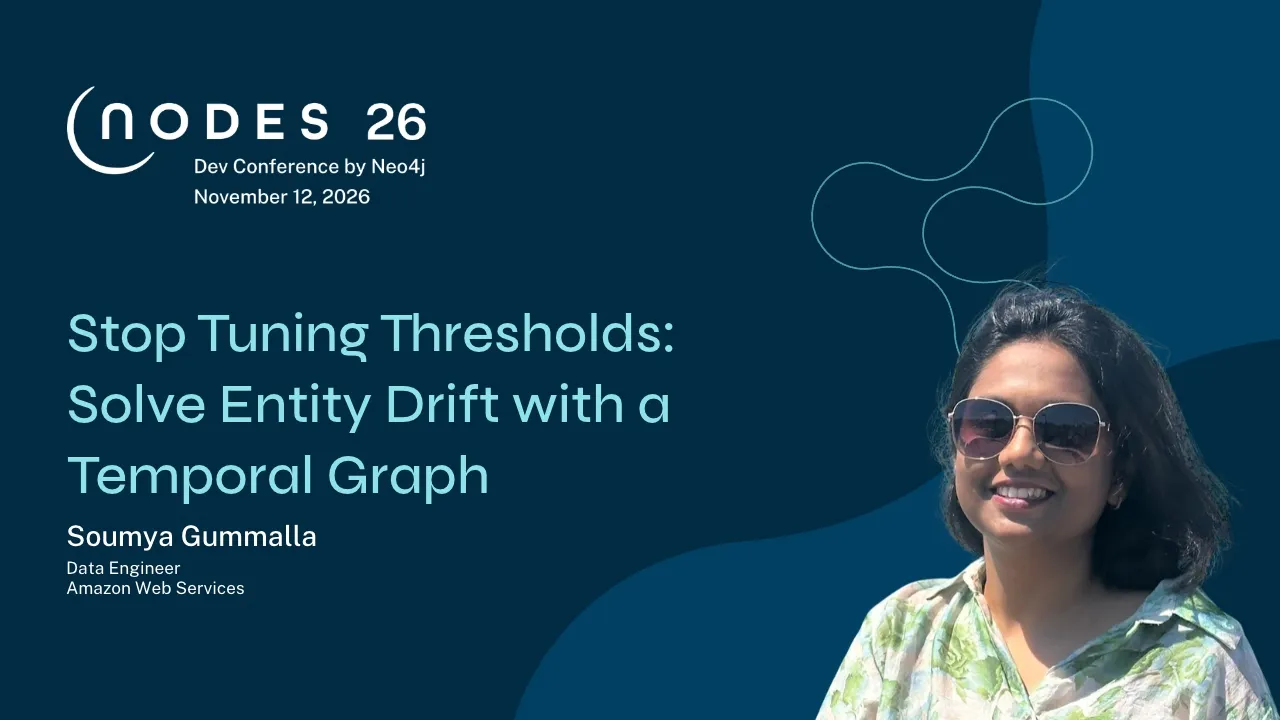
Stop Tuning Thresholds: Solve Entity Drift with a Temporal Graph




Most data pipelines that ingest financial data at a given cadence (monthly/quarterly) have an untold problem: drift in the entity name. Whether it's data for a service provided by the business or customer names, names are always a problem.
This can occur if a service/company is acquired, rebranded, or legally restructured — or simply because someone upstream entered a different name — and your pipeline treats it as someone completely new. Downstream ML and analytics platforms silently inherit this problem and produce results that are confidently wrong. The age-old solution is string matching, which needs constant threshold tuning, yet duplicates still make their way in.
In this session, Soumya will present why this problem needs a graph solution and how it can be structured to solve this silent but long-prevalent problem using graphs across time.
You will learn how to model temporal entity identity as a native graph, where monthly snapshots connect via typed relationships that encode resolution history, confidence scores, and drift events. You will see a hybrid scoring algorithm in action — combining fuzzy name similarity with revenue continuity and matching signals — that catches renames, merges, and spinoffs, identifying truly new entities from name changes that string matching alone misses. You will walk away with a reusable data model built around three node types (EntitySnapshot, CanonicalEntity, DriftEvent) and Cypher queries you can adapt to your own pipelines.
The demo is built on real SEC EDGAR data — public company filings with documented name changes — giving you a reproducible, verifiable dataset you can download and run yourself. If you build pipelines with time-series entity data in any domain where identity drifts, this session will give you a graph-native approach that solves the problem at its root.
Speaker: Soumya Gummalla
Resources mentioned
Resources
- Watched Duration: 25:16

- Watched Duration: 28:40

- Watched Duration: 18:36

- Watched Duration: 27:51

- Watched Duration: 25:59

- Watched Duration: 12:02

- Watched Duration: 16:16

- Watched Duration: 31:19
