

Graph technology: The clear choice for telecom
Telecommunications is all about connections. Graph databases are, therefore, an excellent fit for modeling, storing and querying telecommunications data of all kinds. Whether managing increasingly complex network structures, ever-more-diverse product lines and bundles, or customer satisfaction and retention in today’s competitive environments, graph databases enable businesses to become more agile by leveraging their connected data.
From the network graph, to the social graph, to the call center graph, and the master data graph, telcos around the world have begun to use graph databases to achieve competitive advantage. Neo4j provides thousand-fold performance improvements and massive agility benefits over relational databases, enabling new levels of performance and insight.
Fast track
Get up to speed quickly

Optimize network services: Advanced service assurance with Neo4j
Read the white paper to learn why three of the top five global telecom equipment companies rely on Neo4j to provide the visibility, scalability and adaptability needed for next-generation service assurance.

How Orange uses Neo4j for IT supervision and network security
In this interview Nicolas Rouyer, Senior Architect at Orange, discusses how the French telecommunications giant uses Neo4j in its network security and IT supervision business.
Graph databases in network & data center management
Learn how Neo4j is inherently more suitable than relational databases for making sense of complex interdependencies central to managing IT infrastructure.

Network security & cMDBs: Why graph visualization is essential
Learn how graph databases can be used for Network Security audits and managing Configurations Management systems.
Neo4j Telco customers



“At StarHub, we needed the agility to support a fast-moving set of product lines across an ever-growing range of offerings: mobile services, wireless broadband, Pay TV, residential broadband Internet (Fiber & Cable), residential voice services, and so on. By mapping our commercial product line hierarchy in a Neo4j graph, we’ve been able to greatly improve our business agility and IT responsiveness.”
—Dharmapalan Sampath, Sr. Principal Solutions Architect, StarHub
Why Telco companies choose Neo4j

Business outcomes
Impact analysis and network planning
Quickly determine the impacts of a node failure, maintenance outage or incursion and recommend alternate routes around your most relied-upon components.
Root-cause analysis
Immediately identify the root cause of any network or infrastructure problem by tracing back dependencies quickly and easily. Also provide service desks greater visibility into all components and relationships that make up your IT infrastructure.
Routing and quality-of-service (QoS) mapping
Find the best, shortest or least-busy path; pinpoint the best location in the network to introduce a new service; and complete your QoS mapping from the segment level to the entire network.
IT infrastructure management
Map IT services to the chain of dependent physical and virtual infrastructure components, optionally mapping all the way up to cost centers.

Challenges
Highly interrelated elements
Whether you’re managing a major network change, providing more effective security-related access or optimizing a network, application infrastructure or data center, the physical and human interdependencies are extremely complex and challenging to manage without the right technology.
Non-linear and non-hierarchical relationships
Relationships among the various nodes in your network are neither purely linear nor hierarchical, making it difficult to model using a traditional RDBMS. In addition, when two or more systems are brought together, these relationships become even more complex to describe.
Growing physical and virtual nodes
With rapid growth in network sizes and both the number and types of elements added to support new network users and services, your IT organization must develop systems that accommodate both current and future requirements.

Why Neo4j?
Native graph storage
Unlike relational databases, Neo4j stores interconnected network data that is neither purely linear nor hierarchical. Neo4j’s native graph storage makes it easier to decipher your IT operations by not forcing intermediate indexing at every turn.
Flexible schema
Neo4j’s versatile property graph model makes it easier for organizations to evolve their network and infrastructure models, especially as new technology is constantly added and legacy technology is retired.
Performance and scalability
Neo4j’s native graph processing engine supports high-performance graph queries on large network datasets to enable real-time decision making.
High availability
The built-in, high-availability features of Neo4j ensure your network data is always available to mission-critical applications.
Telco video case studies
-
40:10

Hardening your Information Security: Analyzing Active Directory
Watch video -
16:22

Graph Database in P2P / P2MP Connectivity for Video Contribution and Distribution Network (BT)
Watch video -
36:09
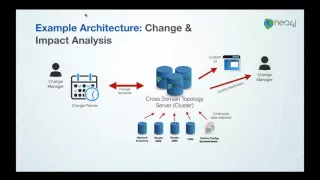
Network & IT Operations: Leveraging Connections in Data with Graph Databases
Watch video