Beyond the return: who controls the business?

Global Head of Public Sector & Workforce Intelligence
7 min read

A tax return can be correct and still tell the authority too little. The filing identifies the taxpayer but it may not reveal who actually controls the business.
Investigations into tax fraud and related financial crime often depend on some or all of the following: resolving identities, identifying businesses that reappear under new registrations, and identifying nominee directors or activity spread across several companies. Each record may be internally consistent while concealing the operator behind it.
Accurate records, but unresolved control
Operation Admiral shows the limits of a national administrative view. In April 2021, Portugal’s tax authority was investigating a company selling phones and other electronics on suspicion of VAT fraud. After the European Public Prosecutor’s Office (EPPO) began operations that June, the Portuguese authorities referred the case to it.
Although the invoicing and tax declarations appeared to be in order from a national administration perspective, the Portuguese European Delegated Prosecutors pursued the investigation further. The wider picture emerged when the EPPO, working with national authorities and Europol, traced connections to close to 9,000 other legal entities and more than 600 individuals across borders.
The structure of this carousel fraud case, which involved organised crime groups, revealed the “extraordinary complexity of the chain of companies.” EPPO described a network in which different companies performed different roles: supplying electronics, claiming VAT refunds, moving sales proceeds offshore and laundering the money. Understanding the scheme required investigators to establish how those activities connected across companies and borders.
Such investigations need to establish who directed suspicious companies and on whose behalf they acted. The registrations are a starting point for this work that evolves to include cross-border pattern analysis and forensic accounting.
Patterns that hide control
Other structures can also separate the registered entity from the person directing it.
The reappearing operator. A company is wound up with unpaid tax debts. A new company continues the business, with the same person directing it under different names or as a director. That connection warrants examination, but does not itself establish wrongdoing. Investigators need to determine whether the operator deliberately used the transition to avoid liabilities.
The layered structure. A holding company, a trust, and a nominee director can separate the decision-maker from the business under investigation. The named director signs the documents, while evidence of control may sit several relationships away, in another company’s records or in the movement of money. The OECD describes how chains of entities and nominee arrangements can obscure beneficial ownership. Investigators need to trace those relationships and establish what they mean; complexity alone does not demonstrate concealment.
The threshold splitter. A business divides its activities across several related entities so that each appears to fall below a gross-receipts threshold. Viewed separately, each may seem eligible for small-business treatment. In the US, IRS guidance states that the aggregation rules under section 448(c) are designed to prevent businesses from using that separation to qualify. They do this by combining the receipts of entities linked through specified ownership, control or service relationships. Establishing those links can require tracing direct and indirect ownership, attributing ownership between certain family members and entities, and examining management and service arrangements. This is a compliance example, not necessarily fraud.
Each mechanism can exploit gaps in the authority’s view of connected entities.
Investigations involving these patterns require two related capabilities. Entity resolution establishes which records refer to the same person or business, despite differences in names, addresses or identifiers. Ownership and control tracing connect distinct entities to the people behind them.
A new company controlled by a previous offender remains a distinct company. The investigator needs to preserve that distinction while establishing the relationship. Collapsing connected businesses into “one taxpayer” would obscure part of the structure that the investigation needs to explain.
Declared ownership is a starting point
Registry records may identify directors and declared owners. In a straw-man arrangement, the person named may have little involvement in running the business. Investigators need to establish who makes the decisions and test the declared structure against other evidence.
That requires following relationships across companies, people and financial activity. Who authorises payments? Where does the money go? Does the named director act independently, or do the records point to someone else directing the business? Tax, banking and trade records can help answer those questions where investigators have lawful access to them.
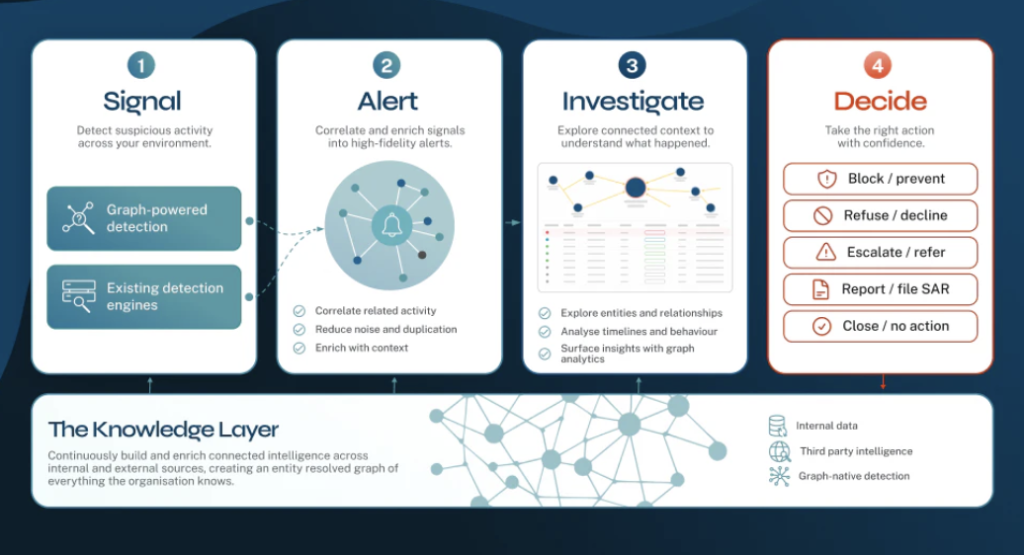
Neo4j provides the graph foundation for an investigative knowledge layer. The graph does not collapse everything into one taxpayer. It preserves the distinct people, companies, accounts, filings, and transactions, and makes the relationships between them visible and reviewable. Investigators can follow an ownership chain through intermediary companies, examine the movement of money alongside it and identify connections that warrant closer scrutiny. The practical value is being able to move between the declared structure and the activity that may support or challenge it.
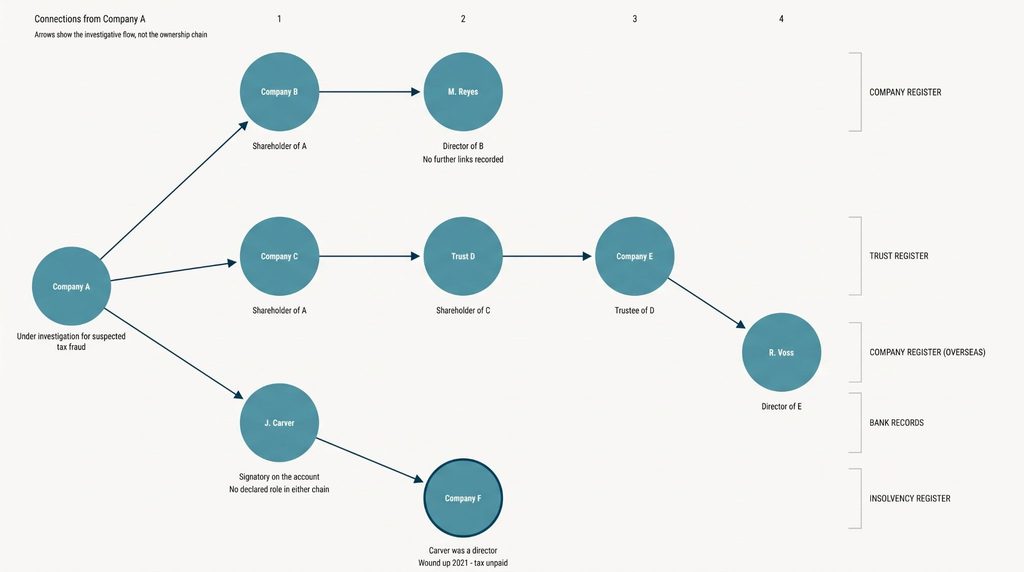
These connections still require judgment. A shared address or bank account may justify further examination without establishing common control or wrongdoing. Each relationship the case relies on needs supporting evidence, with its source and relevant dates available for review. Bringing that information together can reduce the effort required to assemble the structure, giving investigators more time to assess who controls the business and what the evidence establishes.
Why the problem compounds
The same people and infrastructure can recur across cases.
A manually resolved investigation finds the connection it was looking for and may be limited to the connections needed for that case: one taxpayer, one filing, one flagged transaction. The network may extend much further: the same director appears on three other filings, the same address sits behind a cluster of new registrations, and the same bank account receives several supposedly unrelated refunds. Unless the system connects those markers, each becomes a separate investigation, if anyone investigates it at all.
The cost is cumulative. When identity matches and ownership links remain buried in individual case files, later investigations may have to reestablish them. That repeated work leaves analysts less time to assess the evidence and pursue further connections. Adding analysts can increase capacity, but it does not eliminate the repetition.
Entity resolution as a graph problem
Treating entity resolution as a graph problem changes the unit of investigation. In a request for information in June 2026, the US Internal Revenue Service’s Criminal Investigation division explicitly sought tools to resolve identities from fragmented information and to map connections among individuals, businesses, and assets. The request highlights a concrete investigative need: connecting scattered records to reveal relationships that can help advance tax and financial-crime investigations.
Graph-based entity resolution can use similarities in names, addresses and other attributes, together with relationship patterns, to identify records that may refer to the same person or business.
Investigators can then trace ownership and control through holding companies, trusts and chains of nominee directors directly in the data, following the chain as far as it runs, without needing to know in advance how many intermediaries separate a person from a business. This reduces the time analysts spend manually assembling ownership chains, giving them more time to assess the evidence behind each connection.
Carry the knowledge into the next investigation
What an investigation establishes needs to remain open to revision. Directors change, companies are acquired, and new evidence can challenge an earlier identity match. A useful investigative record preserves sources and dates, distinguishes declared relationships from analytical findings, and allows conclusions to be reviewed.
Maintaining those findings in a knowledge layer allows their value to extend beyond the case that first established them. A later investigation can build on the existing work, subject to access permissions and the purpose for which the information can be used. Investigators can examine what was established, the evidence supporting it, what remains uncertain and what has changed.
A tax authority should not have to reconstruct the answer to “who controls this business?” every time a new case opens. Keeping identities, relationships, and supporting evidence connected gives investigators a foundation they can test, extend and revise. Each case can then leave the authority better equipped to understand the next.
Talk to an expert
Interested in exploring how Neo4j can help your organization connect taxpayer, company, ownership and transaction data for investigations?
Share Article



Explore
Related Articles

New Ways to Scale and Apply Enterprise AI with Neo4j
Introducing Neo4j GraphAware Financial Crime Intelligence