Public sector workforce intelligence and compound questions

Global Head of Public Sector & Workforce Intelligence
5 min read
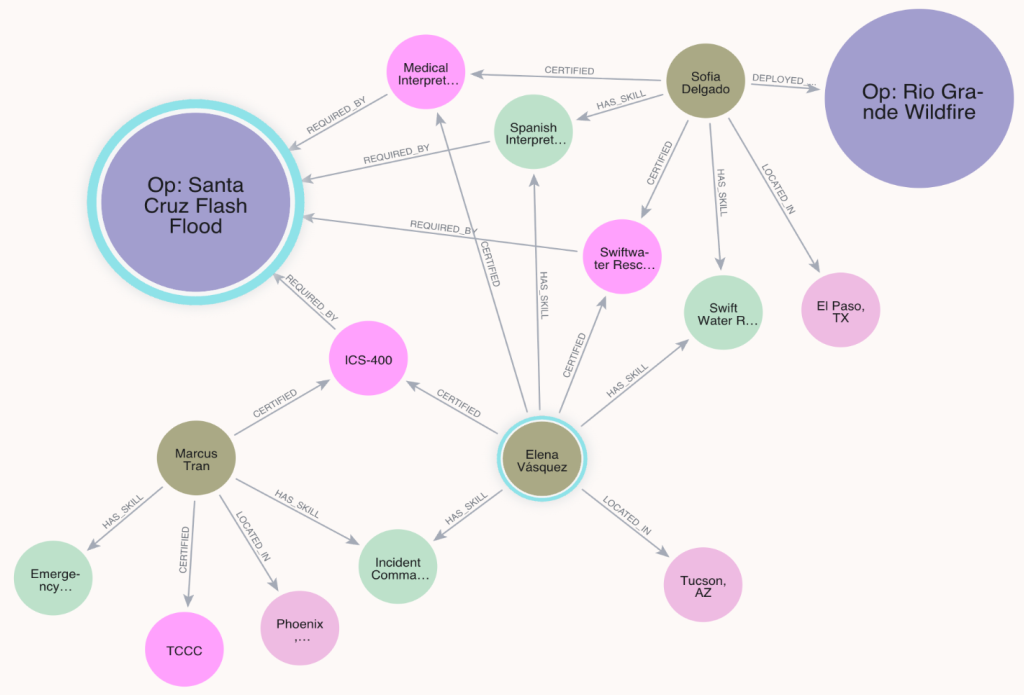
Who’s available right now—with the right skills and clearances, in the right location—and whose redeployment won’t create a critical gap somewhere else?
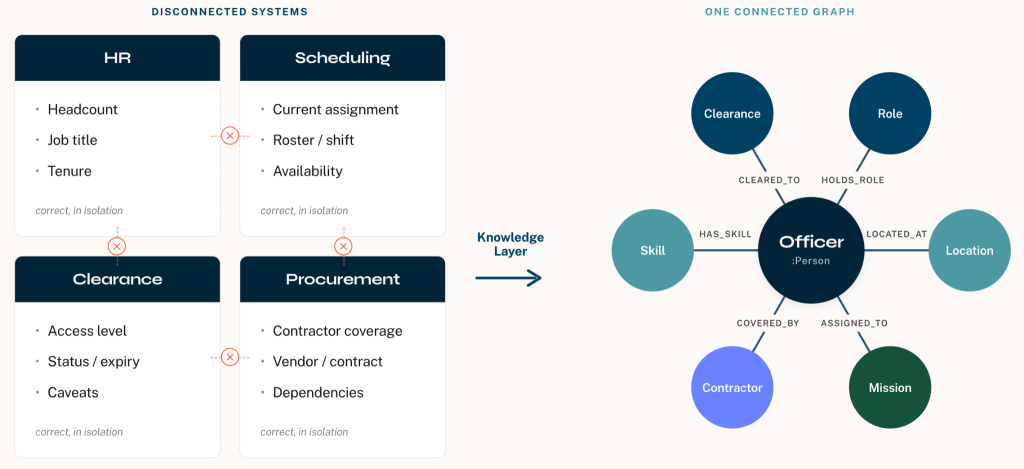
Every public sector operations leader has a version of this question. It’s a chain of conditions, each dependent on the last, spanning systems that were never designed to work together. HR knows who’s employed. Scheduling knows who’s deployed. Security knows who’s cleared. Procurement knows which contractors support which programmes.
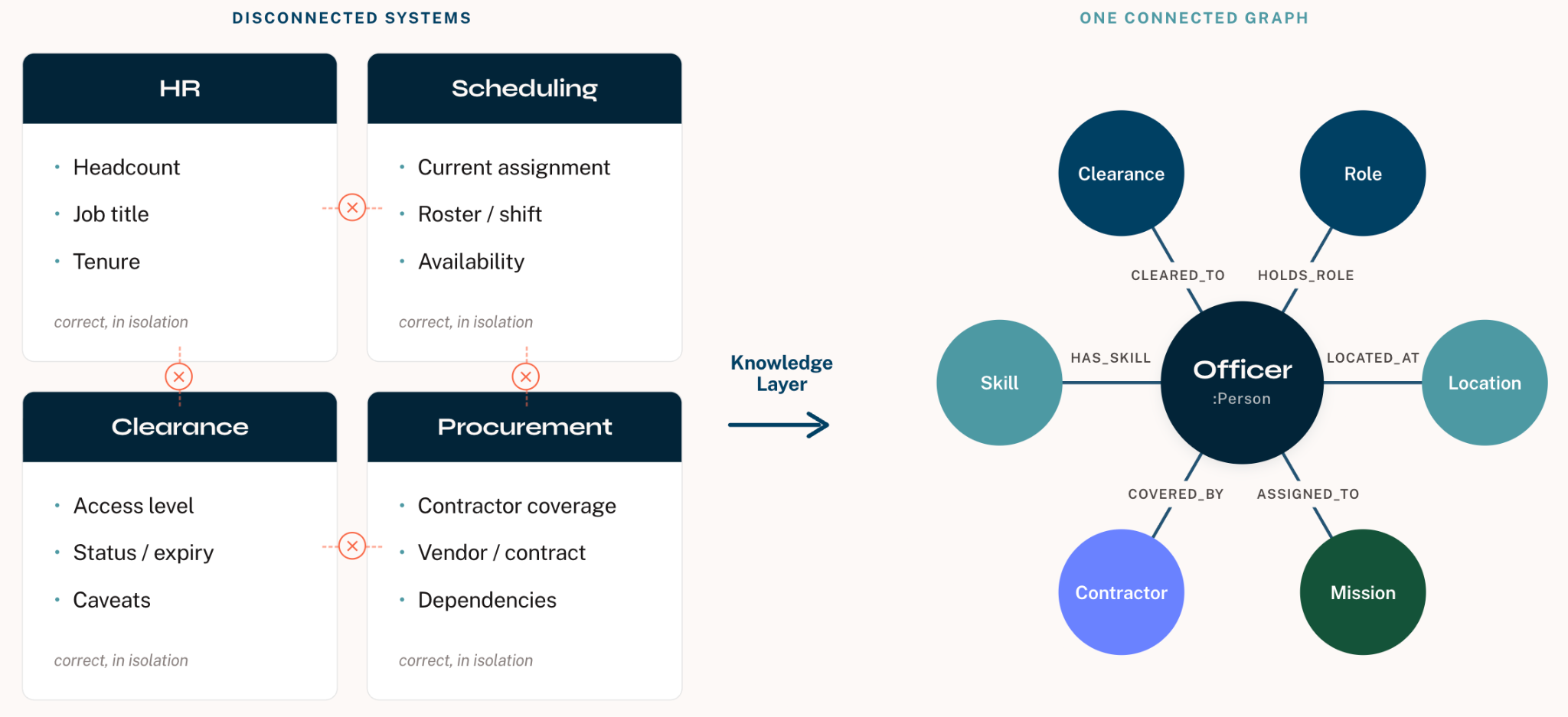
Each system answers its own question correctly but none answer the compound one.
So someone assembles the answer manually: headcount from HR, deployment status from scheduling, clearance records from security, contractor coverage from procurement, stitched together under pressure. By the time the briefing is ready, the situation has already changed.
In emergency response, defence, healthcare, and critical infrastructure, that delay is more than an inconvenience. It’s an operational risk. Decisions that affect public safety and national resilience can’t wait three days for someone to reconcile spreadsheets.
Pressure doesn’t arrive in sequence anymore
Most workforce systems were built for a different operating environment.
Pressure used to arrive in sequence. Respond to one crisis. Recover. Prepare for the next. Workforce decisions could be deliberate. Handovers could be planned. There was time to understand the downstream consequences of moving people between missions.
That environment no longer exists.
The OECD Employment Outlook 2025 describes the structural pressures facing governments across advanced economies: ageing workforces, shrinking talent pipelines, and skills shortages accumulating faster than organisations are replacing them. At the same time, operational demand has become increasingly concurrent. The EU Civil Protection Mechanism was activated 64 times in 2025 in response to conflicts and natural disasters occurring simultaneously rather than sequentially.
Individually, each trend is manageable. Together, they create compound workforce pressure: fewer experienced people available at precisely the moment organisations are expected to respond to more overlapping events.
Budget constraints compound the challenge. Across much of the public sector, workforce leaders are deciding where limited investment in hiring, training, and retention will have the greatest operational impact. Every recruitment decision becomes a prioritisation exercise: which vacancy matters most, which capability gap creates the greatest downstream exposure, and where will one additional specialist strengthen multiple missions rather than just one?
MissionSquare Research Institute found that more than half of public sector HR leaders in the US expect the largest wave of retirements in their organisations within the next few years, yet only 13% of state and local governments have a formal succession planning process.
The question is no longer simply “Who has this skill?”
It’s “Who has the capability, is available now, holds the required clearance, is close enough to deploy, and can move without creating another operational gap?”
That answer depends on everything happening across the organisation at once. Most workforce systems were never designed to answer questions like that.
The failure isn’t inside the systems
Public sector organisations rarely lack workforce data. They have HR platforms, training records, clearance databases, scheduling tools, procurement systems, contractor information, and operational reporting.
The failure doesn’t occur inside any one of those systems. It occurs in the seams between them.
Operational decisions almost always cross organisational boundaries. A deployment decision depends simultaneously on skills, certifications, clearance, location, current assignment, contractor coverage, mission priority, and the cascading impact of moving someone elsewhere. No individual system owns that answer.
Consider an organisation standing up an urgent cyber response team after a major incident. It knows who it employs. It knows who holds cyber certifications. It knows who’s currently deployed. It knows who has the necessary security clearance.
What it cannot answer quickly is who satisfies all of those conditions simultaneously and can be redeployed without leaving another mission exposed. This is an architectural problem.
The gap between “every system is correct” and “the organisation can answer the operational question” is where mission risk emerges.
Operational decisions are relationship problems
Traditional workforce systems are designed to retrieve records. Operational decisions require traversing relationships. A deployment decision is a chain of dependencies:

Every step changes what becomes possible next.
Relational databases can answer these questions, but only through increasingly complex joins, business logic, and manual orchestration as relationships multiply across systems. The query becomes harder to maintain than the decision itself.
Neo4j’s Graph Intelligence Platform approaches this differently, building a knowledge layer across existing workforce systems. Rather than replacing HR, scheduling, security or procurement platforms, the knowledge layer connects people, skills, certifications, clearances, contractors, suppliers, programmes and missions into a single view of the workforce. Organisations keep using the systems they already trust, and gain the ability to reason across them as one operational workforce.
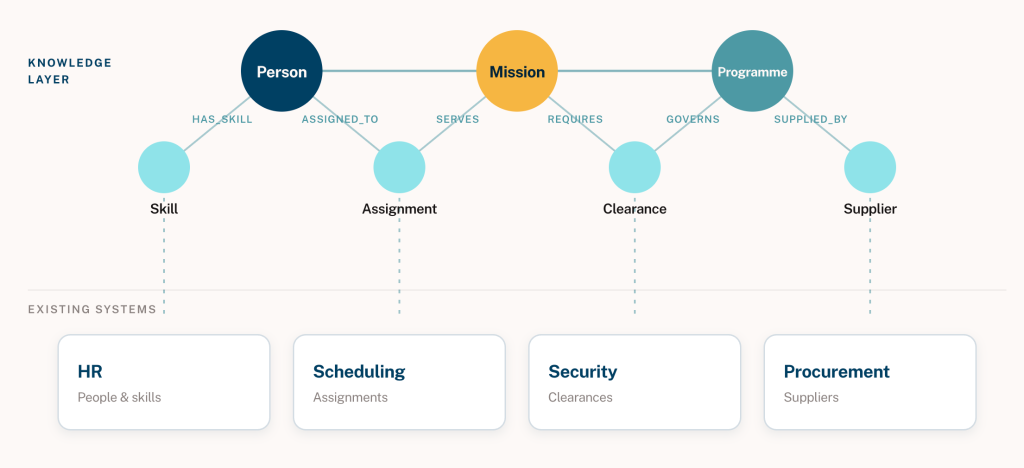
The result is a shift from reporting what exists to understanding what happens next.
Because the knowledge layer is grounded in structured relationships, leaders can ask operational questions that would otherwise require days of manual analysis:
- Which personnel can deploy within 24 hours without degrading another mission?
- If funding allows only twenty specialist hires this year, which roles reduce organisational risk the most?
- Where are we one retirement or clearance expiry away from losing critical capability?
- Which contractor creates a hidden single point of operational failure?
- What breaks if this supplier exits tomorrow?
These are operational intelligence questions, not HR ones. Answering them takes connected intelligence.
From workforce management to workforce intelligence
The organisations that navigate today’s compound operational pressures will be the ones that have built operational workforce intelligence: a connected understanding of people, capabilities and dependencies that supports confident decisions under pressure, not the ones with the largest workforce or the biggest technology budgets.
Your workforce already operates as a connected system. Neo4j’s knowledge layer helps your data reflect that reality, turning disconnected workforce records into operational workforce intelligence.
The question is whether you’ll discover your dependencies before the next crisis—or only because of it.
Part 2: Why public sector AI needs a workforce knowledge layer
Enterprise Graph use cases that solve modern data challenges
Connected views lead to better decisions.
See the power of graph intelligence.
Share Article


Explore
Related Articles