This Week in Neo4j: Memory, Knowledge Graph, GraphRAG, AI Agents and more

Staff Community Manager
4 min read
Welcome to This Week in Neo4j, your fix for news from the world of graph databases!
This edition goes deep on agent memory and graph architecture: the neo4j-labs agent-memory three-tier model, why siloed data systems break under concurrent operational pressure, a benchmark showing a Neo4j semantic layer cutting Text-to-SQL token usage by up to 10× while improving accuracy, and a full production stack walkthrough for GCP agents combining GraphRAG, semantic layers and graph memory.
The Call for Papers for NODES 2026 is still open until June 15 – if you have a graph story to tell, now is the time to submit.
Share your experiences and influence the future of Neo4j products: Join the Neo4j User Research panel! It’s a chance to connect directly with product development teams, get paid compensation, hear about what we are working on and more!
Happy Graphing,
Alexander Erdl
COMING UP!
- Livestream: Going Meta: S03E09 on June 2
- Conferences: Find us at Percona Live, Mountain View on May 27-29, AI Now Summit, Paris on May 28, CascadiaJS, Seattle on June 1-2, Snowflake Summit, San Francisco June 1-4 & AI in Production, Newcastle on June 4-5
- Meetup: Meet us in Krakow, PL on May 25, Berlin, DE on May 27, Paris, FR on June 1
- All Neo4j Events: Webinars and More
- GraphSummit Series: Transform Your Enterprise with Graph and GenAI – Next Stop: San Francisco on July 23
FEATURED COMMUNITY MEMBER: Adam Pingel
Ashita is a developer advocate at AWS, working at the forefront of front-end and AI technologies.
Connect with him on LinkedIn.
His session at NODES AI introduced “Semiont: A Graph-Based, AI-Native Wiki and Annotator”, an open-source, W3C-based semantic annotation layer that lets you build inspectable, self-governed knowledge graphs from documents.
AGENT MEMORY: Inside Neo4j’s agent memory
Paul Iusztin takes a deep dive into neo4j-labs/agent-memory, explaining its three-tier memory model (short-term conversation, long-term typed entities, reasoning traces) and how the library’s three-tier graph architecture (short-term conversation, long-term typed entities, reasoning traces), POLE+O ontology, and SAME_AS deduplication pattern actually solve the agent memory problem.
KNOWLEDGE GRAPH: Sequential Systems. Simultaneous Crises.
Luanne Misquitta started a new series with a diagnosis: military, healthcare and emergency systems don’t have a headcount problem or a budget problem – they have a data architecture problem. When operational pressure arrives concurrently rather than sequentially, siloed HR systems can’t answer compound questions about who is available, qualified and safe to redeploy without breaking something else. That’s exactly the problem a connected, relationship-traversable data model is built to solve.
GRAPHRAG: How a Neo4j semantic layer makes your Text-to-SQL agent smarter and cheaper
Laurent Tande benchmarks two Text-to-SQL agents side by side: one feeding the full YAML schema to the LLM on every call, and the other querying a Neo4j semantic layer for only the relevant subgraph. Resulting in 20–30% fewer tokens on average, up to 10× less on simple queries, and ~10% better accuracy on complex multi-table joins. The repo is public and runnable in three minutes.
AI AGENTS: Build AI Agents that make better decisions on GCP with Neo4j
Michael Hunger covers the full stack for running production-grade agents on GCP with Neo4j: GraphRAG retrieval via hybrid Cypher queries, a semantic layer that helps agents navigate enterprise data sprawl, three-tier graph memory (short-term, long-term entities, reasoning traces) and context graphs that surface tacit decision patterns from agent traces. All of that with working code and integrations for ADK, Gemini Enterprise A2A and the Neo4j MCP server on Cloud Run.
HACKATHON: Aura Agents
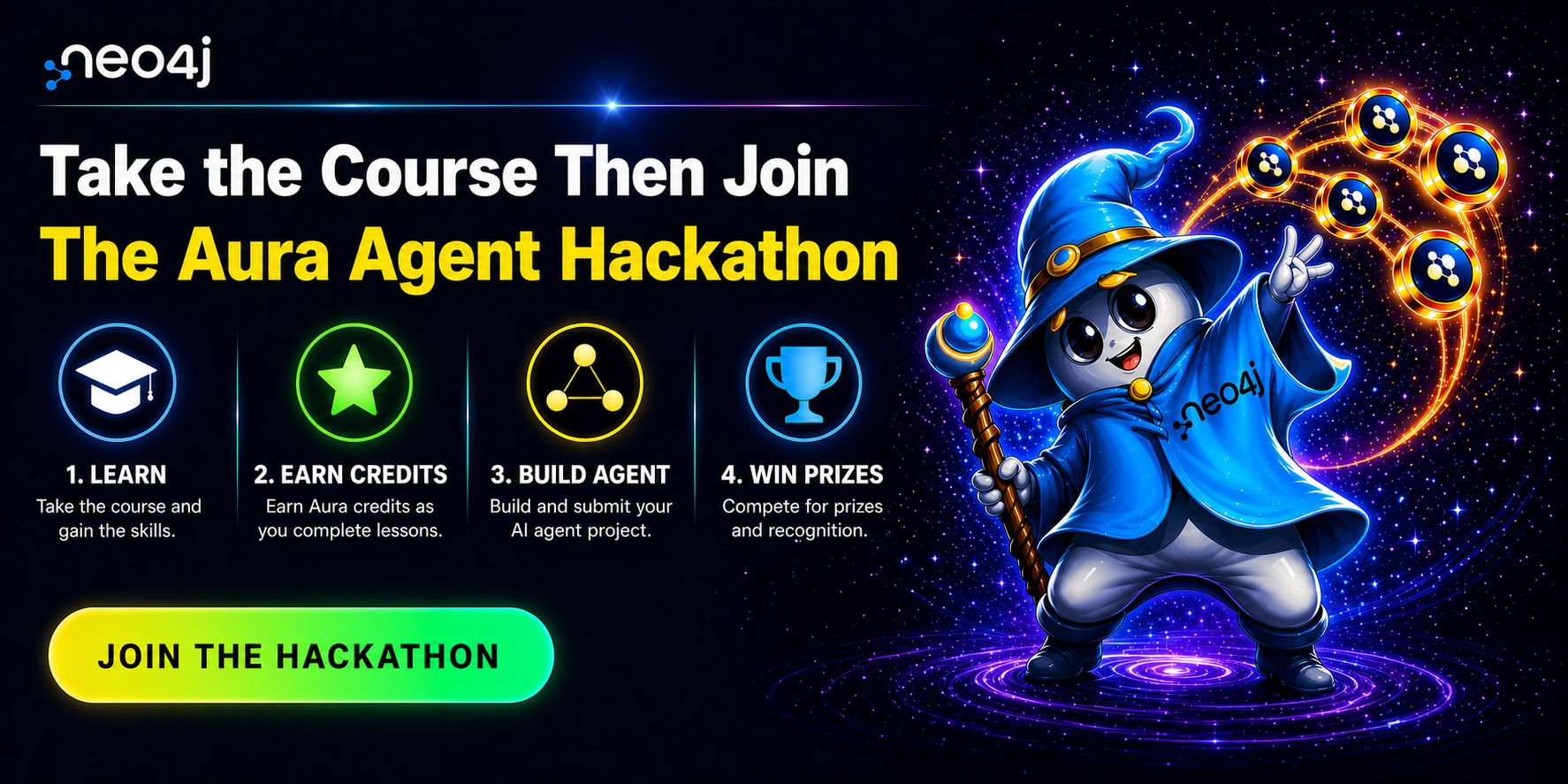
The Aura Agent Hackathon is in full swing and projects can be submitted through June 15. The community is already building some seriously impressive projects.
Complete the Building Agents in Neo4j Aura course by June 15, register for your $100 Aura credits and build an AI agent powered by a knowledge graph. Prizes including Bose QuietComfort Ultra Headphones, a Raspberry Pi 5, Aura credits and a newly designed Neo4j “Agent” T-shirt.
CONTINUOUS LEARNING
- GraphAcademy: There is still time to complete the “Building Agents in Neo4j Aura” course and get free Aura Credits
- Learn on Your Schedule: Go deeper into graph technology on Neo4j’s On-Demand webinar library
- Workshops: Join our virtual classrooms workshops from Fundamentals to GenAI
- New Webinar: Graph-Powered Architecture Design for Agentic AI – Americas, Europe, Middle East & Africa, Asia Pacific
POST OF THE WEEK: Yuval Shimon
Please share it if you like it!
Share Article


Explore
Related Articles

This Week in Neo4j: Agent Orchestration, GraphRAG, Geospatial Knowledge Graph and more
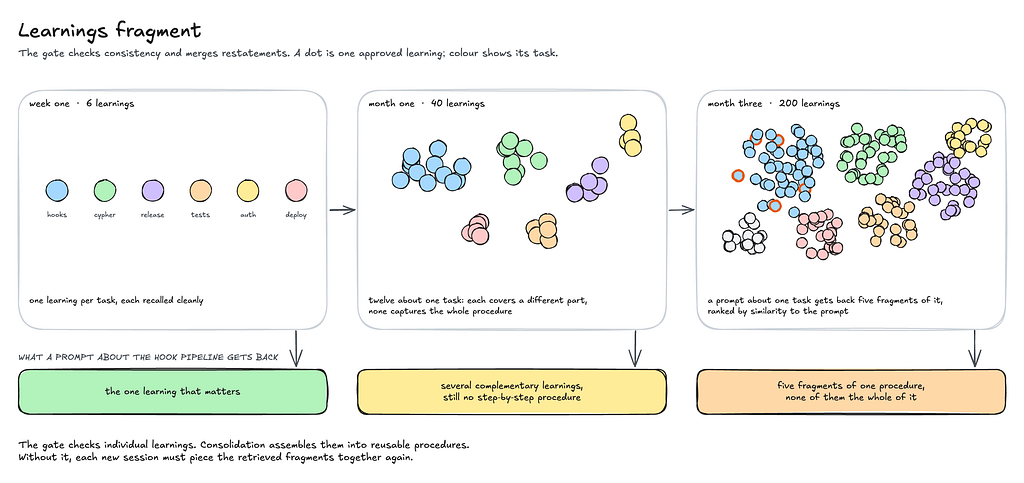
From memory to behavior: skills, user profiles, and the consolidation loop