
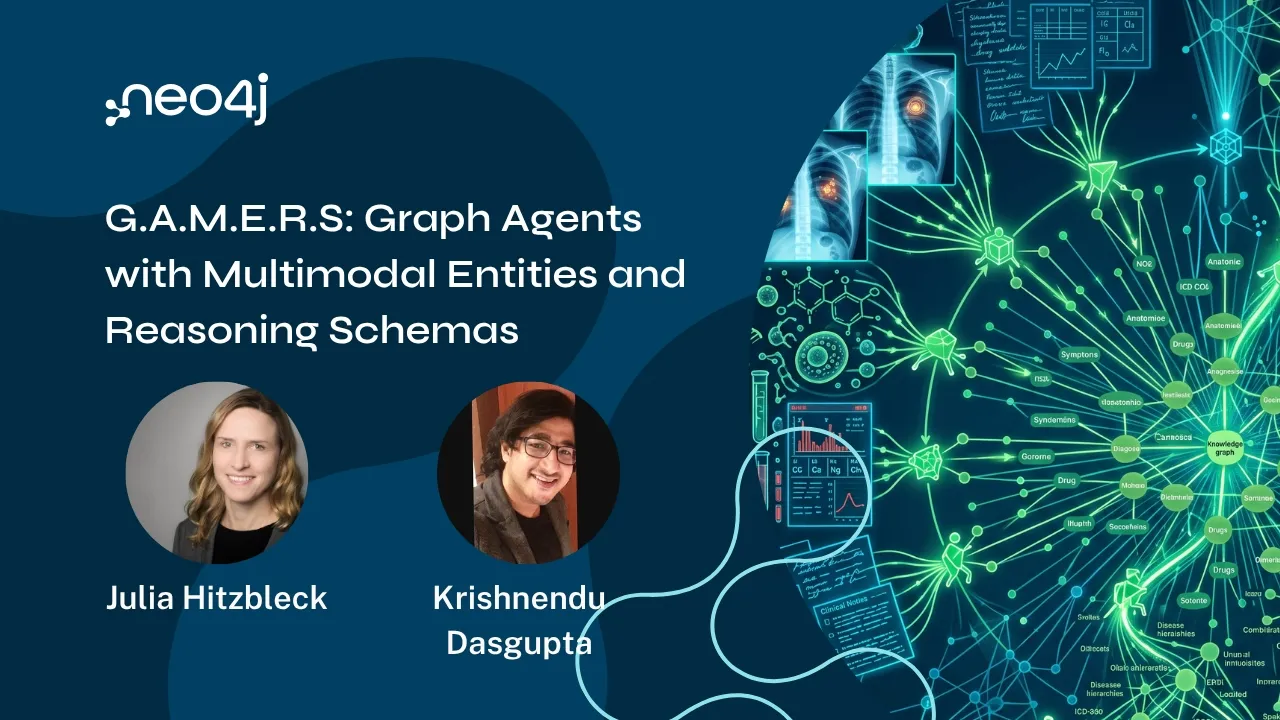
G.A.M.E.R.S: Graph Agents with Multimodal Entities and Reasoning Schemas


Chapters 10
- Play from Introduction & Guest Welcome
- Play from The Problem: Patient-to-Clinical Trial Matching
- Play from Introducing GAMERS: Graph Agents Framework Overview
- Play from System Architecture: Data, Models & Context Gateway
- Play from Knowledge Graph Schema: FHIR, ICD-11 & Medical Ontologies
- Play from Agent Memory & the Stateful Agent Pipeline
- Play from Canonical Evidence & Deterministic Finalization Rules
- Play from Live Demo: Patient Roster & Cohort Intelligence
- Play from Live Demo: Trial Matching & Agent Reasoning in Action
- Play from Q&A: Temporal Data & Why RLM Outperforms Standard LLMs
Patient data lives in PDFs, radiology scans, lab results, and clinical notes. Most AI systems read each one alone, and context disappears between encounters.
G.A.M.E.R.S (Graph Agents with Multimodal Entities and Reasoning Schemas) fixes that with graph-based context memory. See how graph agents extract multimodal clinical entities, traverse disease hierarchies and comorbidity chains, and combine dense embeddings, BM25, and graph traversal in one hybrid retrieval pipeline built on FHIR and the WHOLE framework.
Walk away with the architectural patterns, live demos, and graph schemas to build agents that remember every patient encounter and reason across modalities, running on open-source models in a fully decentralized, private compute stack.
Guests: Krishnendu Dasgupta ( linkedin.com/in/krishdasgupta (opens in a new tab) ) & Julia Hitzbleck ( linkedin.com/in/julia-hitzbleck (opens in a new tab) )
Resources mentioned
- Watched Duration: 19:18

- Watched Duration: 36:04

- Watched Duration: 26:36

- Watched Duration: 30:57
- Watched Duration: 30:00
- Watched Duration: 1:06:18

- Watched Duration: 1:00:42

- Watched Duration: 1:05:33
