This Week in Neo4j: GraphAcademy Takeover

Developer Experience Engineer at Neo4j
5 min read
Hey, Adam (from GraphAcademy) here, filling in for Alex this week.
This week, in This Week in Neo4j, I’m here to let you know that we have launched a brand new, refreshed version of GraphAcademy.
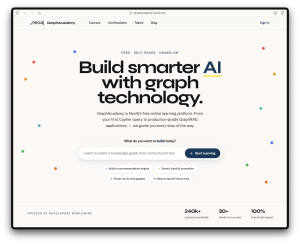
For those of you who aren’t aware, it’s Neo4j’s home for hands-on learning. Real Cypher, real graphs, completely free hands-on learning. You learn by building, either at your own pace or live in a workshop with other people.
Over the past few months, we have been busy rebuilding the site from the ground up. We’re bringing E.L.A.I.N.E, our AI learning assistant, to the front and center, to help you find your next course and guide you through your learning.
If you live in your IDE, we’ve also released a GraphAcademy MCP server, so you don’t need to leave your editor to learn Neo4j.
We’ve also been busy writing for our new blog feature. But that’s not what this email is about. This one’s about what’s new to do.
Share your experiences and influence the future of Neo4j products: Join the Neo4j User Research panel! It’s a chance to connect directly w,ith product development teams, get paid compensation, hear about what we are working on and more!
Happy Graphing,
Adam Cowley
COMING UP!
- Livestream: Network Intrusion Detection with Neo4j and Snowflake on July 22
- Meetup: Meet us in Pune, IN on July 18 & Melbourne, AU on July 23
- All Neo4j Events: Webinars and More
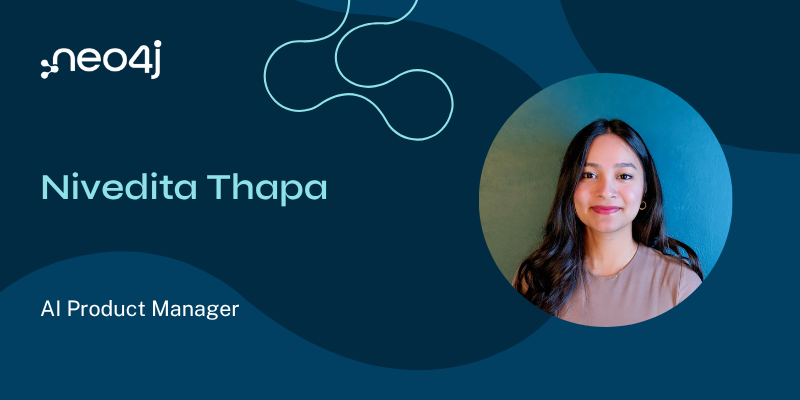
FEATURED COMMUNITY MEMBER: Nivedita Thapa
Nivedita built Semantic Model Inspector, an open-source tool that evaluates how ready enterprise semantic models are for LLM-powered analyst tools like Snowflake Cortex Analyst. Her work sits at the intersection of semantic modeling, knowledge graphs, and AI-powered analytics.
Connect with her on LinkedIn.
She has one of the first confirmed sessions at NODES 2026 “Are Your Semantic Models AI-Ready? What Knowledge Graphs Teach Us About Building Context for LLMs”, where she will take a public semantic model, encode the same domain in Neo4j as a typed knowledge graph, and expose that graph context to an LLM before SQL generation. You will see the graph schema, the Cypher patterns that capture what warehouse-native semantic layers miss, and side-by-side code examples of LLM query generation with and without graph-backed context.
FOCUSSED LEARNING: Try a lab now
Some things don’t need a full course. You just need to learn one thing, fast. That’s what Labs are designed for – short, single-module, hands-on lessons that get you in and out with one specific skill.
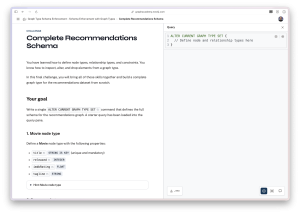
One subject. No setup. Less than an hour.
A few to start with:
- Working with Dates and Durations in Cypher – learn how temporal types, including dates and times, can be used in Neo4j to filter, compare, and calculate with precision.
- Graph type Schema Enforcement – define a consistent schema that acts as your ontology at the database level. Structure without giving up flexibility.
- Full-Text Search in Neo4j – Create and query full-text indexes for case-insensitive search.
Try one now. You’ll be skilled and ready in time for your morning standup.
YOUR OWN PATH: Find your next course
Not sure what to learn next? There’s more than one way to find out.
Courses are now organized by:
- Topic – GraphRAG, Cypher, MCP, and more.
- Persona – developer, data scientist, DevOps, context engineer, graph data scientist.
- Learning path – a sequence of courses aimed at a concrete goal.
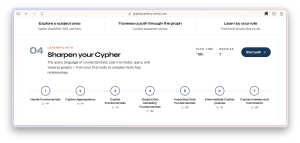
One example of a learning path is Neo4j certification: a defined route that ends with something real, a certified Neo4j developer credential.
Got something specific in mind? Tell the onboarding assistant what you’re trying to build, right from the homepage search box, and it’ll point you to the courses or path that get you there.
Choose your own adventure.
WORKSHOPS: See upcoming events
Self-paced learning gets you far, but nothing beats building something live, with other people, in the room (or on the call) with you. And as more of our workshops get built around MCP, that hands-on format matters even more: you’re learning how to work with Neo4j inside the tools you already use.
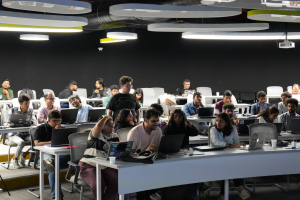
Case in point: the Agentic GraphRAG Mini Hack in Bengaluru, run by Zaid Zaim. Thirty minutes of teaching, two hours of MCP-assisted coding, seventeen projects built, four winners.
Would you like to deliver one of these yourself?
If you know Neo4j and want to teach it – in your workplace, at a meetup, wherever – we want to help you do it.
Deliver through the GraphAcademy platform, and you get instructor notes, a built-in slide view, and help promote the event. We’ll even run a train-the-trainer session with you first, so you walk in confident. Show up, log in, present.
GET IN TOUCH: Graphacademy Feedback
That’s the takeover. New site, new Labs, clearer paths to your next course, and more workshops than ever.
We put a lot of time and thought into this platform, from the design down to how each course teaches you something. So go take a look, and tell us what you think. What’s working, what’s not, what would make it better. We’re genuinely excited to hear it.
And if you’re ready to teach Neo4j yourself, get in touch. We’ll help you get there.
See you at a workshop soon!
STARTUPS: EcocomityChain.AI
EcocomityChain.AI built a material genealogy graph in Neo4j that traces a modeled vehicle from the finished product down to raw ore. Eight levels deep, 34,713 nodes, 554 suppliers across every tier.
The payoff is the kind of question a flat supplier list can’t answer. Their graph spots when the same nickel ore sits under 19 separate assembly chains, quietly turning one mine into a single point of failure for an entire vehicle program. It also surfaces where your real recovery time hides, often six levels below your Tier-1 supplier.
They wrote it up as three worked scenarios against a live graph, so it reads like a build log you can actually follow. If you’re wrestling with deep, connected data of your own, it’s a sharp example of what graph thinking makes visible.

CONTINUOUS LEARNING
- GraphAcademy: Join the “Cup“, complete Courses and win prizes
- Learn on Your Schedule: Go deeper into graph intelligence on Neo4j’s On-Demand webinar library
- Workshops: Join our virtual classrooms workshops from Fundamentals to GenAI
- New Webinar: Enterprise AI is missing a key ingredient: The knowledge layer – Americas, Europe, Middle East & Africa, Asia Pacific
POST OF THE WEEK: Yuval Shimon
Please share it if you like it!
Share Article


Explore
Related Articles
Your AI Agent Forgets Everything. So We Taught It to Remember — With a Graph.

Cut Text2SQL token costs up to 81%, and stop paying for wrong answers: a Neo4j semantic layer across BigQuery and Databricks