What 40 AI Agents Revealed About the Future of Graph Intelligence

Developer Relations Community Manager, Neo4j
8 min read
I’ll be honest. When we kicked off the Aura Agent Hackathon, I didn’t know exactly what to expect. What I did know was that the Neo4j community never disappoints, and this time was no different.
It started at NODES AI 2026. If you weren’t there, go watch the videos. The energy set the tone for everything that followed. We had recently launched a new generation of Aura Agents (low code graph retrieval agents), and the challenge to the community was simple: take the GraphAcademy course, earn Aura credits, build an agent, solve a real problem.
What came back genuinely blew the judges panel and me away.
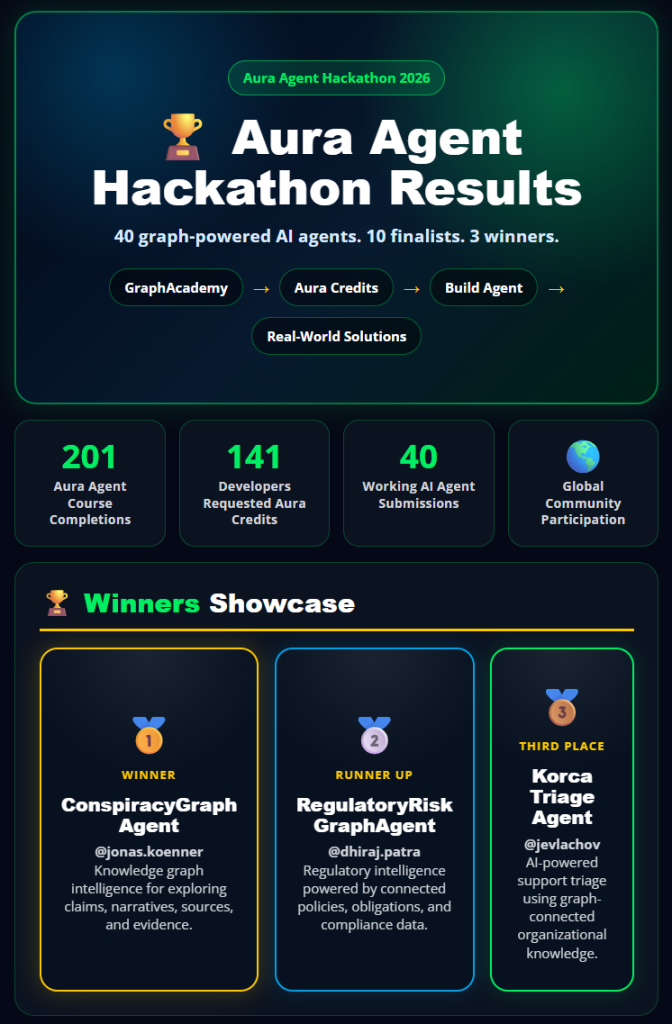
Developers from around the world picked up the tools and ran with them, building knowledge-graph-powered AI applications across healthcare, finance, cybersecurity, geospatial intelligence, misinformation analysis, agriculture, fitness, and more. By the time submissions closed at midnight on June 15, the numbers told their own story:
- 201 Aura Agent course completions
- 141 developers who requested Aura credits
- 40 working AI agent submissions
- Participants from every corner of the world
Forty developers independently converged on knowledge graphs as the right architecture for their hardest problems. That’s not a coincidence. That’s a pattern worth paying attention to.
The Winners
Our judges scored every submission across five dimensions:
- Graph Matters,
- Useful Agent,
- Shows Thinking,
- Interesting Idea,
- and Presentation.
The projects that rose to the top did so because they treated the graph as the intelligence, not just the storage layer.
Here’s who came out on top.
🥇 First Place: ConspiracyGraph Agent (@jonas.koenner)
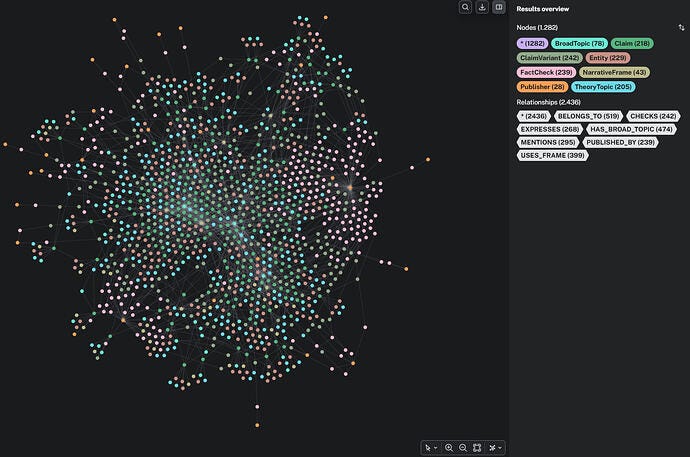
Misinformation is hard to fight not because claims are hard to find, but because context is hard to surface. ConspiracyGraph Agent tackles that directly. It maps relationships between claims, narrative frames, entities, publishers, and fact-checks, creating a connected picture of how narratives propagate, mutate, and get challenged.
The graph model is what makes it work: 1,282 nodes and 2,436 relationships spanning BroadTopics, ClaimVariants, NarrativeFrames, FactChecks, and Entities. It goes beyond true or false to explain how claims connect via narrative frames, entity bridges, and shared topics over real ClaimReview fact-check data. One of our judges said it best: “Every media outlet should be considering an agent like this.”
Congratulations Jonas. This one deserved the win.
🥈 Second Place: RegulatoryRisk GraphAgent (@Dhiraj.Pattra)
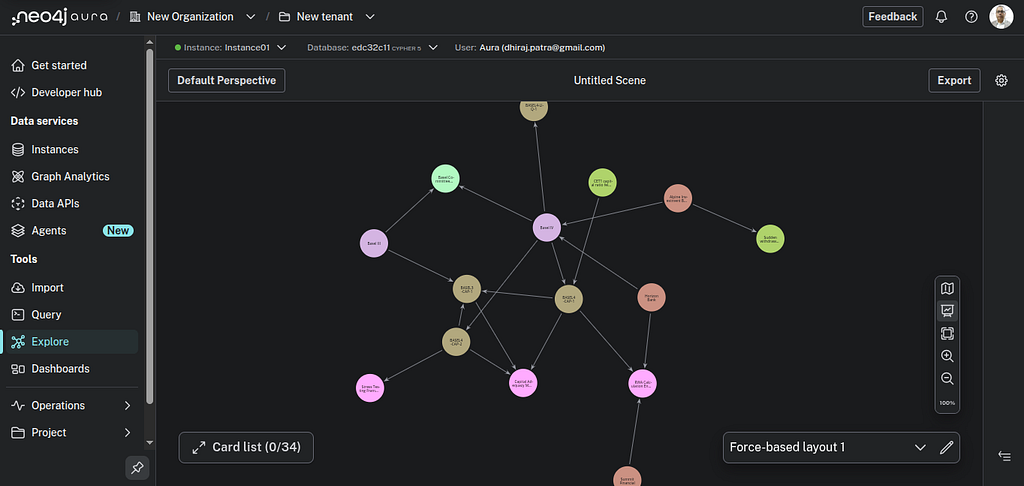
Compliance is notoriously opaque: regulations reference obligations, obligations map to policies, policies govern processes, and processes depend on organizational context. RegulatoryRisk GraphAgent connects all of it into a navigable knowledge graph that supports intelligent recommendations and real-time decision-making for banking and financial institutions.
The screenshot says it plainly: “Show me the counterparty contagion paths from Horizon Bank and calculate the total systemic risk exposure.” One query. Three-hop contagion paths. Billions in exposure surfaced instantly. Our judges recognized exactly why this problem belongs on a graph: “Regulation networks are inherently graph-shaped. So much complexity with so few experts. This is a huge market and innovation opportunity.”
Incredible work Dhiraj. This is the kind of submission that makes me excited about where graph AI is heading.
You can view the Github project here.
🥉 Third Place: Korca Triage Agent (@jevlachov)
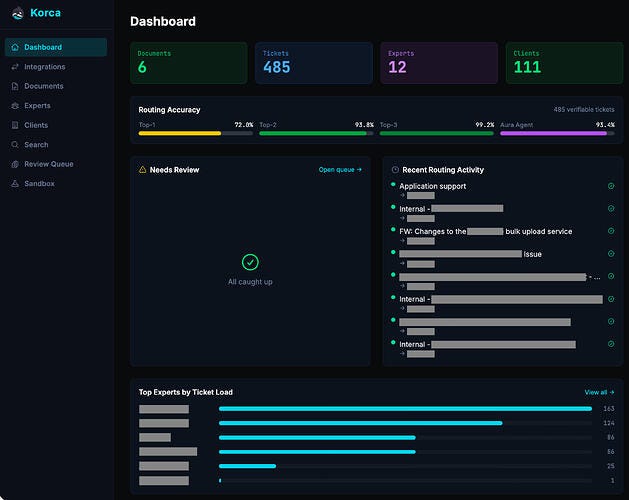
When a support ticket arrives, how do you know who is actually best positioned to resolve it, not just by job title, but by skills, current workload, team relationships, and historical context? Korca Triage Agent builds the graph that answers that. By modeling people, teams, skills, and organizational knowledge as connected data, it routes requests to the right person, not just any available person.
The dashboard reflects the quality of the model underneath: 485 tickets routed, 12 experts, a measured improvement from 72% to 93.4% top-1 routing accuracy. Our judges captured the core insight simply: “Once you have a high quality graph, the answers become a simple recommendation problem.”
Well done. This is exactly the kind of practical, real-world application we were hoping to see.
You can view the Github project here.
From the Field
The top 3 only tell part of the story. Three more from the finalists that I keep coming back to:
Apple HealthGraph Agent (@mabu.mate)
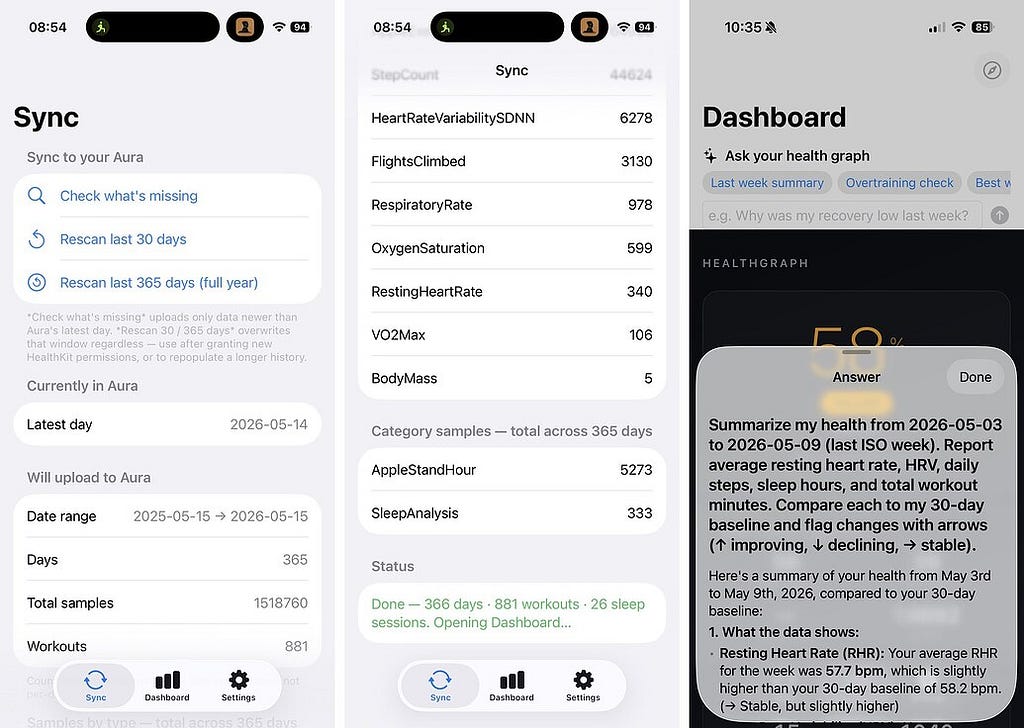
Over 1.5 million health data points from Apple Health, 881 workouts, 366 days of sleep, HRV, VO2Max, respiratory rate, all synced into a knowledge graph and queryable in plain language. Ask it to summarize your week, compare it to your 30-day baseline, and flag changes with trend arrows. Our judges called it “exceptional end-to-end engineering: iPhone to Aura to Agent to iOS chat.” This is what personal health intelligence looks like when the data is actually connected.
You can view the Github project here.
MarketMind (@joslat)
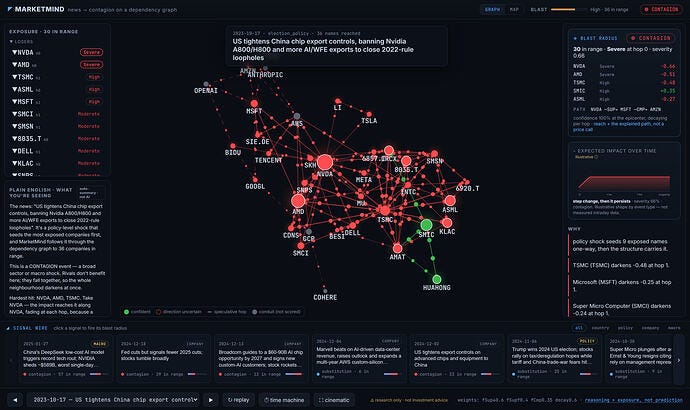
“A US export ban hit the chip sector. Every name went red. One went green. Nobody typed it.” That’s how the builder described what MarketMind does, and the judges couldn’t stop talking about it. By modeling markets as a dependency graph, MarketMind follows a policy shock through the network, company by company, hop by hop, surfacing the names most exposed before any analyst has typed a query. The screenshot makes it visceral: contagion paths, blast radius, severity ratings, all reasoned through a graph in real time. This is what it looks like when connected data becomes a competitive edge.
VibeGraph AI (@kumar20051020shivam)
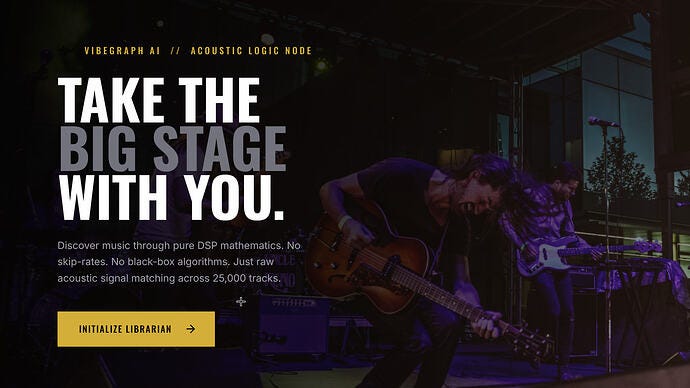
Music discovery through pure DSP mathematics and acoustic signal matching across 25,000 tracks. No skip-rate manipulation. No black-box algorithms. The builder explained the approach directly: “Instead of relying on expensive runtime vector searches, we pre-calculated the top 5 nearest mathematical neighbors for all 25,000 tracks.” The graph does the work at build time so the agent can reason cleanly at query time. The VibeGraph AI landing page design alone, bold, confident, built for a music audience, shows what happens when developers bring genuine craft to the full product experience, not just the graph model.
VibeGraph AI Web App can be seen here
What This All Means
When we built the judging rubric, the most important criterion was Graph Matters: does the graph drive the intelligence, or is it just storing data? That question ended up separating the field more than any other.
The projects that scored highest answered it decisively. They modeled problems that are fundamentally relational: claims that express narrative frames, regulations that govern processes tied to organizational units, people whose skills and history determine who should handle a given request. In each case the graph wasn’t incidental. It was the product.
LLMs answer questions. Knowledge graphs provide context. The projects that worked best stopped treating those as separate concerns and built them into a single architecture. As agentic AI systems multiply, the limiting factor won’t be model capability. It’ll be data architecture. Developers who understand how to model connected data will build agents that reason better, explain themselves, and surface relationships that flat retrieval simply cannot find.
I can’t wait to see what this community builds next.
Thank You
I have to be honest, running this hackathon was one of the most rewarding things I’ve done as a Community Manager. But I didn’t do it alone. From strategy and sponsorship to education, developer advocacy, community engagement, and day-to-day execution, this was a genuine team effort and I want to make sure everyone gets credit.
A huge thank you to our judges who gave every submission a thorough and thoughtful review: Michael, Ed Sandoval, William Lyon, and Adam Cowley, as well as the Neo4j cross-functional teams who were critical to the overall success including: Yolande Poirer, Alexander Erdl, Ed Sandoval, Osman Ishaq, Nariné and Stephen Chin. You all showed up and made this something the community will remember.
And most of all, thank you to every developer who took the course, requested credits, and shipped something real. You are what makes this community worth showing up for every day. Every entrant receives an exclusive Aura Agent T-shirt. Watch your Neo4j Community inbox for the Google Form.
We’re just getting started.
Top 10 Finalists
ConspiracyGraph Agent · RegulatoryRisk GraphAgent · Korca Triage Agent · DepGraph Agent · Apple HealthGraph Agent · DrugPath · RecallScope Agent · MarketMind · VibeGraph AI · CPF Customer Agent
🌍 Explore the Project Gallery
Browse the projects below to explore their graph models, screenshots, demos, and source code.
🌱 Agriculture & Environment
🏥 Healthcare & Life Sciences
· DrugPath
💰 Finance & Business Intelligence
· FinSight
🔐 Cybersecurity & Risk
🌍 Geospatial & Infrastructure
· Geospatial Supply Chain Agent
· Japan Seismic Risk Intelligence Graph
· M-Pesa (Kenya) Insight Agent
🧠 Knowledge, Search & Intelligence
🎬 Media, Entertainment & Sports
· IPL Cricket Intelligence Agent
💪 Fitness & Lifestyle
· GymBuddy
· Athlete Nutrition Intelligence
📈 Customer & Business Operations
⚙️ Graph & Platform Innovation
· NeoSmith
👏 Every one of these projects showcases a different way knowledge graphs can provide the context layer for AI. Take some time to explore them. You’ll find creative ideas, practical architectures, and real-world applications across every domain.
Full winners announcement: Aura Agent Hackathon Winners Announced
What 40 AI Agents Revealed About the Future of Graph Intelligence was originally published in Neo4j Developer Blog on Medium, where people are continuing the conversation by highlighting and responding to this story.
Share Article


Explore
Related Articles