Deviation Root Cause & CAPA
A deviation is a departure from the expected process or specification. Investigating one - finding its root cause, checking whether it has happened before, and confirming the fix actually worked - is one of the most time-consuming activities in a regulated plant. This use case is based on work by Boston Scientific.
Introduction
Every deviation raises the same questions: what caused it, has it happened before, and did we really fix it last time? Answering them means connecting the deviation to the batch it affected, the equipment it happened on, the root cause identified, the people involved, and the Corrective and Preventive Action (CAPA) opened to resolve it. In siloed systems, an investigator reconstructs that picture by hand for each case - which is slow, and makes patterns across cases almost invisible.
The most important pattern is recurrence. If the same root cause keeps producing deviations on the same equipment, a "closed" CAPA did not actually work - it just closed a ticket. Spotting that requires looking across deviations, not at one in isolation.
Scenario
A plant records deviations against its batches. Each deviation is linked to the equipment involved, an identified root cause, and a CAPA. Over a few months, the granulator produces two out-of-spec dissolution results with the same root cause - a temperature control problem - even though a CAPA was raised and closed after the first one. Separately, the tablet press produces a weight-variation deviation from a different root cause.
The quality team needs to see the recurrence, understand that the first CAPA was ineffective, and confirm which fix finally held.
Solution
Neo4j models the deviation as the hub of a small, dense subgraph: it AFFECTS a batch, sits ON a piece of equipment, is CAUSED_BY a root cause, and is RESOLVED_BY a CAPA. Because these are first-class relationships, recurrence detection is a single query - group deviations by shared equipment or shared root cause and count them.
CAPA effectiveness follows naturally: if a root cause recurs after a CAPA was closed, the CAPA did not hold. Ordering the deviations for a root cause by date shows exactly which fix finally stopped the recurrence. The effective property on each CAPA records the verdict.
Modelling
Data Model
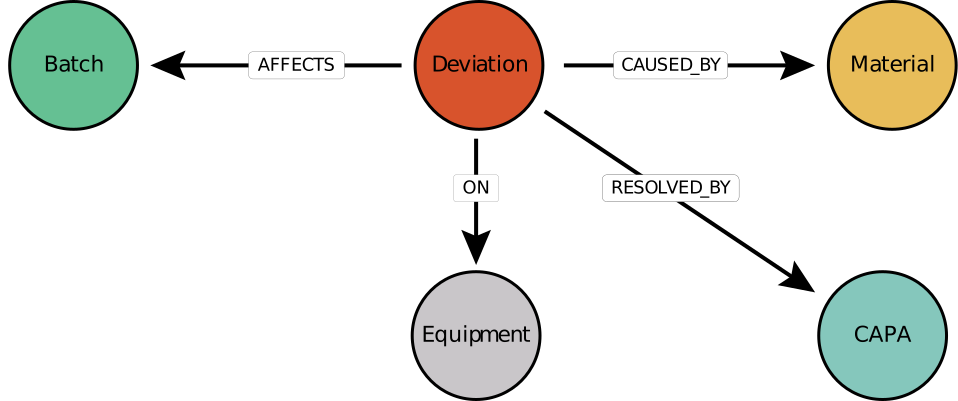
Nodes
-
Deviation- a recorded departure from the expected process or specification, with adateandseverity. -
Batch- the manufactured lot the deviation affected. -
Equipment- the piece of manufacturing equipment involved. -
RootCause- the underlying cause identified for one or more deviations. -
CAPA- a Corrective and Preventive Action. Theeffectiveproperty records whether it actually worked;statusrecords whether it is open or closed.
Relationships
-
AFFECTS- connects aDeviationto theBatchit affected. -
ON- connects aDeviationto theEquipmentinvolved. -
CAUSED_BY- connects aDeviationto itsRootCause. -
RESOLVED_BY- connects aDeviationto theCAPAopened to resolve it.
Demo Data
// Batches
MERGE (b1:Batch {id: 'BATCH-2001', madeDate: date('2026-03-01'), status: 'Released'})
MERGE (b2:Batch {id: 'BATCH-2002', madeDate: date('2026-05-12'), status: 'Released'})
MERGE (b3:Batch {id: 'BATCH-2003', madeDate: date('2026-05-28'), status: 'Released'})

// Equipment
MERGE (eq1:Equipment {id: 'EQ-01', name: 'Granulator G-200'})
MERGE (eq2:Equipment {id: 'EQ-02', name: 'Tablet Press TP-5'})

// Root causes
MERGE (rc1:RootCause {id: 'RC-01', description: 'Granulator temperature control drift'})
MERGE (rc2:RootCause {id: 'RC-02', description: 'Tablet press tooling wear'})

// CAPAs
MERGE (capa1:CAPA {id: 'CAPA-01', description: 'Recalibrate granulator temperature sensor', status: 'Closed', effective: false})
MERGE (capa2:CAPA {id: 'CAPA-02', description: 'Replace granulator heating element and add continuous monitoring', status: 'Closed', effective: true})
MERGE (capa3:CAPA {id: 'CAPA-03', description: 'Replace worn tablet press tooling', status: 'Closed', effective: true})

// Deviations
MERGE (d1:Deviation {id: 'DEV-01', date: date('2026-03-10'), description: 'Out-of-spec dissolution result', severity: 'Major'})
MERGE (d2:Deviation {id: 'DEV-02', date: date('2026-05-22'), description: 'Out-of-spec dissolution result (recurrence)', severity: 'Major'})
MERGE (d3:Deviation {id: 'DEV-03', date: date('2026-06-01'), description: 'Tablet weight variation', severity: 'Minor'})

MERGE (d1)-[:AFFECTS]->(b1)
MERGE (d1)-[:ON]->(eq1)
MERGE (d1)-[:CAUSED_BY]->(rc1)
MERGE (d1)-[:RESOLVED_BY]->(capa1)

MERGE (d2)-[:AFFECTS]->(b2)
MERGE (d2)-[:ON]->(eq1)
MERGE (d2)-[:CAUSED_BY]->(rc1)
MERGE (d2)-[:RESOLVED_BY]->(capa2)

MERGE (d3)-[:AFFECTS]->(b3)
MERGE (d3)-[:ON]->(eq2)
MERGE (d3)-[:CAUSED_BY]->(rc2)
MERGE (d3)-[:RESOLVED_BY]->(capa3)
Example Queries
Each query below has been run against the demo data above.
Recurrence detection by Equipment
Recurring deviations on the same equipment are an early signal of an unresolved problem. This query surfaces every piece of equipment linked to more than one deviation.
// Equipment with recurring deviations
MATCH (d:Deviation)-[:ON]->(e:Equipment)
WITH e, collect(d) AS devs
WHERE size(devs) > 1
UNWIND devs AS d
RETURN
    e.name AS Equipment,
    d.id AS Deviation,
    d.date AS Date,
    d.description AS Description
ORDER BY Equipment, Date;
Recurrence detection by RootCause
Grouping by root cause shows which underlying problems keep coming back, regardless of which equipment or batch they surfaced on.
// How many deviations share each root cause
MATCH (rc:RootCause)<-[:CAUSED_BY]-(d:Deviation)
RETURN
    rc.description AS RootCause,
    count(d) AS DeviationCount,
    collect(d.id) AS Deviations
ORDER BY DeviationCount DESC;
Did the CAPA work?
Ordering the deviations for a root cause by date, alongside the CAPAs raised and their effectiveness, shows exactly where a "closed" ticket failed to stop the problem - and which fix finally held.
// Did the first fix hold, or did the root cause recur?
MATCH (rc:RootCause)<-[:CAUSED_BY]-(d:Deviation)-[:RESOLVED_BY]->(c:CAPA)
WITH rc, d, c
ORDER BY d.date
RETURN
    rc.description AS RootCause,
    collect(d.id) AS DeviationsOverTime,
    collect(c.id + ' (effective=' + c.effective + ')') AS CAPAs;
Trace a failure to its full context
From a single deviation, pull the complete picture - batch, equipment, root cause, and the CAPA that resolved it - in one query.
// Full context of an end-of-line failure
WITH 'DEV-02' AS deviationId
MATCH (d:Deviation {id: deviationId})
OPTIONAL MATCH (d)-[:AFFECTS]->(b:Batch)
OPTIONAL MATCH (d)-[:ON]->(e:Equipment)
OPTIONAL MATCH (d)-[:CAUSED_BY]->(rc:RootCause)
OPTIONAL MATCH (d)-[:RESOLVED_BY]->(c:CAPA)
RETURN
    d.description AS Deviation,
    b.id AS Batch,
    e.name AS Equipment,
    rc.description AS `Root Cause``,
    c.description AS CAPA,
    c.effective AS `CAPA Effective``;
Real World Example
Boston Scientific
Working with GraphAware, Boston Scientific built a manufacturing-quality tool on Neo4j that traces an end-of-line failure back through its value stream to the source, driving striking gains in the speed, quality, and number of quality investigations.
Read more on the Neo4j blog and Customer Story.