The Unified Quality Graph
The three preceding use cases each solve one problem with a focused model. In reality they are the same graph, seen from different starting points. This page combines them into a single unified quality knowledge graph, where a complaint, a deviation, a chemical of concern, and a recall all traverse the same connected data.
Introduction
Finding chemicals of concern, investigating deviations, and scoping recalls are usually treated as separate exercises in separate systems. But they share almost all of their data. A batch is the anchor: a complaint is about a batch, a deviation affects a batch, a batch is made from materials that contain chemicals and come from suppliers, and a batch is shipped to distributors. Model all of it once and every one of those investigations becomes a traversal of the same graph.
This unified model is a superset of the chemicals-of-concern, deviation root cause, and recall traceability models. It adds the Complaint entity that ties the field back to the plant, and connects the chemical layer to the supply-chain spine so a banned substance can be traced all the way to the distributors that received it.
Scenario
A regulated manufacturer runs the whole operation on one graph. Suppliers provide raw materials and Active Pharmaceutical Ingredients (APIs); materials (some of which contain tracked chemicals) are combined into batches at sites; batches produce products and ship to distributors. Deviations are raised against batches and materials, linked to equipment, root causes, and Corrective and Preventive Actions (CAPAs); and complaints arrive from the field and are linked to deviations.
Now every quality question - "what does this complaint touch?", "where did this banned chemical go?", "did this recurring fault reach customers?" - is answerable from the same model, in one query.
Solution
The unified graph keeps every relationship from the three focused models and lets them meet at the shared Batch, Material, and Product nodes. Because the connections already exist, cross-cutting questions that would otherwise span the Quality Management System (QMS), the Manufacturing Execution System (MES), the Enterprise Resource Planning (ERP) system, and supplier records collapse into single traversals - which is where the "weeks to minutes" saving comes from.
Modelling
Data Model
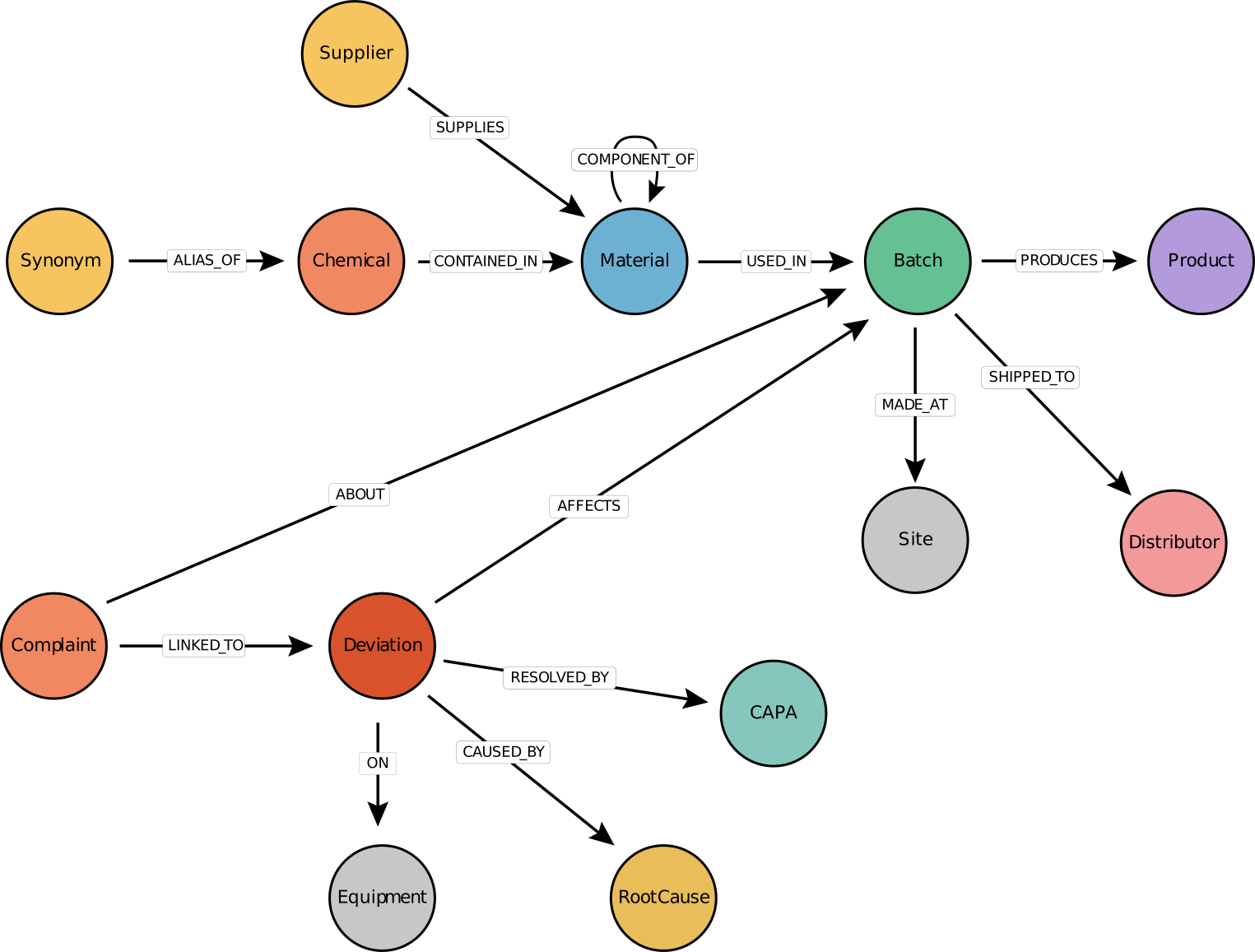
Nodes
-
Supplier- an external vendor that supplies raw materials or APIs. -
Material- a raw material, API, excipient, or colorant. Thetypeproperty distinguishes them. -
Chemical- a single, canonical substance tracked within a material. -
Synonym- an alternative name for a chemical, as recorded in some system. -
Batch- a specific manufactured lot, with amadeDateand releasestatus. -
Product- a finished drug product. -
Site- a manufacturing facility where a batch is made. -
Distributor- a downstream customer a batch is shipped to. -
Equipment- a piece of manufacturing equipment involved in a deviation. -
Deviation- a recorded departure from the expected process or specification. -
RootCause- the underlying cause identified for one or more deviations. -
CAPA- a Corrective and Preventive Action. Theeffectiveproperty records whether it worked;statuswhether it is open or closed. -
Complaint- a quality complaint raised from the field.
Relationships
-
SUPPLIES-SuppliertoMaterial. -
ALIAS_OF-SynonymtoChemical. -
CONTAINED_IN-Chemicalto theMaterialthat contains it. -
COMPONENT_OF-Materialto anotherMaterialit is a component of (multi-level genealogy). -
USED_IN-MaterialtoBatch. -
PRODUCES-BatchtoProduct. -
MADE_AT-BatchtoSite. -
SHIPPED_TO-BatchtoDistributor. -
AFFECTS-Deviationto theBatchorMaterialit affects. -
ON-DeviationtoEquipment. -
CAUSED_BY-DeviationtoRootCause. -
RESOLVED_BY-DeviationtoCAPA. -
ABOUT-ComplainttoBatch. -
LINKED_TO-ComplainttoDeviation.
Demo Data
This single Cypher statement creates the entire unified graph:
// ================= SUPPLY CHAIN =================
MERGE (sup1:Supplier {id: 'SUP-01', name: 'Nordic Fine Chemicals'})
MERGE (sup2:Supplier {id: 'SUP-02', name: 'BayState Excipients'})

MERGE (mRaw1:Material {id: 'MAT-RAW-01', name: 'Salicylic Acid',      type: 'Raw'})
MERGE (mRaw2:Material {id: 'MAT-RAW-02', name: 'Acetic Anhydride',    type: 'Raw'})
MERGE (mRaw3:Material {id: 'MAT-RAW-03', name: 'Isobutylbenzene',     type: 'Raw'})
MERGE (mApi1:Material {id: 'MAT-API-01', name: 'Acetylsalicylic Acid', type: 'API'})
MERGE (mApi2:Material {id: 'MAT-API-02', name: 'Ibuprofen',            type: 'API'})
MERGE (mExc1:Material {id: 'MAT-EXC-01', name: 'Microcrystalline Cellulose', type: 'Excipient'})
MERGE (mCoat:Material {id: 'MAT-EXC-02', name: 'Red Coating',          type: 'Colorant'})

MERGE (mRaw1)-[:COMPONENT_OF]->(mApi1)
MERGE (mRaw2)-[:COMPONENT_OF]->(mApi1)
MERGE (mRaw3)-[:COMPONENT_OF]->(mApi2)

MERGE (sup1)-[:SUPPLIES]->(mRaw1)
MERGE (sup1)-[:SUPPLIES]->(mRaw2)
MERGE (sup1)-[:SUPPLIES]->(mRaw3)
MERGE (sup2)-[:SUPPLIES]->(mExc1)
MERGE (sup2)-[:SUPPLIES]->(mCoat)

MERGE (site1:Site {id: 'SITE-01', name: 'Cork Plant',   location: 'Cork, Ireland'})
MERGE (site2:Site {id: 'SITE-02', name: 'Boston Plant', location: 'Boston, USA'})

MERGE (prodA:Product {id: 'PROD-A', name: 'CardioAspirin 100mg'})
MERGE (prodB:Product {id: 'PROD-B', name: 'PainRelief 500mg'})

MERGE (dist1:Distributor {id: 'DIST-01', name: 'EuroPharma Distribution'})
MERGE (dist2:Distributor {id: 'DIST-02', name: 'MedSupply US'})

MERGE (b1:Batch {id: 'BATCH-2001', madeDate: date('2026-03-01'), status: 'Released'})
MERGE (b2:Batch {id: 'BATCH-2002', madeDate: date('2026-05-12'), status: 'Released'})
MERGE (b3:Batch {id: 'BATCH-2003', madeDate: date('2026-05-28'), status: 'Released'})

MERGE (mApi1)-[:USED_IN]->(b1)
MERGE (mExc1)-[:USED_IN]->(b1)
MERGE (mCoat)-[:USED_IN]->(b1)
MERGE (mApi1)-[:USED_IN]->(b2)
MERGE (mExc1)-[:USED_IN]->(b2)
MERGE (mCoat)-[:USED_IN]->(b2)
MERGE (mApi2)-[:USED_IN]->(b3)
MERGE (mExc1)-[:USED_IN]->(b3)

MERGE (b1)-[:PRODUCES]->(prodA)
MERGE (b2)-[:PRODUCES]->(prodA)
MERGE (b3)-[:PRODUCES]->(prodB)
MERGE (b1)-[:MADE_AT]->(site1)
MERGE (b2)-[:MADE_AT]->(site1)
MERGE (b3)-[:MADE_AT]->(site2)
MERGE (b1)-[:SHIPPED_TO]->(dist1)
MERGE (b2)-[:SHIPPED_TO]->(dist1)
MERGE (b2)-[:SHIPPED_TO]->(dist2)
MERGE (b3)-[:SHIPPED_TO]->(dist2)

// ================= CHEMICAL LAYER =================
MERGE (ery:Chemical {id: 'CHEM-01', name: 'Erythrosine'})
MERGE (syn1:Synonym {name: 'Red Dye No. 3'})
MERGE (syn2:Synonym {name: 'FD&C Red 3'})
MERGE (syn3:Synonym {name: 'E127'})
MERGE (syn1)-[:ALIAS_OF]->(ery)
MERGE (syn2)-[:ALIAS_OF]->(ery)
MERGE (syn3)-[:ALIAS_OF]->(ery)
MERGE (ery)-[:CONTAINED_IN]->(mCoat)

// ================= DEVIATIONS / CAPA =================
MERGE (eq1:Equipment {id: 'EQ-01', name: 'Granulator G-200'})
MERGE (eq2:Equipment {id: 'EQ-02', name: 'Tablet Press TP-5'})

MERGE (rc1:RootCause {id: 'RC-01', description: 'Granulator temperature control drift'})
MERGE (rc2:RootCause {id: 'RC-02', description: 'Tablet press tooling wear'})
MERGE (rc3:RootCause {id: 'RC-03', description: 'Supplier raw material impurity'})

MERGE (capa1:CAPA {id: 'CAPA-01', description: 'Recalibrate granulator temperature sensor', status: 'Closed', effective: false})
MERGE (capa2:CAPA {id: 'CAPA-02', description: 'Replace granulator heating element and add continuous monitoring', status: 'Closed', effective: true})
MERGE (capa3:CAPA {id: 'CAPA-03', description: 'Replace worn tablet press tooling', status: 'Closed', effective: true})
MERGE (capa4:CAPA {id: 'CAPA-04', description: 'Add incoming impurity test and supplier audit', status: 'Open'})

MERGE (d1:Deviation {id: 'DEV-01', date: date('2026-03-10'), description: 'Out-of-spec dissolution result', severity: 'Major'})
MERGE (d2:Deviation {id: 'DEV-02', date: date('2026-05-22'), description: 'Out-of-spec dissolution result (recurrence)', severity: 'Major'})
MERGE (d3:Deviation {id: 'DEV-03', date: date('2026-06-01'), description: 'Tablet weight variation', severity: 'Minor'})
MERGE (d4:Deviation {id: 'DEV-04', date: date('2026-06-15'), description: 'Incoming API impurity above limit', severity: 'Major'})

MERGE (d1)-[:AFFECTS]->(b1)
MERGE (d1)-[:ON]->(eq1)
MERGE (d1)-[:CAUSED_BY]->(rc1)
MERGE (d1)-[:RESOLVED_BY]->(capa1)
MERGE (d2)-[:AFFECTS]->(b2)
MERGE (d2)-[:ON]->(eq1)
MERGE (d2)-[:CAUSED_BY]->(rc1)
MERGE (d2)-[:RESOLVED_BY]->(capa2)
MERGE (d3)-[:AFFECTS]->(b3)
MERGE (d3)-[:ON]->(eq2)
MERGE (d3)-[:CAUSED_BY]->(rc2)
MERGE (d3)-[:RESOLVED_BY]->(capa3)
MERGE (d4)-[:AFFECTS]->(mApi1)
MERGE (d4)-[:CAUSED_BY]->(rc3)
MERGE (d4)-[:RESOLVED_BY]->(capa4)

// ================= COMPLAINTS =================
MERGE (cmp1:Complaint {id: 'CMP-01', date: date('2026-04-02'), description: 'Tablets not dissolving properly'})
MERGE (cmp2:Complaint {id: 'CMP-02', date: date('2026-06-05'), description: 'Inconsistent tablet size'})
MERGE (cmp1)-[:ABOUT]->(b1)
MERGE (cmp1)-[:LINKED_TO]->(d1)
MERGE (cmp2)-[:ABOUT]->(b3)
MERGE (cmp2)-[:LINKED_TO]->(d3)Example Queries
These queries each cross the boundaries of the three focused models, which is exactly what the unified graph makes possible. Each has been run against the demo data above.
What else does this Complaint touch?
The central question of quality, in one traversal: from a field complaint, out to the batch, the linked deviation and its root cause, whether the CAPA was effective, the materials and suppliers involved, and the distributors that received the batch.
// Full blast radius of a complaint
WITH 'CMP-01' AS complaintId
MATCH (cmp:Complaint {id: complaintId})-[:ABOUT]->(b:Batch)
OPTIONAL MATCH (cmp)-[:LINKED_TO]->(d:Deviation)-[:CAUSED_BY]->(rc:RootCause)
OPTIONAL MATCH (d)-[:RESOLVED_BY]->(c:CAPA)
OPTIONAL MATCH (m:Material)-[:USED_IN]->(b)
OPTIONAL MATCH (s:Supplier)-[:SUPPLIES]->()-[:COMPONENT_OF*0..]->(m)
OPTIONAL MATCH (b)-[:SHIPPED_TO]->(dist:Distributor)
RETURN
      cmp.description AS Complaint, b.id AS Batch, d.id AS Deviation,
      rc.description AS RootCause, c.id AS CAPA, c.effective AS CAPAEffective,
      collect(DISTINCT m.name) AS Materials,
      collect(DISTINCT s.name) AS Suppliers,
      collect(DISTINCT dist.name) AS Distributors;
Where did a banned Chemical go?
Resolve any synonym of a banned chemical to the entity, then trace it through the materials and batches to the released products and the distributors that received them - joining the chemical layer to the supply-chain spine.
// From a banned chemical (by any name) to the distributors that received it
WITH 'Red Dye No. 3' AS synonym
MATCH
      (:Synonym {name: synonym})-[:ALIAS_OF]->(c:Chemical)-[:CONTAINED_IN]->(m:Material),
      (m)-[:COMPONENT_OF*0..]->(:Material)-[:USED_IN]->(b:Batch)-[:PRODUCES]->(p:Product)
OPTIONAL
      MATCH (b)-[:SHIPPED_TO]->(dist:Distributor)
RETURN
      c.name AS Chemical,
      collect(DISTINCT b.id) AS Batches,
      collect(DISTINCT p.name) AS Products,
      collect(DISTINCT dist.name) AS Distributors;
What does a material Deviation touch?
From a deviation raised against a material, reach the suppliers behind it and the batches, products, and distributors downstream - a full impact assessment in one query.
// Everything a material deviation touches
WITH 'DEV-04' AS deviationId
MATCH (d:Deviation {id: deviationId})-[:AFFECTS]->(m:Material)
MATCH (s:Supplier)-[:SUPPLIES]->()-[:COMPONENT_OF*0..]->(m)
MATCH (m)-[:USED_IN]->(b:Batch)-[:PRODUCES]->(p:Product)
OPTIONAL MATCH (b)-[:SHIPPED_TO]->(dist:Distributor)
RETURN
      d.description AS Deviation, m.name AS Material,
      collect(DISTINCT s.name) AS Suppliers,
      collect(DISTINCT b.id) AS Batches,
      collect(DISTINCT p.name) AS Products,
      collect(DISTINCT dist.name) AS Distributors;
Did an ineffective fix reach customers?
Combine CAPA effectiveness with distribution: find ineffective CAPAs whose affected batches were still shipped to distributors - the highest-priority follow-ups.
// Ineffective CAPAs whose affected batches reached distributors
WITH false AS effectiveness
MATCH (c:CAPA {effective: effectiveness})<-[:RESOLVED_BY]-(d:Deviation)-[:AFFECTS]->(b:Batch)-[:SHIPPED_TO]->(dist:Distributor)
RETURN
      c.id AS IneffectiveCAPA,
      d.id AS Deviation,
      b.id AS Batch,
      collect(DISTINCT dist.name) AS ShippedTo;
A practical path to a quality graph
You do not have to model everything at once. A practical path is:
-
Start with one question - pick a single high-value problem, usually root cause or recall scope, and make it concrete.
-
Connect what answers it - wire in only the systems that question depends on, and model the relationships; leave the systems of record in place.
-
Expand from the win - each connected question makes the next one easier, so grow the graph as the value proves itself.
Your quality data is already a graph - it is just stored as if it weren’t. The three focused use cases in this section are each a good place to start; this unified model is where they lead.