Recall Scoping & Traceability
When a material is implicated, the manufacturer’s job is to reach exactly the batches and products that actually used it - no more, no less - so a recall can be scoped precisely instead of over-broadly. This use case is based on work by Transparency-One.
Introduction
A recall is expensive, and an over-broad recall is more expensive still. When a raw material, Active Pharmaceutical Ingredient (API), or supplier lot is found to be defective, the manufacturer must trace the full lifecycle - supplier, to raw material, to API, to drug product, to distributor - and identify only the batches and products that the implicated material actually reached.
Getting this wrong in either direction is costly: too broad and you recall good product and erode trust; too narrow and you leave affected product in the field. The traceability data almost always exists, scattered across an Enterprise Resource Planning (ERP) system, supplier records, and shipping logs - but reconstructing the chain by hand, batch by batch, is exactly what makes a recall slow.
Scenario
A manufacturer buys raw materials and APIs from suppliers, combines them into batches at its sites, produces finished products, and ships those batches to distributors. Materials have genealogy: raw materials are components of APIs, and an API may be used across several batches and products.
A supplier reports an impurity in one API. The team needs to know, within minutes, every batch that used it, every product those batches became, and every distributor that received them.
Solution
Neo4j models the supply chain as it physically exists: a Supplier SUPPLIES a Material, a Material is USED_IN a Batch, a Batch PRODUCES a Product and is SHIPPED_TO a Distributor. Material genealogy is captured with COMPONENT_OF, so a raw material that is a component of an API can be traced downstream at any depth.
Recall scoping is then a directed traversal from the implicated material outward - reaching only the batches that actually used it. Because the graph is navigable in both directions, the same model answers the reverse question just as easily: a distributor reports a problem, and you trace upstream to the suppliers and materials behind what they received.
Modelling
Data Model
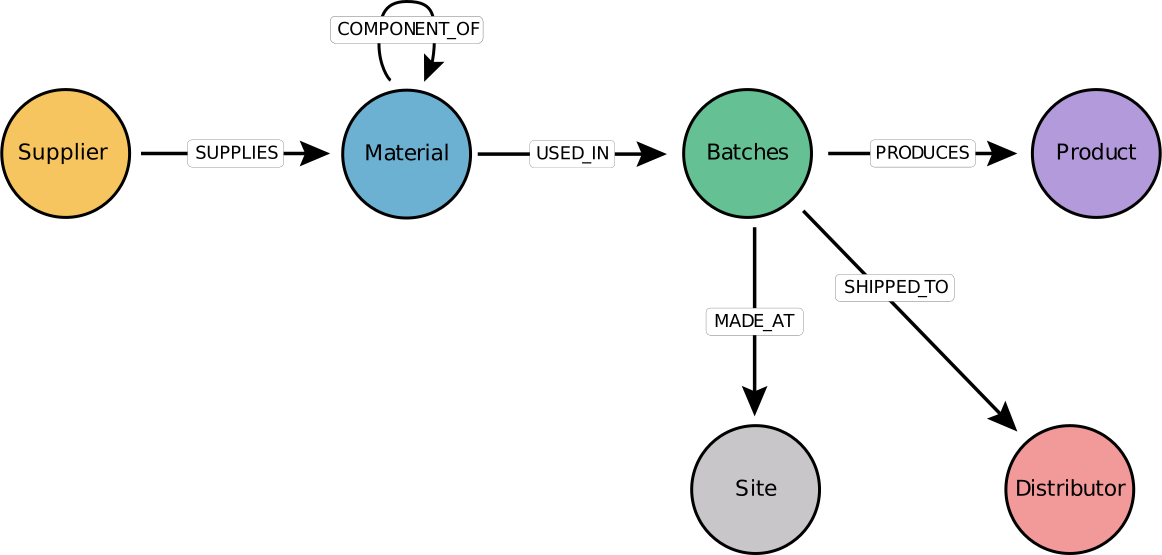
Nodes
-
Supplier- an external vendor that supplies raw materials or APIs. -
Material- a raw material, API, or excipient. Thetypeproperty distinguishes them. -
Batch- a specific manufactured lot, with amadeDateand releasestatus. -
Product- a finished drug product. -
Site- a manufacturing facility where a batch is made. -
Distributor- a downstream customer a batch is shipped to.
Relationships
-
SUPPLIES- connects aSupplierto theMaterialit provides. -
COMPONENT_OF- connects aMaterialto anotherMaterialit is a component of, enabling multi-level genealogy. -
USED_IN- connects aMaterialto theBatchit was used in. -
PRODUCES- connects aBatchto theProductit produces. -
MADE_AT- connects aBatchto theSitewhere it was manufactured. -
SHIPPED_TO- connects aBatchto theDistributorit was shipped to.
Demo Data
// Suppliers
MERGE (sup1:Supplier {id: 'SUP-01', name: 'Nordic Fine Chemicals'})
MERGE (sup2:Supplier {id: 'SUP-02', name: 'BayState Excipients'})

// Materials
MERGE (mRaw1:Material {id: 'MAT-RAW-01', name: 'Salicylic Acid',      type: 'Raw'})
MERGE (mRaw2:Material {id: 'MAT-RAW-02', name: 'Acetic Anhydride',    type: 'Raw'})
MERGE (mRaw3:Material {id: 'MAT-RAW-03', name: 'Isobutylbenzene',     type: 'Raw'})
MERGE (mApi1:Material {id: 'MAT-API-01', name: 'Acetylsalicylic Acid', type: 'API'})
MERGE (mApi2:Material {id: 'MAT-API-02', name: 'Ibuprofen',            type: 'API'})
MERGE (mExc1:Material {id: 'MAT-EXC-01', name: 'Microcrystalline Cellulose', type: 'Excipient'})

// Genealogy: raw materials are components of the APIs
MERGE (mRaw1)-[:COMPONENT_OF]->(mApi1)
MERGE (mRaw2)-[:COMPONENT_OF]->(mApi1)
MERGE (mRaw3)-[:COMPONENT_OF]->(mApi2)

// Supplier -> Material
MERGE (sup1)-[:SUPPLIES]->(mRaw1)
MERGE (sup1)-[:SUPPLIES]->(mRaw2)
MERGE (sup1)-[:SUPPLIES]->(mRaw3)
MERGE (sup2)-[:SUPPLIES]->(mExc1)

// Sites
MERGE (site1:Site {id: 'SITE-01', name: 'Cork Plant',   location: 'Cork, Ireland'})
MERGE (site2:Site {id: 'SITE-02', name: 'Boston Plant', location: 'Boston, USA'})

// Products
MERGE (prodA:Product {id: 'PROD-A', name: 'CardioAspirin 100mg'})
MERGE (prodB:Product {id: 'PROD-B', name: 'PainRelief 500mg'})

// Distributors
MERGE (dist1:Distributor {id: 'DIST-01', name: 'EuroPharma Distribution'})
MERGE (dist2:Distributor {id: 'DIST-02', name: 'MedSupply US'})

// Batches
MERGE (b1:Batch {id: 'BATCH-2001', madeDate: date('2026-03-01'), status: 'Released'})
MERGE (b2:Batch {id: 'BATCH-2002', madeDate: date('2026-05-12'), status: 'Released'})
MERGE (b3:Batch {id: 'BATCH-2003', madeDate: date('2026-05-28'), status: 'Released'})

// Material -> Batch
MERGE (mApi1)-[:USED_IN]->(b1)
MERGE (mExc1)-[:USED_IN]->(b1)
MERGE (mApi1)-[:USED_IN]->(b2)
MERGE (mExc1)-[:USED_IN]->(b2)
MERGE (mApi2)-[:USED_IN]->(b3)
MERGE (mExc1)-[:USED_IN]->(b3)

// Batch -> Product / Site / Distributor
MERGE (b1)-[:PRODUCES]->(prodA)
MERGE (b2)-[:PRODUCES]->(prodA)
MERGE (b3)-[:PRODUCES]->(prodB)
MERGE (b1)-[:MADE_AT]->(site1)
MERGE (b2)-[:MADE_AT]->(site1)
MERGE (b3)-[:MADE_AT]->(site2)
MERGE (b1)-[:SHIPPED_TO]->(dist1)
MERGE (b2)-[:SHIPPED_TO]->(dist1)
MERGE (b2)-[:SHIPPED_TO]->(dist2)
MERGE (b3)-[:SHIPPED_TO]->(dist2)
Example Queries
Each query below has been run against the demo data above.
Recall scope for an implicated Material
Reach only the batches that actually used the material, and the products and distributors downstream - so the recall can be scoped precisely.
// Recall scope for an implicated material
WITH 'MAT-API-01' AS materialId
MATCH (m:Material {id: materialId})-[:USED_IN]->(b:Batch)
OPTIONAL MATCH (b)-[:PRODUCES]->(p:Product)
OPTIONAL MATCH (b)-[:SHIPPED_TO]->(dist:Distributor)
RETURN
      b.id AS Batch,
      collect(DISTINCT p.name) AS Products,
      collect(DISTINCT dist.name) AS Distributors
ORDER BY Batch;
Which Products does a raw Material reach, at any depth?
A raw material may be several steps removed from the finished product, nested inside an API. A single variable-length traversal (COMPONENT_OF*0..) follows the genealogy to every product it reaches.
// Every product a raw material reaches, at any depth in the genealogy
WITH 'MAT-RAW-01' AS rawMaterialId
MATCH
      (raw:Material {id: rawMaterialId})-[:COMPONENT_OF*0..]->(m:Material),
      (m)-[:USED_IN]->(:Batch)-[:PRODUCES]->(p:Product)
RETURN
      raw.name AS RawMaterial,
      collect(DISTINCT p.name) AS ProductsReached;
Full lifecycle genealogy for a Product
Trace the full lifecycle behind a product - the suppliers and materials that fed each batch, and the distributors each batch shipped to.
// Suppliers, materials and distributors behind every batch of a product
WITH 'PROD-A' AS productId
MATCH (p:Product {id: productId})<-[:PRODUCES]-(b:Batch)<-[:USED_IN]-(m:Material)
OPTIONAL MATCH (s:Supplier)-[:SUPPLIES]->()-[:COMPONENT_OF*0..]->(m)
OPTIONAL MATCH (b)-[:SHIPPED_TO]->(dist:Distributor)
RETURN
    p.name AS Product, b.id AS Batch,
    collect(DISTINCT m.name) AS Materials,
    collect(DISTINCT s.name) AS Suppliers,
    collect(DISTINCT dist.name) AS Distributors
ORDER BY Batch;
Upstream trace from a Distributor
The graph runs both ways. If a distributor reports a problem, trace upstream to the batches they received and the suppliers and materials behind them.
// A distributor reports a problem - trace upstream to suppliers and materials
WITH 'DIST-02' AS distributorId
MATCH (dist:Distributor {id: distributorId})<-[:SHIPPED_TO]-(b:Batch)<-[:USED_IN]-(m:Material)
OPTIONAL MATCH (s:Supplier)-[:SUPPLIES]->()-[:COMPONENT_OF*0..]->(m)
RETURN
    dist.name AS Distributor, b.id AS Batch,
    collect(DISTINCT m.name) AS Materials,
    collect(DISTINCT s.name) AS Suppliers
ORDER BY Batch;
Real World Example
Amalgo LLC
Amalgo LLC have quantified the financial impact of cutting biopharma QA investigation times from a 30-day industry standard down to 10 days, citing double-digit swings in gross profit, penalties, and inventory costs. He used knowledge graph simulations to model bullwhip effects across the supply chain and show where faster investigations create the most value.
Transparency-One
Transparency-One built a supply-chain platform on Neo4j that traces every ingredient, supplier, and facility, so a manufacturer can instantly see how one impacted component affects its entire product portfolio and act precisely.
Read the Transparency-One case study.