Store entities, relationships, and facts
|
Available on NAMS: Yes, with differences. NAMS supports this kind of memory, but not every call on this page: some steps run server-side, some calls take different arguments or return different shapes, and some are Bolt-only. Check the backend capabilities reference before you adapt a Bolt procedure. |
To build explicit graph knowledge, create typed entities, connect their returned IDs, and read the stored relationship back. Use POLE+O types with optional subtypes to distinguish domain concepts such as products.
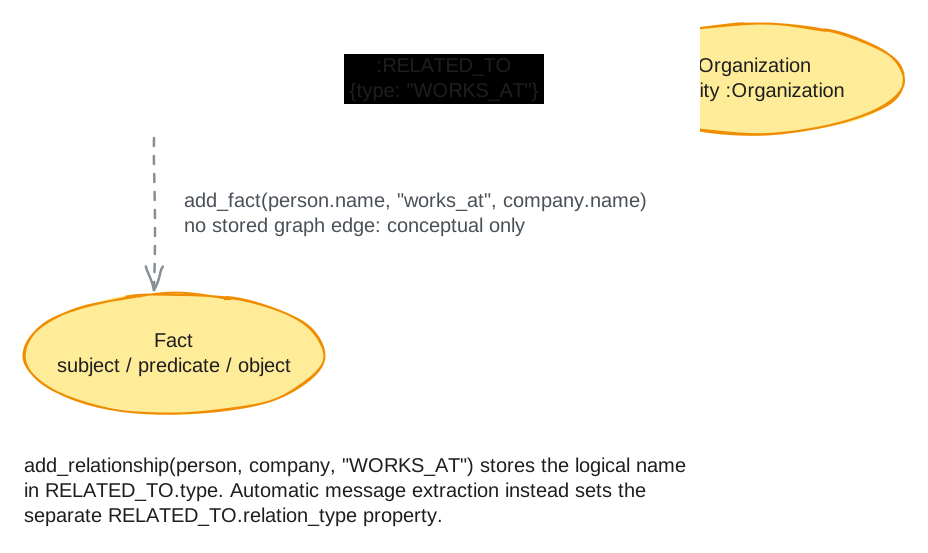
For the rationale, see The POLE+O data model.
1. Prepare the Bolt client
Use a dedicated AuraDB instance from the first memory tutorial’s Aura setup, with exported NEO4J_URI, NEO4J_USERNAME, and NEO4J_PASSWORD. Set OPENAI_API_KEY for the selected embedding provider. Prepare the example files below and install the provider extra:
Create a local folder and virtual environment for the examples on this page. The commands reuse an existing environment without changing its files:
mkdir -p ~/agent-memory-tutorials
cd ~/agent-memory-tutorials
if [ -e .venv ]; then
  printf '%s\n' 'Using the existing virtual environment.'
else
  python3 -m venv .venv
fi
source .venv/bin/activate
Expected: ~/agent-memory-tutorials is your working directory and its virtual environment is active. Install the published SDK with the command below.
Each complete code block labelled Save as names a file to create in this folder using your editor. Copy the entire block, including imports and the entry point. Expand each helper disclosure and use Copy code to copy its full source. Keep all files together so their imports resolve.
When continuing from another tutorial or guide, retain the existing environment, configuration, session files, and .tutorial-state/. Reuse unchanged helper files; compare an existing file before replacing it, and finish any pending cleanup or recovery before changing the code that owns its state.
python -m pip install 'neo4j-agent-memory[openai]==0.7.0'The maintained program core_memory_recipes.py imports core_memory_settings.py from the same directory. That helper explicitly selects Bolt and disables automatic extraction/enrichment. Each command creates a new ID suffix so it can run independently. Embedding requests send example text to OpenAI.
These tasks use Python with Bolt, and not every call they make is portable to NAMS. On the hosted backend, preferences, facts, direct relationship writes, client-side deduplication configuration, add_messages_batch (use bulk_add_messages on NAMS), session listing and summaries, and reasoning search and statistics are unavailable: depending on the call, the client raises NotSupportedError, AttributeError or TypeError, or silently drops a Bolt-only option. Consult backend capabilities before adapting a task to NAMS.
Save the three complete files below in agent-memory-tutorials/. If a file already exists from another guide, keep its matching contents; do not replace configuration or state files. The task-specific excerpt in the next section explains the operation to run.
Open the helper below and save its complete source as aura_connection.py in ~/agent-memory-tutorials.
Show aura_connection.py
aura_connection.py"""Read the Aura connection exported by the documentation setup commands."""
import os
class AuraConfigurationError(ValueError):
"""Missing or invalid tutorial settings, with no credential values in errors."""
def aura_config():
required = ("NEO4J_URI", "NEO4J_USERNAME", "NEO4J_PASSWORD")
missing = [name for name in required if not os.environ.get(name, "").strip()]
if missing:
raise AuraConfigurationError("Export the Aura connection settings: " + ", ".join(missing))
uri = os.environ["NEO4J_URI"]
if not uri.startswith("neo4j+s://"):
raise AuraConfigurationError("NEO4J_URI must use the Aura neo4j+s:// connection scheme")
database = os.environ.get("NEO4J_DATABASE", "neo4j")
if not database.strip():
raise AuraConfigurationError("NEO4J_DATABASE must not be empty")
return {
"uri": uri,
"username": os.environ["NEO4J_USERNAME"],
"password": os.environ["NEO4J_PASSWORD"],
"database": database,
}Complete core_memory_settings.py
core_memory_settings.py"""Shared settings for the three Aura-backed memory tutorials."""
from aura_connection import aura_config
from neo4j_agent_memory import MemorySettings
def settings():
return MemorySettings(
backend="bolt",
neo4j=aura_config(),
embedding="openai/text-embedding-3-small",
llm=None,
extraction={"extractor_type": "none"},
resolution={"strategy": "none"},
geocoding={"enabled": False},
enrichment={"enabled": False},
)Complete core_memory_recipes.py
core_memory_recipes.py"""Independent Bolt how-to recipes; each command creates a distinct test dataset."""
import argparse
import asyncio
from datetime import datetime, timedelta, timezone
from uuid import uuid4
from core_memory_settings import settings
from neo4j_agent_memory import MemoryClient
from neo4j_agent_memory.core.memory import ToolCallStatus
from neo4j_agent_memory.memory.long_term import DeduplicationConfig, LongTermMemory
from neo4j_agent_memory.schema.models import EntityRef, TraceOutcome
# tag::messages[]
async def messages(client, run_id):
session = f"docs-messages-{run_id}"
# Explicit timestamps record when each turn happened; untimed rows are stamped in list order.
start = datetime.now(timezone.utc)
stored = await client.short_term.add_messages_batch(
session,
[
{
"role": "user",
"content": "Please find wide walking shoes.",
"metadata": {"topic": "shopping"},
"timestamp": start.isoformat(),
},
{
"role": "assistant",
"content": "I will look for wide fits.",
"timestamp": (start + timedelta(seconds=1)).isoformat(),
},
],
user_identifier=f"docs-user-{run_id}",
extract_entities=False,
)
conversation = await client.short_term.get_conversation(session)
assert [m.id for m in conversation.messages] == [m.id for m in stored]
summary = await client.short_term.get_conversation_summary(
session,
include_entities=False,
summarizer=lambda _transcript: "A shopper requested wide walking shoes.",
)
assert summary.message_count == 2
print(summary.summary)
# This semantic search is database-wide; it is not used for user-scoped readback.
matches = await client.short_term.search_messages("wide walking shoes", threshold=0.0, limit=5)
for message in matches:
print(message.content, message.metadata.get("similarity"))
print(f"Verified: ordered message IDs and summary count; session={session}")
# end::messages[]
# tag::entities[]
async def entities(client, run_id):
    person, _ = await client.long_term.add_entity(
        f"Maya {run_id}",
        "PERSON",
        aliases=[f"M. {run_id}"],
        description="An engineer at the fictional Northstar laboratory.",
        attributes={"team": "robotics"},
        resolve=False,
        deduplicate=False,
    )
    company, _ = await client.long_term.add_entity(
        f"Northstar {run_id}", "ORGANIZATION", resolve=False, deduplicate=False
    )
    edge = await client.long_term.add_relationship(person, company, "WORKS_AT", confidence=1.0)
    fact = await client.long_term.add_fact(person.name, "works_at", company.name)
    assert fact.as_triple == (person.name, "works_at", company.name)
    rows = await client.query.cypher(
        "MATCH (a:Entity {id: $source})-[r:RELATED_TO {id: $edge}]->(b:Entity) "
        "RETURN a.name AS source, r.type AS relation, b.name AS target",
        {"source": str(person.id), "edge": str(edge.id)},
    )
    assert rows == [{"source": person.name, "relation": "WORKS_AT", "target": company.name}]
    facts = await client.long_term.get_facts_about(person.name)
    assert any(item.as_triple == fact.as_triple for item in facts)
    print(f"Verified: entity relationship and fact readback; person={person.id}")
# end::entities[]
# tag::preferences[]
async def preferences(client, run_id):
user = f"docs-preference-user-{run_id}"
product, _ = await client.long_term.add_entity(
f"Walking shoes {run_id}",
"OBJECT",
subtype="PRODUCT",
generate_embedding=False,
resolve=False,
deduplicate=False,
)
scope = EntityRef(id=str(product.id))
# Disable embedding-based global preference dedupe for independent user revisions.
old = await client.long_term.add_preference(
"budget",
"Spend at most USD 60",
user_identifier=user,
applies_to=[scope],
generate_embedding=False,
context="Explicit user statement",
)
replacement = await client.long_term.add_preference(
"budget",
"Spend at most USD 80",
user_identifier=user,
applies_to=[scope],
generate_embedding=False,
context="Explicit user revision",
)
await client.long_term.supersede_preference(old.id, replacement.id)
active = await client.long_term.get_preferences_for(user, applies_to=scope)
historical = await client.long_term.get_preferences_for(user, active_only=False)
assert [p.id for p in active] == [replacement.id]
assert {p.id for p in historical} == {old.id, replacement.id}
context = "\n".join(f"{p.category}: {p.preference}" for p in active)
print(context)
print(f"Verified: current preference and retained history; user={user}")
# end::preferences[]
# tag::reasoning[]
async def reasoning(client, run_id):
session = f"docs-trace-{run_id}"
trace = await client.reasoning.start_trace(session, "Check a deliberately unavailable product")
step = await client.reasoning.add_step(trace.id, action="lookup_product")
try:
raise LookupError("The fictional product is unavailable")
except LookupError as error:
await client.reasoning.record_tool_call(
step.id,
"lookup_product",
{"sku": "missing-example-sku"},
status=ToolCallStatus.ERROR,
error=str(error),
duration_ms=0,
)
await client.reasoning.complete_trace(
trace.id,
outcome=TraceOutcome(success=False, summary=str(error), error_kind="no_results"),
)
saved = await client.reasoning.get_trace_with_steps(trace.id)
assert saved is not None and saved.success is False
assert len(saved.steps) == 1 and len(saved.steps[0].tool_calls) == 1
assert saved.steps[0].tool_calls[0].status == ToolCallStatus.ERROR
print(f"Verified: failed tool call and completed failure trace; trace={trace.id}")
# end::reasoning[]
# tag::deduplication[]
async def deduplication(client, run_id):
store = LongTermMemory(
client.graph,
embedder=client.long_term.embedder,
# The same bands MemoryClient applies from ResolutionConfig (0.90 merge, 0.85 review).
deduplication=DeduplicationConfig(
auto_merge_threshold=0.90, flag_threshold=0.85, use_fuzzy_matching=False
),
)
# Create an isolated pair without similarity-based merging so manual review is reproducible.
target, _ = await store.add_entity(
f"Northstar Laboratory {run_id}", "ORGANIZATION", resolve=False, deduplicate=False
)
source, _ = await store.add_entity(
f"Northstar Lab {run_id}", "ORGANIZATION", resolve=False, deduplicate=False
)
# The application has established that this specific pair denotes the same organization.
merged = await store.merge_duplicate_entities(source.id, target.id)
assert merged is not None
rows = await client.query.cypher(
"MATCH (s:Entity {id: $source}), (t:Entity {id: $target}) "
"RETURN s.merged_into AS merged_into, t.aliases AS aliases",
{"source": str(source.id), "target": str(target.id)},
)
assert rows[0]["merged_into"] == str(target.id)
assert source.name in rows[0]["aliases"]
stats = await store.get_deduplication_stats()
print(f"Verified: reviewed pair merged into {target.id}; merged nodes={stats.merged_entities}")
# end::deduplication[]
# tag::audit[]
async def audit(client, run_id):
session = f"docs-audit-{run_id}"
client_name = f"Anthem {run_id}"
consultant_name = f"Sara {run_id}"
trace = await client.reasoning.start_trace(session, "Recommend a consulting team")
step = await client.reasoning.add_step(trace.id, action="recommend_team")
await client.reasoning.record_tool_call(
step.id,
tool_name="recommend_team",
arguments={"client_name": client_name},
result=[{"consultant": consultant_name}],
touched_entities=[
EntityRef(name=client_name, type="CLIENT"),
EntityRef(name=consultant_name, type="PERSON"),
],
)
await client.reasoning.complete_trace(
trace.id,
outcome=TraceOutcome(success=True, summary="Matched one consultant"),
)
rows = await client.query.cypher(
"MATCH (:Entity {name: $client_name})<-[:TOUCHED]-(s:ReasoningStep)"
"<-[:HAS_STEP]-(rt:ReasoningTrace) "
"RETURN rt.task AS task, s.action AS action, rt.outcome AS outcome",
{"client_name": client_name},
)
assert rows == [
{"task": trace.task, "action": "recommend_team", "outcome": "Matched one consultant"}
]
print(f"Verified: touched-entity audit query found the trace; client={client_name}")
# end::audit[]
async def main():
commands = {
"messages": messages,
"entities": entities,
"preferences": preferences,
"reasoning": reasoning,
"deduplication": deduplication,
"audit": audit,
}
parser = argparse.ArgumentParser()
parser.add_argument("command", choices=commands)
args = parser.parse_args()
async with MemoryClient(settings()) as client:
await commands[args.command](client, uuid4().hex[:8])
if __name__ == "__main__":
asyncio.run(main())2. Apply the task function
Create a source and target entity, link them with an explicit relationship, and attach a fact to one of them. add_entity returns (Entity, DeduplicationResult) on Bolt. Repeated exact name/type writes merge at storage even with deduplicate=False. Python 0.7.0 returns the existing stored ID for SDK-created entities, so the returned entity can be used as a relationship endpoint. The recipe disables resolution and deduplication for its isolated example names, then verifies the stored edge. add_fact takes obj (or its third positional argument), and Fact.as_triple is a property.
The function below is included from the complete maintained program, which already supplies imports, client setup, unique IDs, and asyncio.run. Run the file in step 3; this extract is not a separate top-level script.
async def entities(client, run_id):
person, _ = await client.long_term.add_entity(
f"Maya {run_id}",
"PERSON",
aliases=[f"M. {run_id}"],
description="An engineer at the fictional Northstar laboratory.",
attributes={"team": "robotics"},
resolve=False,
deduplicate=False,
)
company, _ = await client.long_term.add_entity(
f"Northstar {run_id}", "ORGANIZATION", resolve=False, deduplicate=False
)
edge = await client.long_term.add_relationship(person, company, "WORKS_AT", confidence=1.0)
fact = await client.long_term.add_fact(person.name, "works_at", company.name)
assert fact.as_triple == (person.name, "works_at", company.name)
rows = await client.query.cypher(
"MATCH (a:Entity {id: $source})-[r:RELATED_TO {id: $edge}]->(b:Entity) "
"RETURN a.name AS source, r.type AS relation, b.name AS target",
{"source": str(person.id), "edge": str(edge.id)},
)
assert rows == [{"source": person.name, "relation": "WORKS_AT", "target": company.name}]
facts = await client.long_term.get_facts_about(person.name)
assert any(item.as_triple == fact.as_triple for item in facts)
print(f"Verified: entity relationship and fact readback; person={person.id}")3. Run and verify
python core_memory_recipes.py entitiesExpected: Verified: entity relationship and fact readback; person=…. The recipe checks the exact source/target names and stored logical relationship type, then checks the fact triple returned by get_facts_about.
The command retains its example records for inspection. Remove the disposable tutorial database using that tutorial’s cleanup command when finished. Do not substitute an unrestricted delete query against an existing database.
Search or list entities
Use search_entities(query, entity_types=["PERSON"], threshold=0.7, limit=10) for semantic candidates. Similarity is in entity.metadata["similarity"], not a top-level score field. An empty semantic query is not an all-entities listing.
For an exact ID/type/property lookup on Bolt, use client.query.cypher with parameters. Entity attributes and metadata may be serialized fields; inspect the stored schema before writing a property filter. get_entity_by_name checks names/canonical names/aliases but has no type argument.
Preserve relationship and source meaning
Explicit add_relationship calls and automatic message extraction both store the logical relationship name in RELATED_TO.type. The name is part of the edge’s merge key, so one entity pair can carry several differently typed edges; RELATED_TO.relation_type is written as a mirror for one release, so read type. Python 0.7.0 returns the stored relationship ID when an existing edge is matched and raises NotFoundError when an endpoint is absent. Its write does not persist the attributes argument; do not depend on an attribute surviving that call. Record edge provenance with the message_id=, evidence= and extractor= keywords instead: they populate source_message_ids (up to 25), evidence (up to 3) and extractor on the edge. Use link_entity_to_message for EXTRACTED_FROM links and get_entity_provenance for inspection. The document tutorial demonstrates complete extraction and provenance storage.
Update an existing graph deliberately
There are no Python update_entity, delete_entity, merge_entities, or get_entity wrappers in these stores. For manual duplicate resolution use merge_duplicate_entities. For another Bolt mutation, implement a parameterized application query through client.graph.execute_write, validate the exact affected IDs, and consider any linked provenance. client.query.cypher is read-only; hosted query access does not provide an equivalent write path.
For enrichment and geospatial tasks, follow enrichment configuration and geospatial operations. Full parameters, result models, facts, and relationship queries are in the long-term reference.
These are the maintained method names on each SDK’s client (client.<layer> in Python, client.<camelCaseLayer> in TypeScript), not a support matrix — the TypeScript SDK talks to the hosted NAMS REST backend only, so confirm an operation is exposed there in backend capabilities before assuming parity with a Bolt-connected Python client.
| Python | TypeScript |
|---|---|
|
|
|
|
|
|
|
|
|
|
|
|
On a Bolt-connected Python client, bulk_add_messages forwards to add_messages_batch, the Bolt-only form that also accepts batch_size and on_progress. The NAMS Python client has only bulk_add_messages.
| Python | TypeScript |
|---|---|
|
|
|
|
|
|
|
|
|
|
|
|
|
|
|
|
|
|
| Python | TypeScript |
|---|---|
|
|
|
|
|
|
|
|
|
|
|
|
|
|