OverviewInfinigraphNot available on AuraIntroduced in 2025.12
Property sharding is part of Infinigraph, Neo4j’s distributed graph architecture that uses sharding to distribute the graph’s property data across different members of a cluster. The graph remains logically intact, queries behave as expected, and applications scale without requiring code changes or manual workarounds.
|
Property sharding is not included in the standard Neo4j Enterprise Edition and requires an Infinigraph subscription. Contact Neo4j Sales for access. |
What is property sharding?
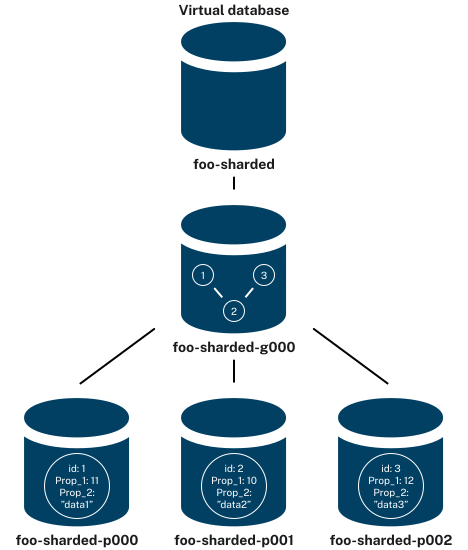
Property sharding involves decoupling the properties associated with nodes and relationships, and storing them in separate graphs.
The graph structure, comprising nodes and relationships, is stored in a single "graph shard".
The properties associated with these nodes and relationships are distributed across multiple "property shards".
This architecture enables the independent scaling of property data, allowing for the handling of larger volumes of properties without impacting the performance of the graph structure.
At the same time, it also allows for the optimization of storage for graph data, as the graph shards are designed to store more graph-centric information without the overhead of properties.
The sharded property database behaves like a standard database.
It provides ACID guarantees for write transactions and full API support, i.e., Cypher language queries, driver’s API, and Neo4j Java internal API.
How it works
The graph shard contains only nodes and relationships without the properties. Each shard is simply a Neo4j standard database with some custom behaviors.
All node and relationship properties are distributed evenly across the property shards using a sharding (hash) function. Each property shard contains equivalent unconnected nodes and relationships, each of which has the same unique identifier as the one in the graph shard, and stores the properties associated with those elements. This means that each entity in the graph shard has one and only one corresponding entity in one of the property shards, and that property shard will serve all requests for that entity.
The entire system is deployed into a Neo4j cluster, with the graph shard being a regular Raft group (see Leadership, routing, and load balancing). This setup provides all the failover and availability guarantees and allows the addition of primaries and secondaries as in a normal Neo4j cluster. If you want to deploy graph data science (GDS) on a sharded property database, you can deploy a secondary with the graph shard and GDS installed to run the GDS operations. For details, see Deploying GDS on a sharded property database.
Property shards use replicas (property shard copies) for data redundancy and failover. Each property shard can have multiple replicas to ensure data availability. If a property shard replica fails, another replica can take over its responsibilities.
Transactionality concerns are handled entirely on the graph shards using Raft consensus, the same way as in a standard database. However, the graph shard and a replica of the property shard must communicate with each other to ensure that ACID compliance is maintained. Internal bookmarks are used to ensure that the cluster can read its own writes.
Glossary
- allocator
-
A component in the cluster that allocates databases to servers according to the topology constraints specified and an allocation strategy.
- asynchronous replication
-
Asynchronous replication is used by secondary copies to poll for new transactions, which means they cannot be guaranteed to have received the most recent transactions. This enables efficient scale-out of read-performance.
- Aura instance
-
A fully-managed DBMS represented by a single instance ID, that is running in the Neo4j Aura cloud.
- auto-commit transaction
-
An automatically committed transaction that contains a single query.
- Bolt protocol
-
Bolt is a protocol used for interaction between Neo4j instances and drivers.
- bookmark
-
A marker the client can request from the cluster to ensure that it is able to read its own writes so that the application’s state is consistent and only databases that have a copy of the bookmark are permitted to respond.
- category (Bloom)
-
A category is based on a node label and is defined in a Perspective as a way of visually distinguishing nodes with the same label(s).
- causal consistency
-
All servers in a cluster agree on the order in which transactions take place. The position of a server on the causal chain can be guaranteed using a bookmark.
- cluster
-
A Neo4j DBMS that spans multiple servers working together to increase fault tolerance and/or read scalability. Databases on a cluster may be configured to replicate across servers in the cluster thus achieving read scalability or high availability.
- client application
-
Software that interacts with a Neo4j server.
- commit
-
A commit is the successful completion of a transaction, which ensures durability of any changes made. For more details, visit Operations Manual → Transaction management.
- composite database
-
Composite databases are the means to access partitioned graph data with a single Cypher query.
- constraint
-
Constraints are sets of data modeling rules that ensure the data is consistent and reliable.
- Cypher®
-
Neo4j’s graph query language.
- data model
-
A data model defines how information is organized in a database. A good data model will make querying and understanding your data easier. In Neo4j, the data models have a graph structure.
- database
-
A database is a container used by the DBMS to manage and store graph data. The physical structure of data is controlled by the database.
- database vs graph
-
Databases are the physical containers of graph data. Graphs are the logical structure of data in Neo4j.
- Database Management System
-
Database Management System, or DBMS, capable of managing multiple databases. A DBMS may run on a single server, or span several servers configured as a cluster.
- database schema
-
The prescribed property existence and datatypes for nodes and relationships.
- deallocate
-
An act of removing a database from a server or a server from a cluster without loss of data or reduced fault tolerance.
- degree (of a node)
-
The number of relationships of a specific node; loops are counted twice.
- disaster recovery
-
A manual intervention to restore availability of a cluster, or databases within a cluster.
- driver
-
A software library that provides access to Neo4j from a particular programming language.
- election
-
In the event that the Raft leader becomes unresponsive, followers automatically trigger an election and vote for a new leader.
- entity
-
A node or a relationship.
- expression (Cypher)
-
A component of a Cypher query which produces values. It may be used in projections, as a predicate, or when setting properties on graph elements.
- fabric
-
Fabric is the architectural design of a unified system that provides a single access point to local or distributed graph data.
- fault tolerance
-
A guarantee that a cluster can maintain a database’s persistence and availability in the event of one or more servers failing.
- follower
-
A primary copy of a database acting as a follower, receives and acknowledges synchronous writes from the leader.
- Generative AI (GenAI)
-
A type of artificial intelligence (AI) system that generates text, images, or other media in response to prompts.
- graph
-
A logical representation of a set of nodes where some pairs are connected by relationships.
- index
-
Data structure that improves read performance of a database.
- knowledge graph
-
A specific type of graph that has an organizing principle so that a user (or a computer system) can reason about the underlying data. The organizing principle provides an additional layer of structure that adds context to support knowledge discovery.
- label
-
Marks a node as a member of a named and indexed subset. A node may be assigned zero or more labels.
- leader
-
A single primary copy of a database is designated as the leader. It receives all write transactions from clients and replicates writes synchronously to followers and asynchronously to secondary copies of the database.
- main database
-
In terms of Neo4j Enterprise Studio, the database(s) containing the user’s data. Can exist in the same Neo4j deployment as the tool asset database.
- motif
-
A description of a specific pattern within a graph.
- node
-
A node represents an entity or discrete object in your graph data model. Nodes can be connected by relationships, hold data in properties, and are classified by labels.
- operator
-
A symbol representing a mathematical or logical operation.
- parameter
-
Named value provided when running a Cypher statement.
- path
-
A sequence of nodes and the relationships connecting them, that does not contain duplicate relationships. Several paths can match a pattern.
- pattern
-
A specific arrangement of nodes and relationships that can be matched in a graph. A pattern follows a motif.
- perspective (Bloom)
-
A Perspective defines a certain business view or domain that can be found in the target Neo4j graph. A single Neo4j graph can be viewed through different Perspectives, each tailored for a different business purpose.
- primary
-
A copy of the database that is able to process write transactions and is eligible to be elected as a leader. It participates in fault tolerant writes as it is part of the majority required to acknowledge and commit write transactions.
- primary vs secondary
-
In a cluster, databases can operate in either primary or secondary mode. Primary databases are able to process write and read transactions, ensuring fault tolerance. Secondary databases are replicated asynchronously from primaries, and their main purpose is to provide read scaling within the cluster.
- project (Aura)
-
An isolated environment in the unified Aura console that contains its own database instances, configurations, and resources. Preceded by tenant in the classic Aura console.
- property
-
Properties are key-value pairs that are used for storing data on nodes and relationships.
- query (Cypher)
-
A statement that retrieves or writes information to a database.
- Raft group
-
A group of servers that are participating in hosting a particular database in primary mode.
- Raft group member
-
A server that is participating in a Raft group. A server can be a member of one or more groups.
- Raft log
-
A shared log between all Raft group members that is guaranteed to be consistently updated and viewed by those members. The log contains both database data and operational state of the Raft group.
- Raft protocol
-
The networking mechanism that enables a database to replicate its data across multiple servers to give high availability for accessing the data and high durability to the data stored.
- read scaling
-
Distributing query load by creating additional database copies hosted in secondary mode (read-only).
- relationship
-
A relationship represents a connection between nodes in your graph data model. Relationships connect a source node to a target node, hold data in properties, and are classified by type.
- secondary
-
An asynchronously replicated copy of the database that provides read scaling within the cluster.
- seed
-
A seed is a database dump or a full backup used to create a database on a cluster. This is sometimes called seeding.
- server
-
A physical machine, a virtual machine, or a container running an instance of Neo4j. Servers can be standalone or part of a cluster.
- session
-
A causally linked sequence of transactions.
- session consistency
-
An alternative name for Neo4j’s causal consistency.
- standalone
-
A single server running Neo4j and not part of a cluster.
- synchronous replication
-
Synchronous replication requires the leader primary to replicate a transaction and block the commit until a quorum of the follower primaries acknowledges that the transaction is successfully replicated. Once the transaction is replicated, the commit is allowed to proceed. This ensures data durability and consistency within the cluster.
- system database
-
A database used by Neo4j to store system information.
- tenant (Aura)
-
An isolated environment in the classic Aura console that contains its own database instances, configurations, and resources. Replaced by project in the unified Aura console.
- tool asset database
-
In terms of Neo4j Enterprise Studio, the database where tools' assets are stored. This can be in the same Neo4j deployment as the main database(s) or in a separate deployment.
- topology
-
A configuration that describes how the copies of a database should be spread across the servers in a cluster, see primary mode and secondary mode.
- transaction
-
A transaction comprises a unit of work performed against a database. It is treated in a coherent and reliable way, independent of other transactions. Transactions comply with the ACID consistency model (atomic, consistent, isolated, and durable).